---
title: "ChEn 433 Solar"
date: Class 21-22
lang: en-US
slideNumber: false
width: 1600
height: 1000
transition: fade
css: ../assets/style.css
theme: simple
title-slide-attributes: 
    data-background-image: "https://www.extremetech.com/wp-content/uploads/2014/08/Solar-farm.jpg"
    data-background-opacity: "1.0"

verticator:
    enable: true
menu:
    enable: true
chalkboard:
    enable: false
---

# Solar energy
What are the major themes and issues with solar power?

::: incremental
* Intermittent
* Cloud cover
* Energy storage
* Materials availability
* Land use requirements
:::

## Solar Energy
* Two major types
    * solar thermal
    * photovoltaic
* Wind and hydro power may be considered indirect solar energy.
* Outline
    * Solar radiation physics
    * Solar thermal
    * Photovoltaics
    * Implementation and contributions to world energy
    * Economics

<!----------------------------------------------------------------------------> 

# World solar energy
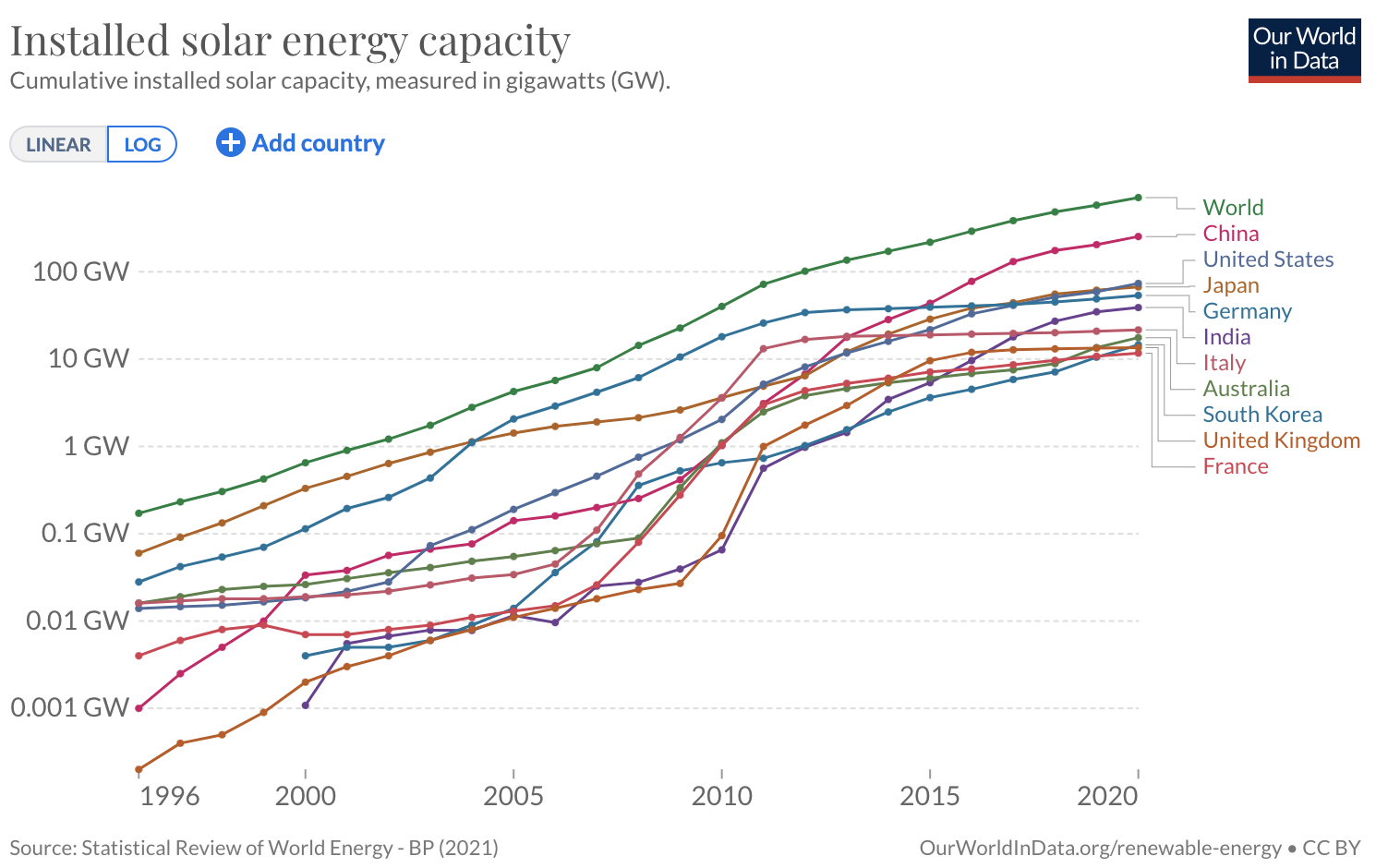
<a href="https://ourworldindata.org/grapher/installed-solar-pv-capacity?time=1996..2020&country=CHN~OWID_WRL~USA~JPN~IND~DEU~AUS~ITA~GBR~KOR~FRA" target="_blank"><img src="world_solar_linear.png" title="https://ourworldindata.org" width=1000 alt="image"></a>

<p style="font-size:0.8em">
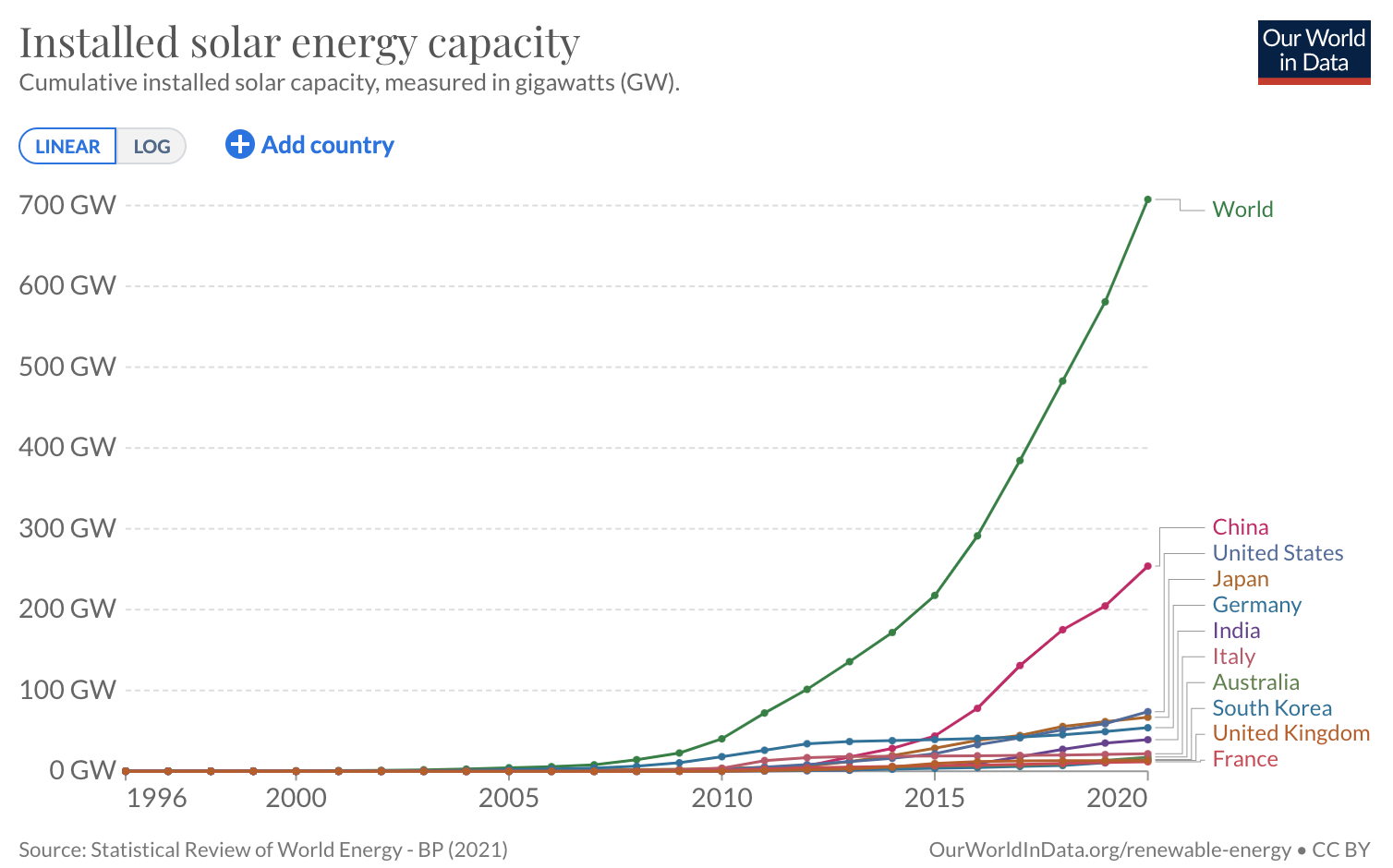
Solar is growing fast, and is [4.5%](https://www.energyinst.org/statistical-review/resources-and-data-downloads) of world electricity
</p>

## World solar energy
<a href="https://ourworldindata.org/grapher/installed-solar-pv-capacity?yScale=log&time=1996..2020&country=CHN~OWID_WRL~USA~JPN~IND~DEU~AUS~ITA~GBR~KOR~FRA" target="_blank"><img src="world_solar.png" title="https://ourworldindata.org" width=1200 alt="image"></a>

## Economics
<img src="https://upload.wikimedia.org/wikipedia/commons/thumb/a/af/20201019_Levelized_Cost_of_Energy_%28LCOE%2C_Lazard%29_-_renewable_energy.svg/2560px-20201019_Levelized_Cost_of_Energy_%28LCOE%2C_Lazard%29_-_renewable_energy.svg.png" title="https://en.wikipedia.org/wiki/Levelized_cost_of_energy" width=1200 alt="image">

<a href="https://en.wikipedia.org/wiki/Cost_of_electricity_by_source" style="color:black;">
<div style="font-size:0.8em;">
>"The levelized cost of energy (LCOE) is a measure of a power source that allows comparison of different methods of electricity generation on a consistent basis. The LCOE can also be regarded as the minimum constant price at which electricity must be sold in order to break even over the lifetime of the project."
</div>
</a>

::: notes
* [Gas (peaker)](https://en.wikipedia.org/wiki/Peaking_power_plant) are plants that only run on high demand so have a high cost per kWh
* This plot will explain some of the increasing wind, solar, and natural gas plants
:::

## LCOE
<iframe src="https://web.archive.org/web/20161028152421/http://blog.rmi.org/blog_2014_05_29_you_down_with_lcoe" width=1400 height=800></iframe>

## Economics
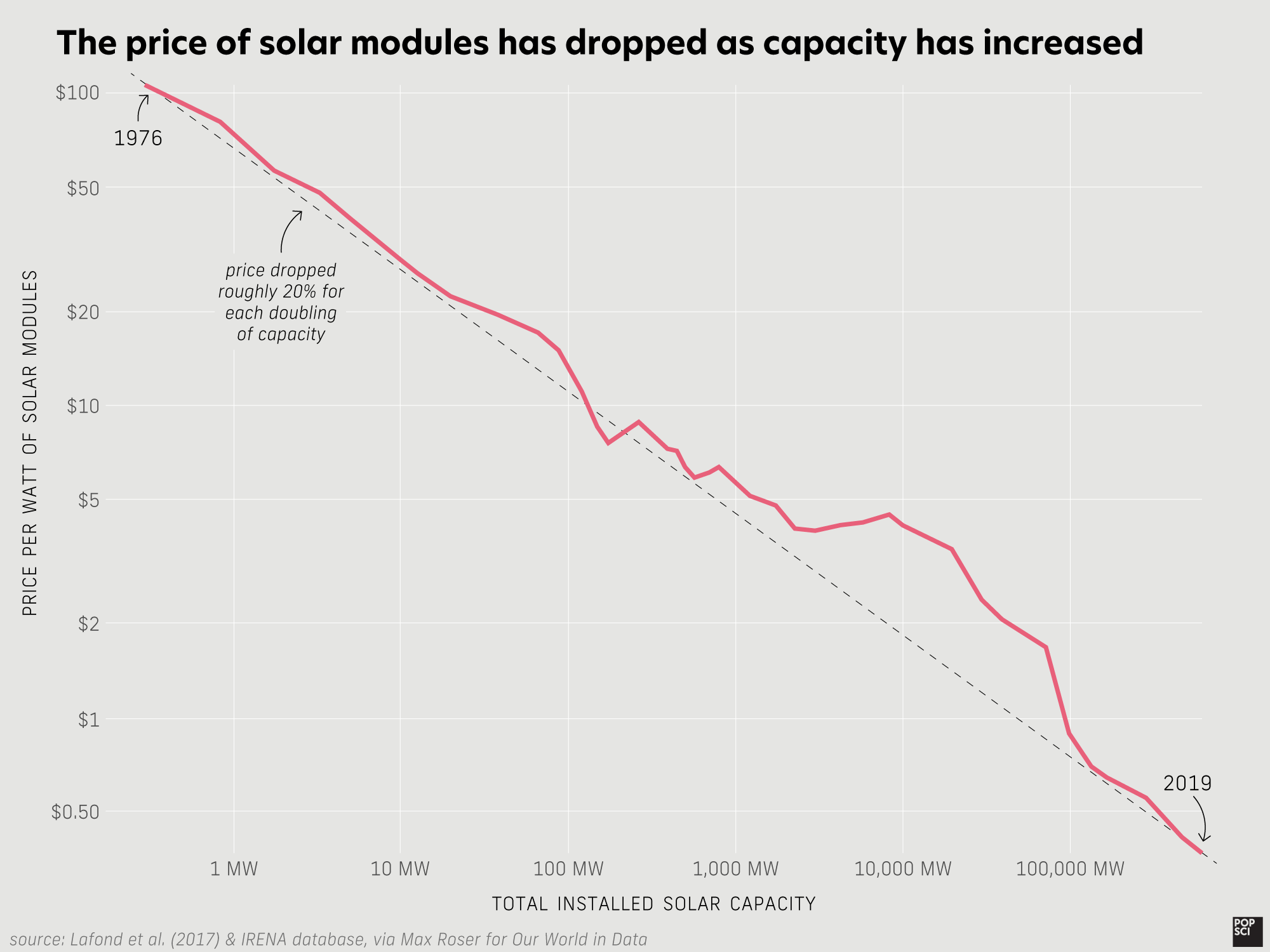
<a href="https://www.popsci.com/story/environment/cheap-renewable-energy-vs-fossil-fuels/" target="_blank">
<img src="https://www.popsci.com/uploads/2021/01/28/N6EVEXR4HNDOFHLCIOM6CVBBKI.png" title="https://www.popsci.com/uploads/2021/01/28/N6EVEXR4HNDOFHLCIOM6CVBBKI.png" width=1000 alt="image">
</a>

## 1 CMO
:::{.cols2}
:::{.col2-vp}
<div class="math">
* 47 billion solar panals
    * 450 W (72 cell panel)
    * Area = 2.06 m$^2$
    * [*using 24% capacity factor (avg in US)*](https://en.wikipedia.org/wiki/Capacity_factor)
    * 268,000 per hour for 20 years
    * [American power use 1.23 kW (avg)](https://www.eia.gov/tools/faqs/faq.php?id=97&t=3)
* [Current world electricity use = 0.626 CMO (29165 TWh)](https://www.energyinst.org/statistical-review) 
    * (Energy Institute Statistical Review of World Energy).
</div>
:::
:::{.col2-vp}
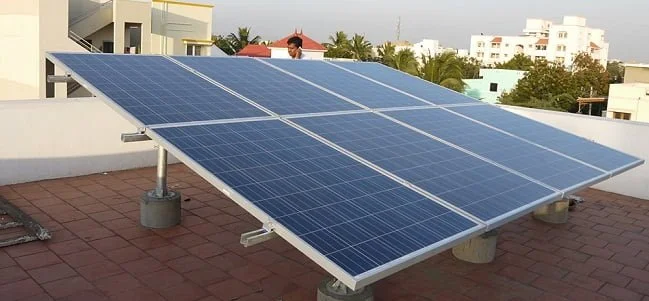
<img src="https://kenbrooksolar.com/wp-content/uploads/2Kw-solar-power-plant.jpg.webp" title="https://kenbrooksolar.com/wp-content/uploads/2Kw-solar-power-plant.jpg.webp" width=400 alt="image">

<p style="font-size:0.6em">
*2 kW solar plant*
</p>
<img src="solar_area_3.5_cmo.png" width=400 alt="image">
<p style="font-size:0.6em">
*3.5 CMO*
</p>
:::
:::
<div style="font-size:0.7em">
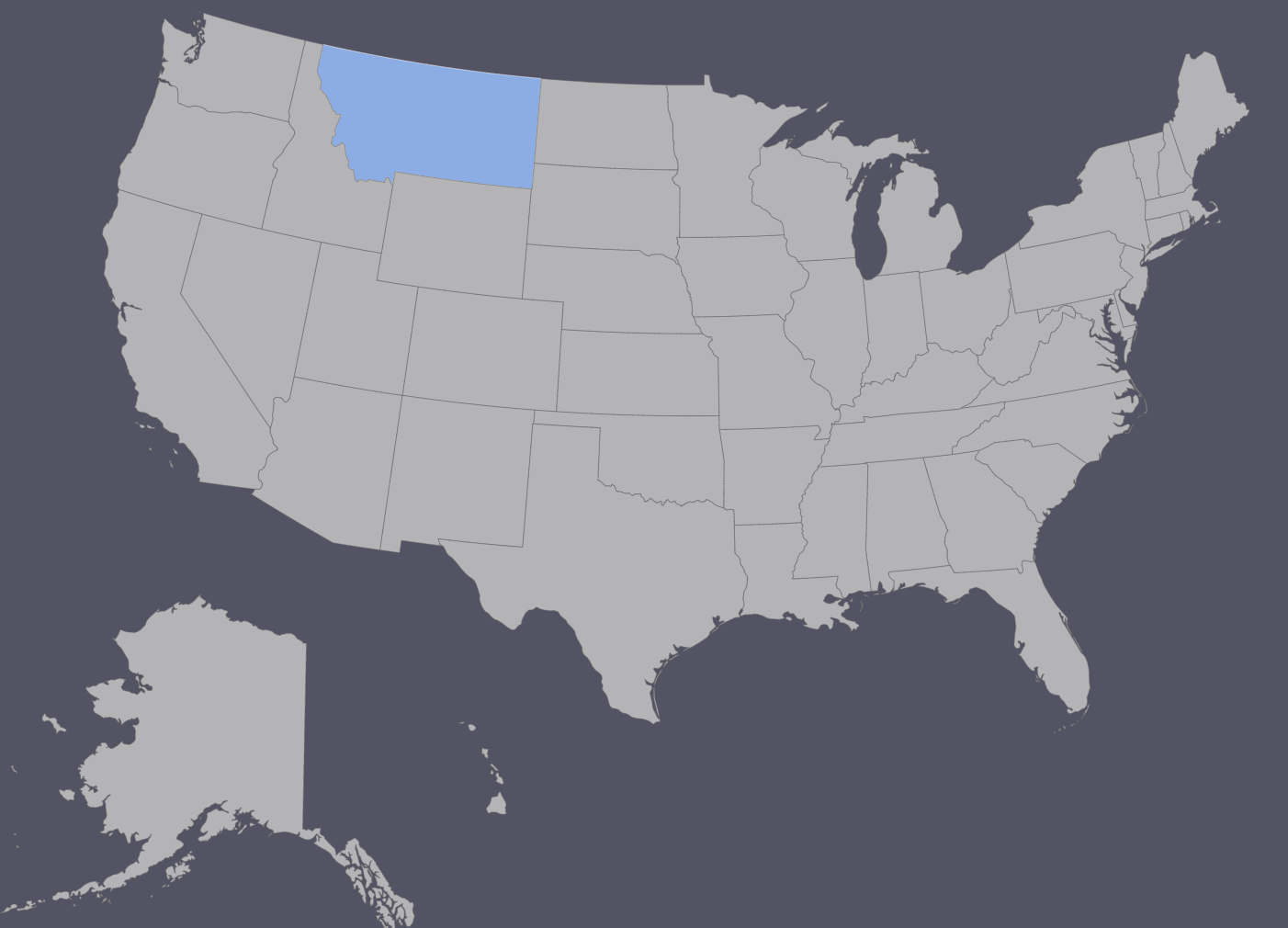
>If all the highways, streets, buildings, parking lots and other solid structures in the 48 contiguous United States were pieced together like a giant jigsaw puzzle, they would almost cover the state of Ohio ([Reference](https://en.wikipedia.org/wiki/Impervious_surface))
</div>

## Rate of growth (articles)

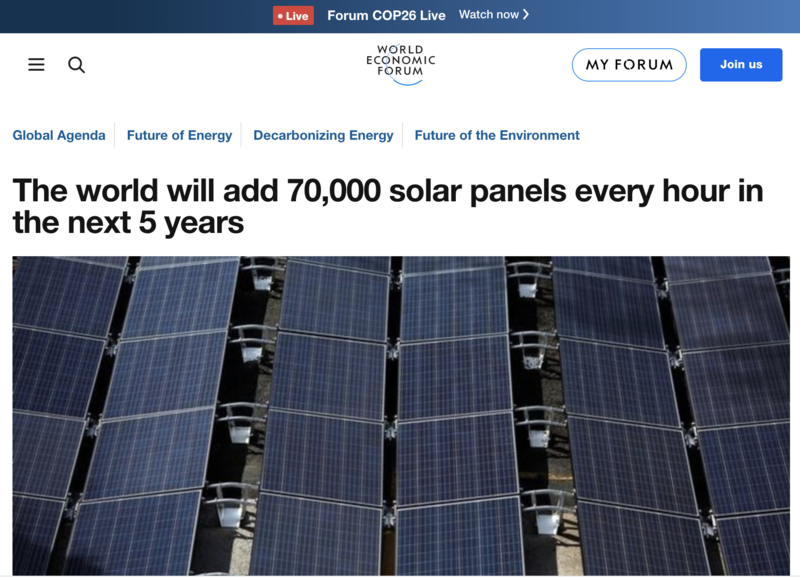
<a href="https://www.weforum.org/agenda/2018/03/chart-of-the-day-the-world-will-add-70-000-solar-panels-every-hour-in-the-next-5-years/" target="_blank"><img src="article.png" height=800 alt="image"></a>

## Human cost (article)

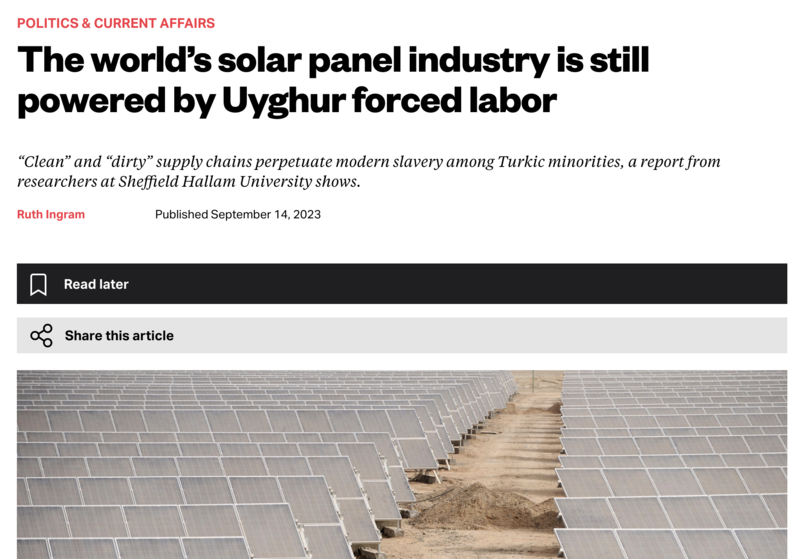
<a href="https://thechinaproject.com/2023/09/14/the-worlds-solar-panel-industry-is-still-powered-by-uyghur-forced-labor/" target="_blanck"><img src="article3.png" height=800 alt="image"></a>

<!--
<a href="https://www.bbc.com/news/world-asia-china-57124636" target="_blank"><img src="article2.png" height=800 alt="image"></a>
-->

## Greenhouse gases from metals (article)
<div class="scrollpic">
<img src="solar_metals.png"  alt="image">
</div>
<div style="font-size:0.7em">

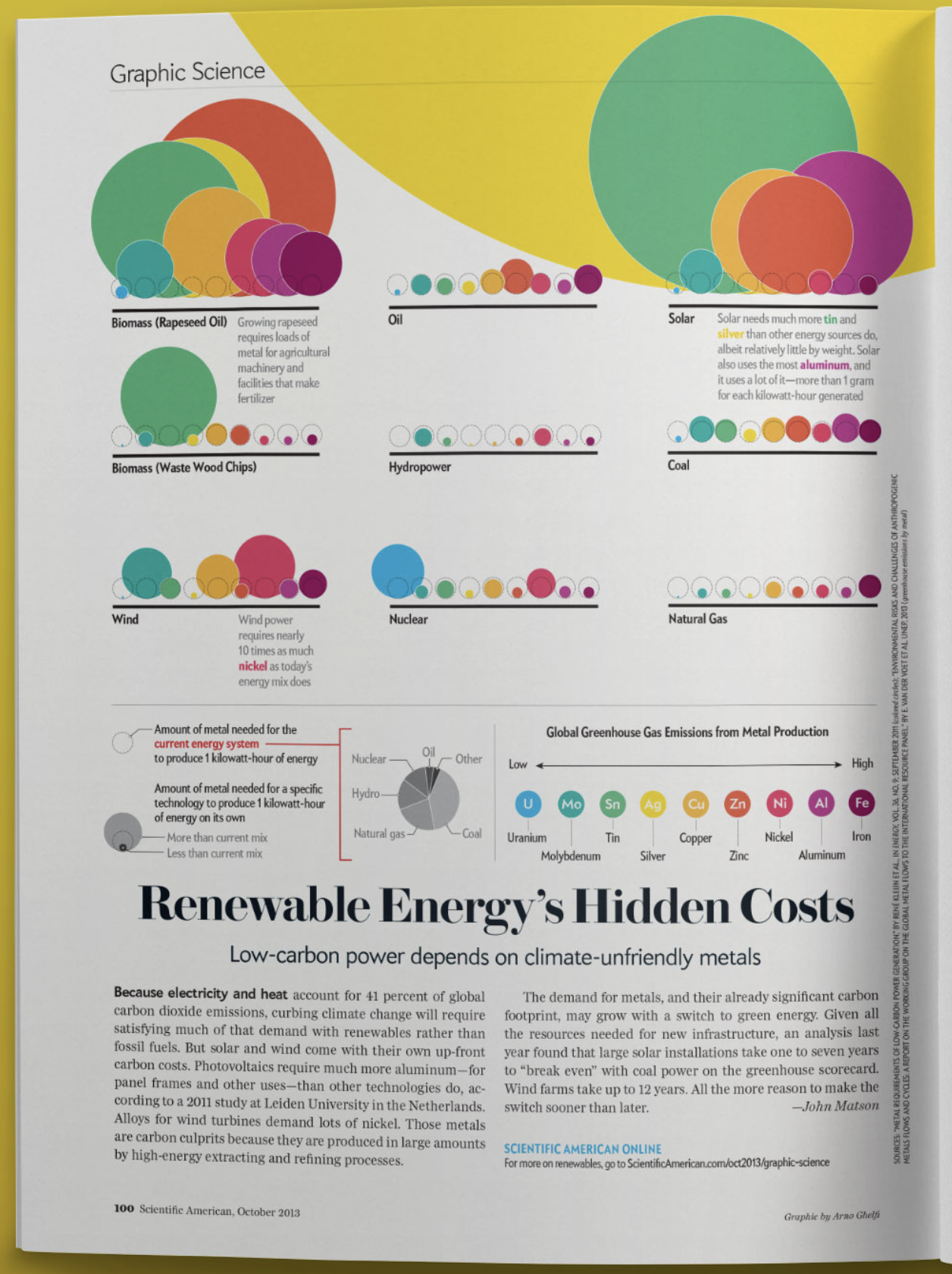
>Large solar installations take one to seven years to “break even” with coal power on the greenhouse scorecard
</div>

## Break even (article)
<iframe src="https://www.popsci.com/science/article/2013-04/solar-panels-now-make-more-electricity-they-use/" width=1500 height=800></iframe>

<!----------------------------------------------------------------------------> 

# The Sun
:::{.cols2}
:::{.col2-vp}
<div class="math">
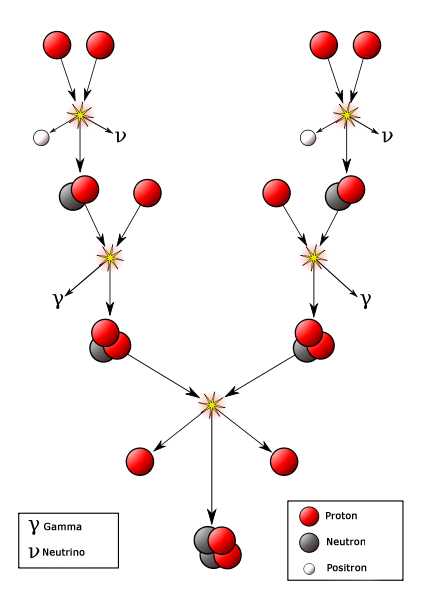
Nuclear fusion
$$4^1_1p \rightarrow _2^4\alpha + 2e^+ + 2\nu_e +\Delta E$$
<img src="https://energyeducation.ca/wiki/images/7/72/Sunfusion2.png" width=400 alt="image">   
$$\Delta E = 3.955\times 10^{-12}\, J\, = 24.687 MeV$$
</div>
::: 
:::{.col2-v}
<div class="math">
<img src="sun.jpg" width=600 alt="image">   

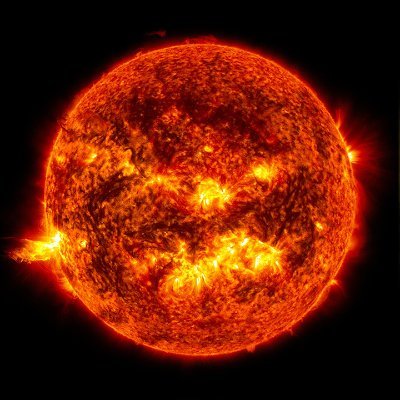
* Energy released = $3.8\times 10^{26}$ W  
* E per Area = $63.3$ MW/m$^2$

<div style="color:red">
E at Earth = $1361$ W/m$^2$
***solar constant***
</div>

</div>
::: 
::: 
::: notes
90 kg person (200 lb), density of water,  2500 kcal per day --> 1400 W/m3 
sun: 3.8E26 W / 1.4E27 m3 --> 0.27 W/m3
sun: 20% of the radius produces 99% of the power --> 34 W/m3
:::

## Radiative Spectrum
<img src="https://upload.wikimedia.org/wikipedia/commons/thumb/e/e7/Solar_spectrum_en.svg/1600px-Solar_spectrum_en.svg.png" title="https://upload.wikimedia.org/wikipedia/commons/thumb/e/e7/Solar_spectrum_en.svg/1600px-Solar_spectrum_en.svg.png"width=1200 alt="image">

## Radiative Spectrum
:::{.cols2}
:::{.col2-vp}
* $E = \sigma T^4\rightarrow T=5777$ K
* Distribution
    * 7% ultraviolet (UV)
    * 47% visible
    * 46% infrared (IR)
* Atmospheric losses
    * reflection
    * absorption: O$_3$, H$_2$O, O$_2$, CO$_2$
    * Rayleigh scattering: molecules $d\ll\lambda$
    * Mie scattering: particles (pollution) $d\gg\lambda$
:::
:::{.col2-v}
<img src="https://upload.wikimedia.org/wikipedia/commons/thumb/e/e7/Solar_spectrum_en.svg/1600px-Solar_spectrum_en.svg.png" title="https://upload.wikimedia.org/wikipedia/commons/thumb/e/e7/Solar_spectrum_en.svg/1600px-Solar_spectrum_en.svg.png"width=600 alt="image">
:::
:::

## Air mass
:::{.cols2}
:::{.col2-vp}
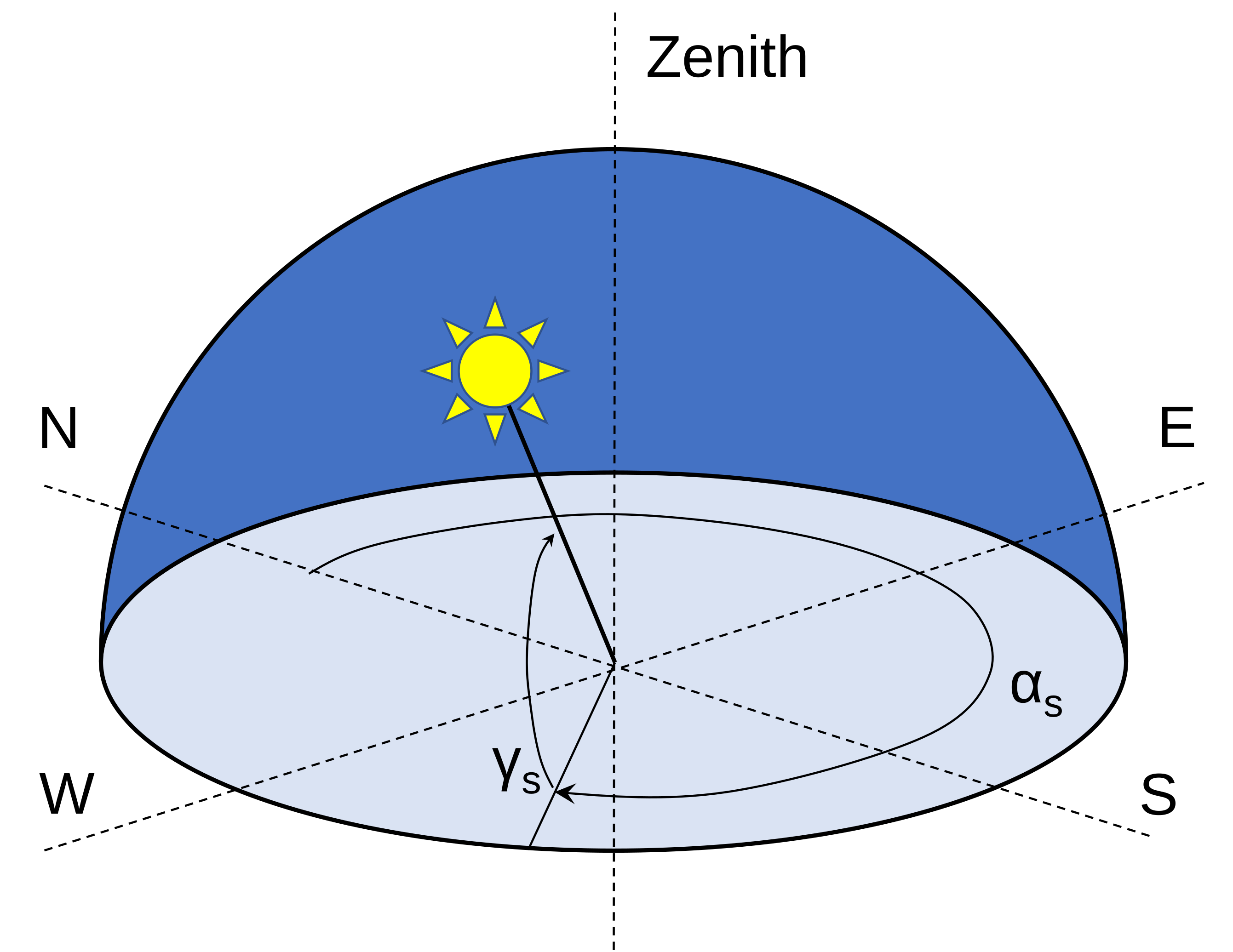
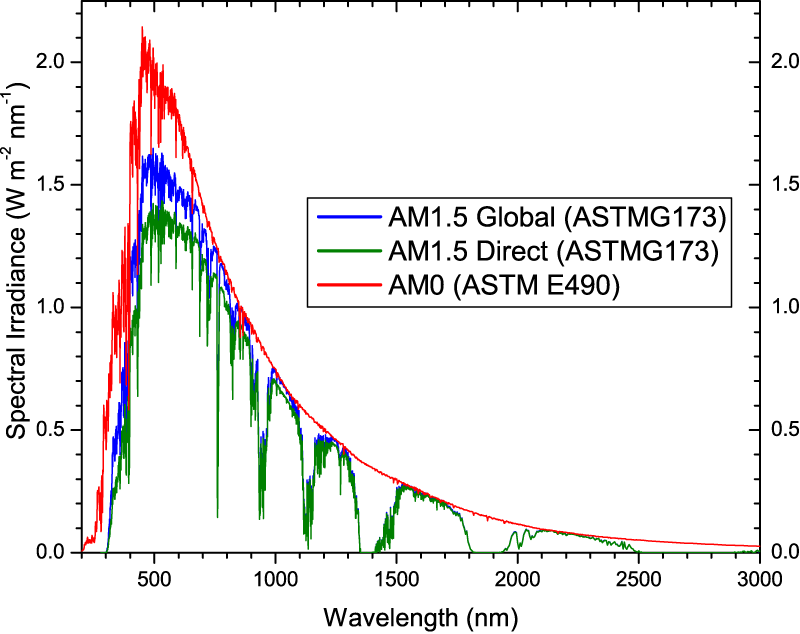
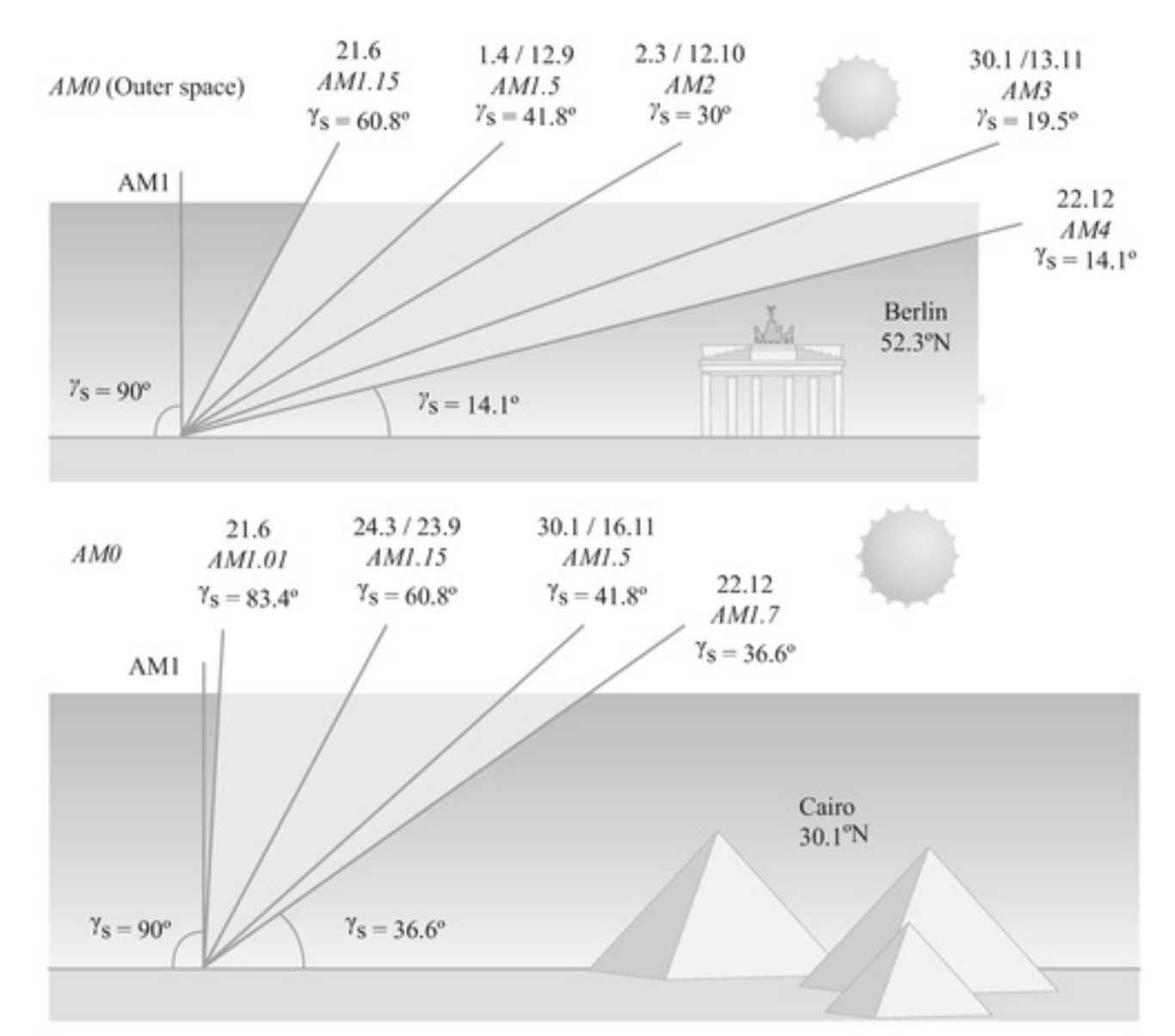
* [AM](https://en.wikipedia.org/wiki/Air_mass_(solar_energy)) is (relative) mass of air light travels through
$$AM = \frac{1}{\sin\gamma_s}$$
* time of day, year
* Summer, winter
* Zenith angle is $90^o-\gamma_s$
    * [= latitude - solar declination angle](https://en.wikipedia.org/wiki/Solar_zenith_angle)
        - at solar noon
    * latitude is measured from the equator
        - positive toward the north
    * [-23.45$^o$ < declination angle < 23.45$^o$](https://www.researchgate.net/profile/Rasha-Ghoneim-2/publication/310621648/figure/fig1/AS:432959875489794@1480237086251/Solar-declination-angle-Solar-declination-can-also-be-defined-as-the-angle-between-the.png)
        - winter, summer
:::
:::{.col2-v}
<img src="sun_angles.svg" width=600 alt="image">

* $\gamma_s$ is angle of sun from horizontal (elevation)
* $\alpha_s$ is the solar azmuth
:::
:::

## Air mass
<img src="https://www.pveducation.org/sites/default/files/PVCDROM/Appendices/Images/Spectra.png" title="https://www.pveducation.org/pvcdrom/appendices/standard-solar-spectra" height=700 alt="image">

* [Standard spectrum](https://www.pveducation.org/pvcdrom/appendices/standard-solar-spectra) at AM1.5 $\rightarrow$ 1000 W/m$^2$

## Air mass
<img src="sun_angles_2.png" title="Understanding Renewable Energy Systems, Quaschning" height=800 alt="image">

## Effect of solar angle
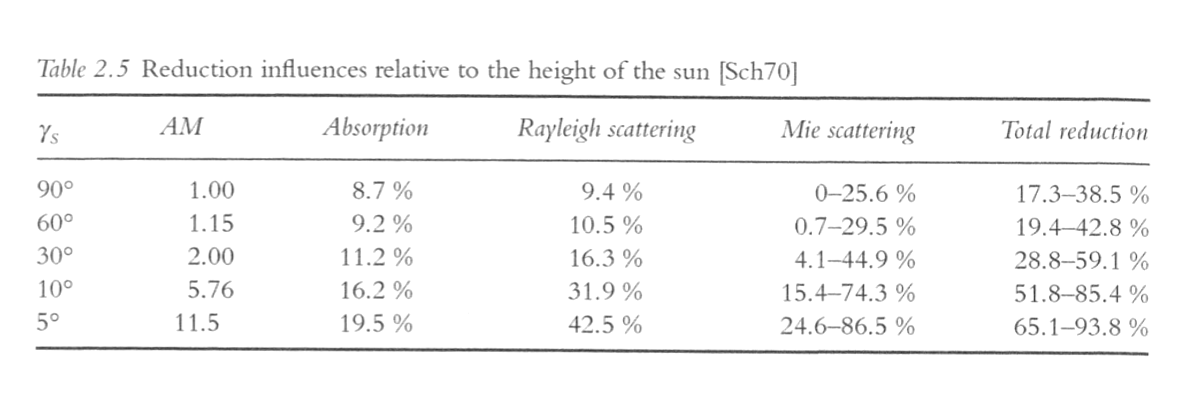
<img src="table_1.png" title="Understanding Renewable Energy Systems, Quaschning" height=400 alt="image">

<div class="math">
:::{.cols2}
:::{.col2-v}
<img src="https://www.researchgate.net/profile/Giannis-Koudouris/publication/319864978/figure/fig2/AS:669621644443680@1536661649864/Solar-radiation-in-W-m-2-for-each-month-and-daily-hour-Athens.png" title="https://www.researchgate.net/profile/Giannis-Koudouris/publication/319864978/figure/fig2/AS:669621644443680@1536661649864/Solar-radiation-in-W-m-2-for-each-month-and-daily-hour-Athens.png" height=400 alt="image">
:::
:::{.col2-v}
* plot is for Athens
* June:Dec = 40:1 in Bergen, Norway
* June:Dec = 3.3:1 in Lisbon, Portugal
:::
:::
</div>

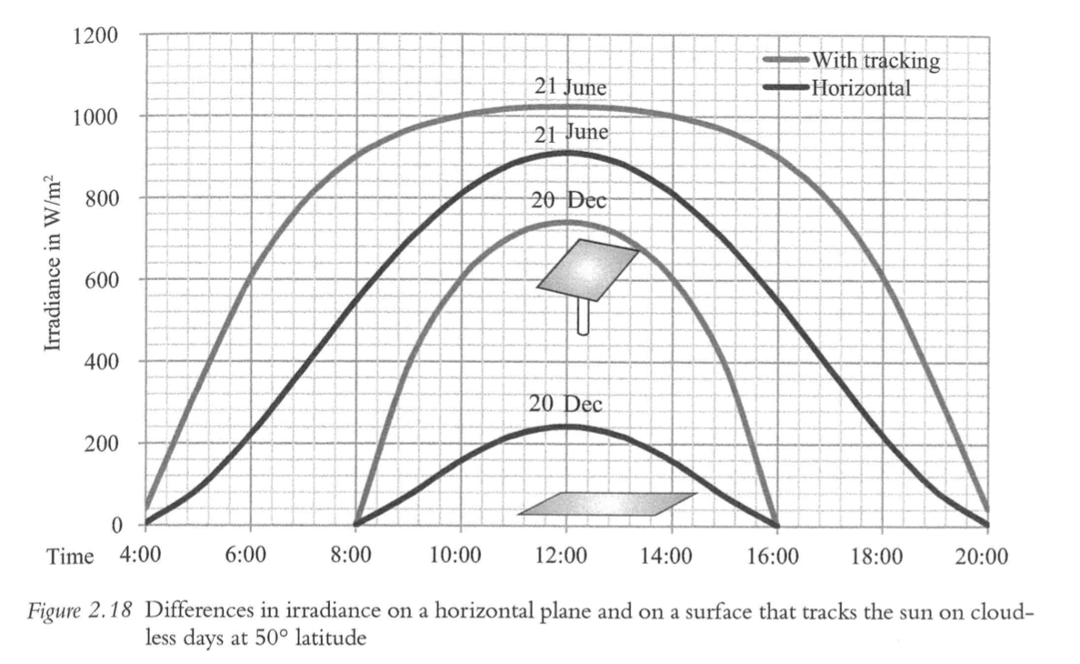
## Tracking solar panels
<img src="panel_tracking.png" title="Understanding Renewable Energy Systems, Quaschning" height=800 alt="image">

<!----------------------------------------------------------------------------> 

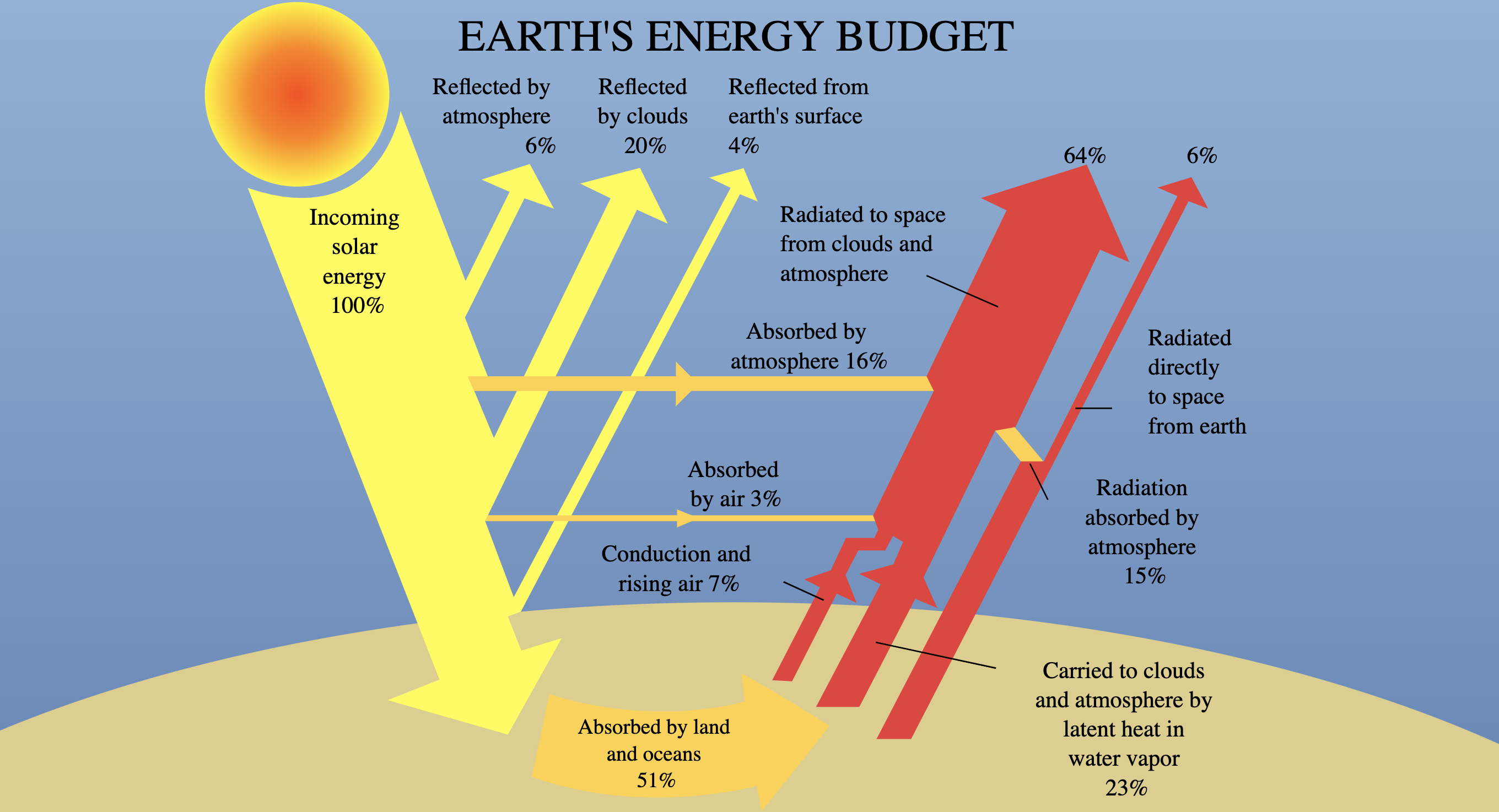
# Earth energy balance
<a href="https://www.nasa.gov/audience/forstudents/5-8/features/F_The_Role_of_Clouds.html" target="_blank"><img src="Earth_energy_budget.png" title="https://commons.wikimedia.org/wiki/File:Earth_energy_budget.svg" width=1200 alt="image"></a>

::: notes
* "absorbed by air 3%" is really "absorbed by clouds"
:::

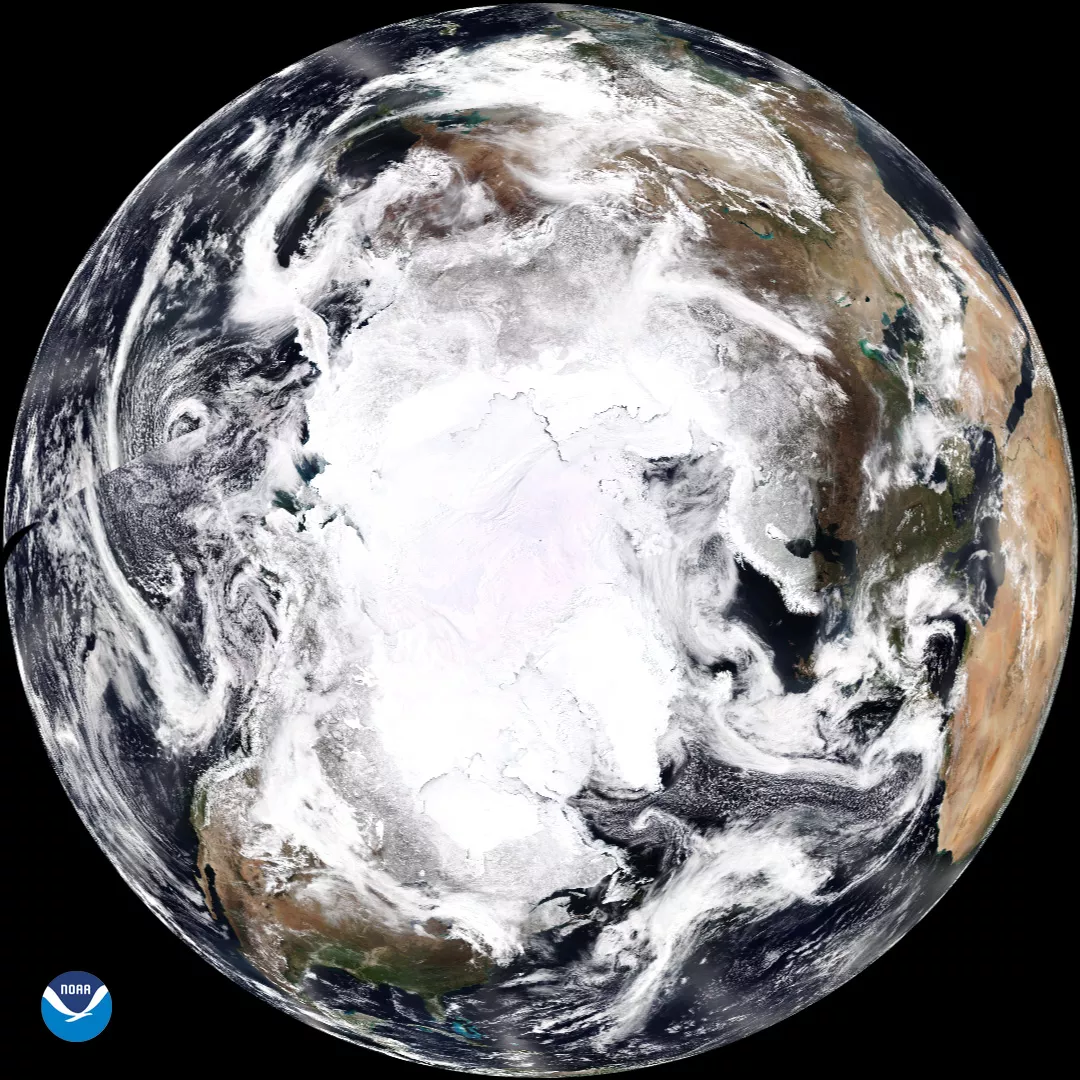
## Albedo
:::{.cols2}
:::{.col2-vp}
<img src="https://www.nesdis.noaa.gov/s3/styles/webp/s3/migrated/brighterbug.jpg.webp?itok=VjfRh6rF" title="https://www.nesdis.noaa.gov/s3/styles/webp/s3/migrated/brighterbug.jpg.webp?itok=VjfRh6rF" height=450 alt="image">
:::
:::{.col2-v}
Rank order the albedo of the following surfaces:

| Surface                  |
|:-------------------------|
| Forest                   |
| Fresh Snow               |
| Water ($\gamma_s > 45^o$)|
| Bare ground              |
| Clean cement             |
:::
:::

*Albedo is the proportion of incident light or radiation that is reflected by a surface, typically a planet or moon.*

## Albedo
:::{.cols2}
:::{.col2-vp}
<img src="https://www.nesdis.noaa.gov/s3/styles/webp/s3/migrated/brighterbug.jpg.webp?itok=VjfRh6rF" title="https://www.nesdis.noaa.gov/s3/styles/webp/s3/migrated/brighterbug.jpg.webp?itok=VjfRh6rF" height=450 alt="image">
:::
:::{.col2-v}
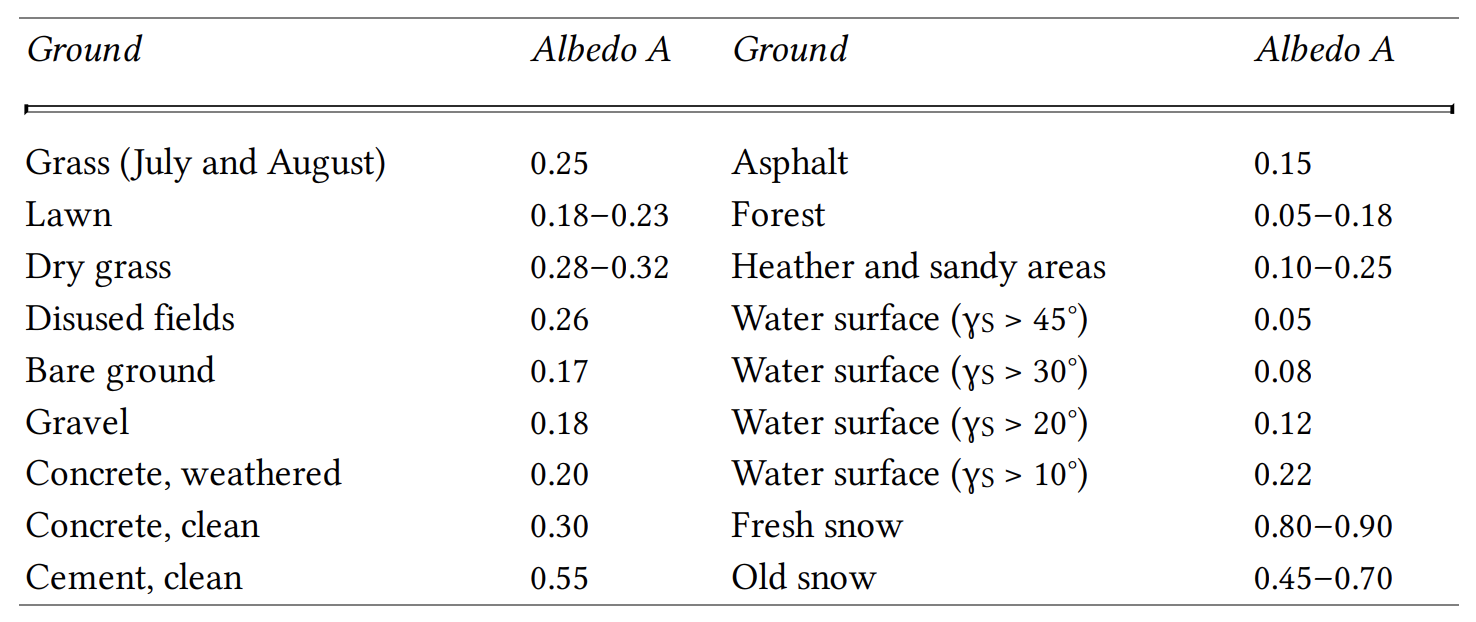
Rank order the albedo of the following surfaces:

| Surface                  | Albedo |
|:-------------------------|:------:|
| Water ($\gamma_s > 45^o$)| 0.05   |
| Forest                   | 0.1    |
| Bare ground              | 0.2    |
| Clean cement             | 0.55   |
| Fresh Snow               | 0.85   |
:::
:::

*Albedo is the proportion of incident light or radiation that is reflected by a surface, typically a planet or moon.*

## Albedo
<img src="https://www.nesdis.noaa.gov/s3/styles/webp/s3/migrated/brighterbug.jpg.webp?itok=VjfRh6rF" title="https://www.nesdis.noaa.gov/s3/styles/webp/s3/migrated/brighterbug.jpg.webp?itok=VjfRh6rF" height=450 alt="image">
<img src="albedo.png" title="Understanding Renewable Energy Systems, Quaschning" height=450 alt="image">

## Solar irradiance
<a href="https://climate.nasa.gov/internal_resources/2502" target="_blank"><img src="https://climate.nasa.gov/internal_resources/2502" title="https://climate.nasa.gov/internal_resources/2502" height=700 alt="image"></a>

* [11 year cycle](https://www.nasa.gov/mission_pages/sunearth/solar-events-news/Does-the-Solar-Cycle-Affect-Earths-Climate.html) (changes in the sun's magnetic field)

## Solar irradiance
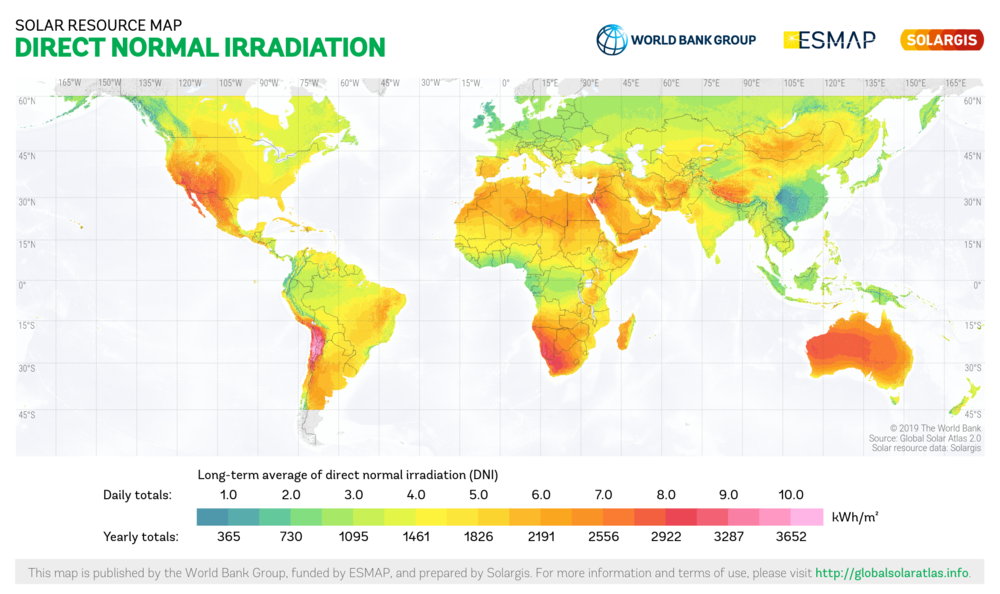
<a href="https://globalsolaratlas.info/download/world" target="_blank"><img src="world_map_DNI.png" title="https://globalsolaratlas.info/download/world" width=700 alt="image"></a>
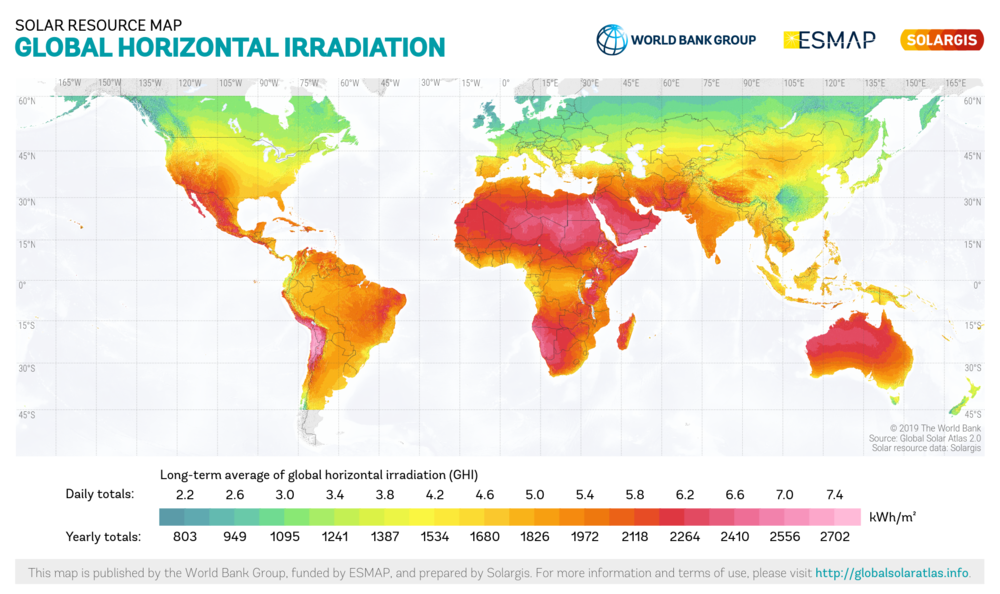
<a href="https://globalsolaratlas.info/download/world" target="_blank"><img src="world_map_DHI.png" title="https://globalsolaratlas.info/download/world" width=700 alt="image"></a>

[Glossary of terms](https://www.3tier.com/en/support/glossary/#ghi)

* Convert units: 7.4 kWh/m$^2$ to W/m$^2$, compare to the solar constant.
* What is the reason for the difference?
* How is this information useful?

::: notes
* consider elevation 
:::

<!----------------------------------------------------------------------------> 

# Solar thermal

:::{.cols2}
:::{.col2-vp}
* Key types
    * non-concentrated
        * e.g., hot water heating
    * concentrated
        * high temperature, power generation
* Focus on concentrated here
* Concentrate solar energy using reflectors
* Higher temperatures for heat engine efficiency
* Energy storage benefits over PV
    * Store the existing high T fluid, versus batteries
* [Higher costs than PV](https://www.sciencedirect.com/science/article/pii/B9780128187623000121)
    * See also the LCOE chart.
:::
:::{.col2-v}
<img src="https://upload.wikimedia.org/wikipedia/commons/b/b1/Solar_panels%2C_Santorini2.jpg" title="https://upload.wikimedia.org/wikipedia/commons/b/b1/Solar_panels%2C_Santorini2.jpg" width=400 alt="image">  
<img src="https://www.nrel.gov/csp/assets/images/csp-solar-heat-848.jpg" title="https://www.nrel.gov/csp/assets/images/csp-solar-heat-848.jpg" width=400 alt="image">
:::
:::

## Solar thermal
:::{.cols2}
:::{.col2-vp}
<div style="font-size:0.8em;">
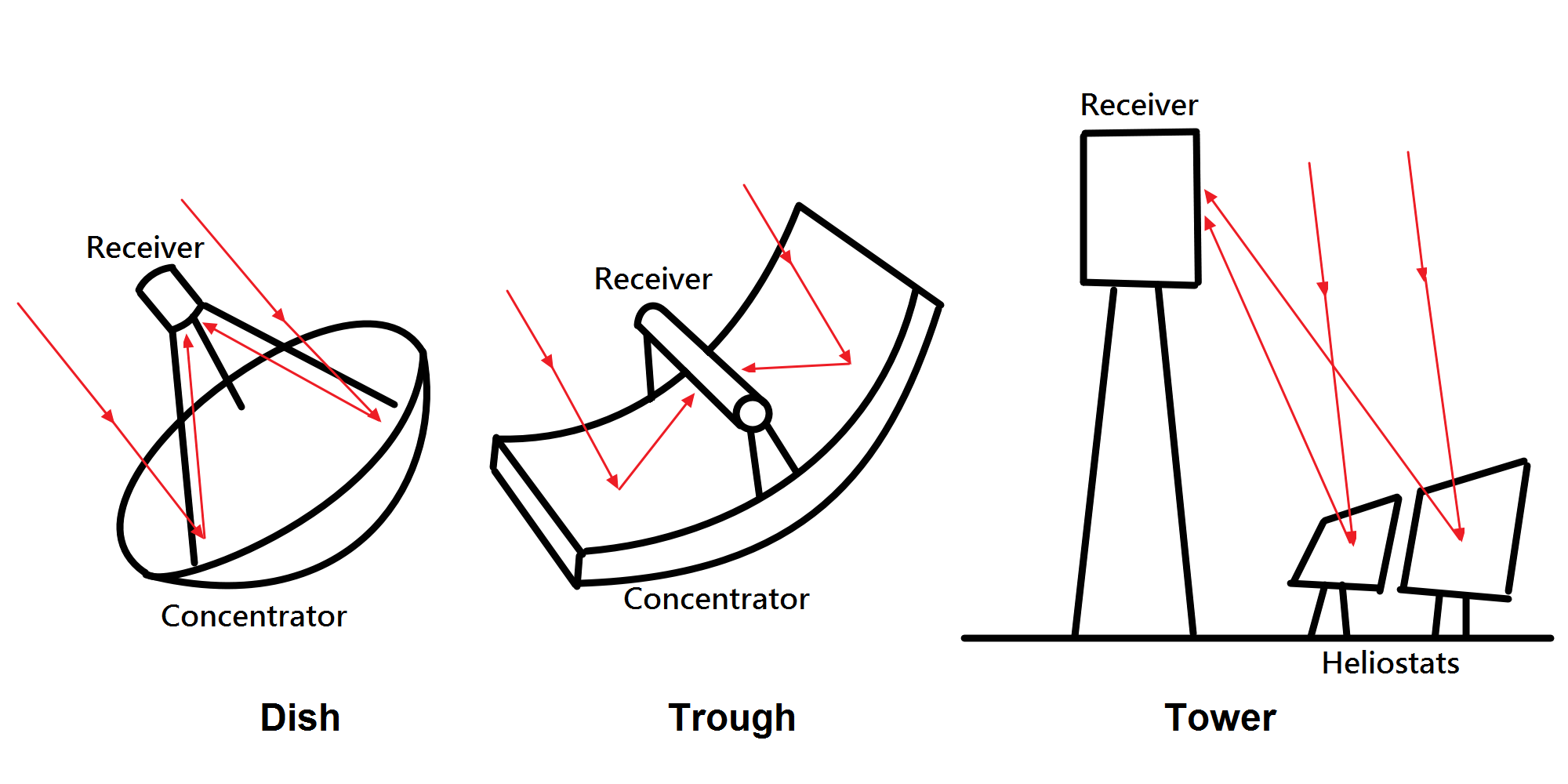
* Linear recievers:
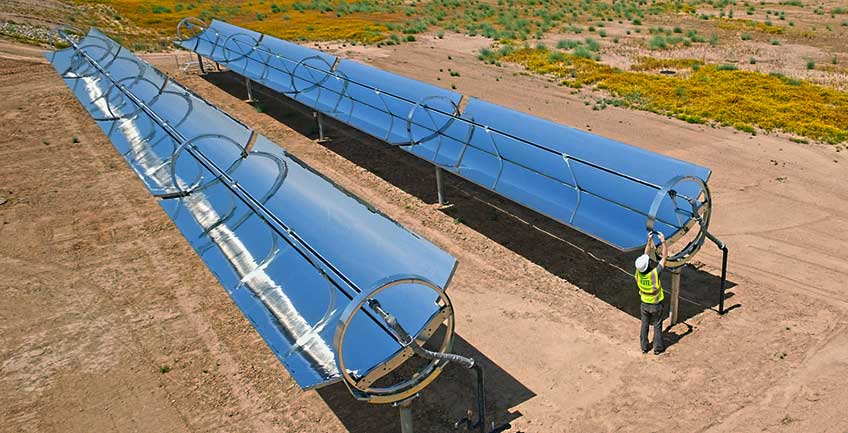
    * Parabolic trough
        * oil, molten salt, pressurized steam
        * most common
    * Enclosed trough
        * sheltered from wind, dust
    * Fresnel reflector: lower costs
    * [efficiencies 8-18%](https://www.sciencedirect.com/science/article/pii/B9780128187623000121)
    * only need one axis tracking
* Point recievers:
    * Power tower
        * higher temperatures
        * allows uneven ground
        * 1st in Spain, 2007, 11 MW
        * Largest = [Mohammad bin Rashid, UAE](https://en.wikipedia.org/wiki/List_of_solar_thermal_power_stations), 600 MW. 
        * 3rd largest is Ivanpah in California, 392 MW.
        * About 60 plants that are larger than 50 MW.
        * consolidated operations
    * Dish
        * Stirling engine
        * High efficiency
        * [Engineering issues](https://www.reutersevents.com/renewables/csp-today/technology/trouble-dish-stirling-csp)
    * efficiencies 20-40%
    * dual axis control needed
</div>
:::
:::{.col2-v}
<img src="https://upload.wikimedia.org/wikipedia/commons/thumb/f/ff/IvanpahRunning.JPG/2560px-IvanpahRunning.JPG" title="https://upload.wikimedia.org/wikipedia/commons/thumb/f/ff/IvanpahRunning.JPG/2560px-IvanpahRunning.JPG" height=300 alt="image">  
<img src="https://upload.wikimedia.org/wikipedia/commons/f/f2/Dish-stirling-at-odeillo.jpg" title="https://upload.wikimedia.org/wikipedia/commons/f/f2/Dish-stirling-at-odeillo.jpg" height=300 alt="image">  
:::
:::


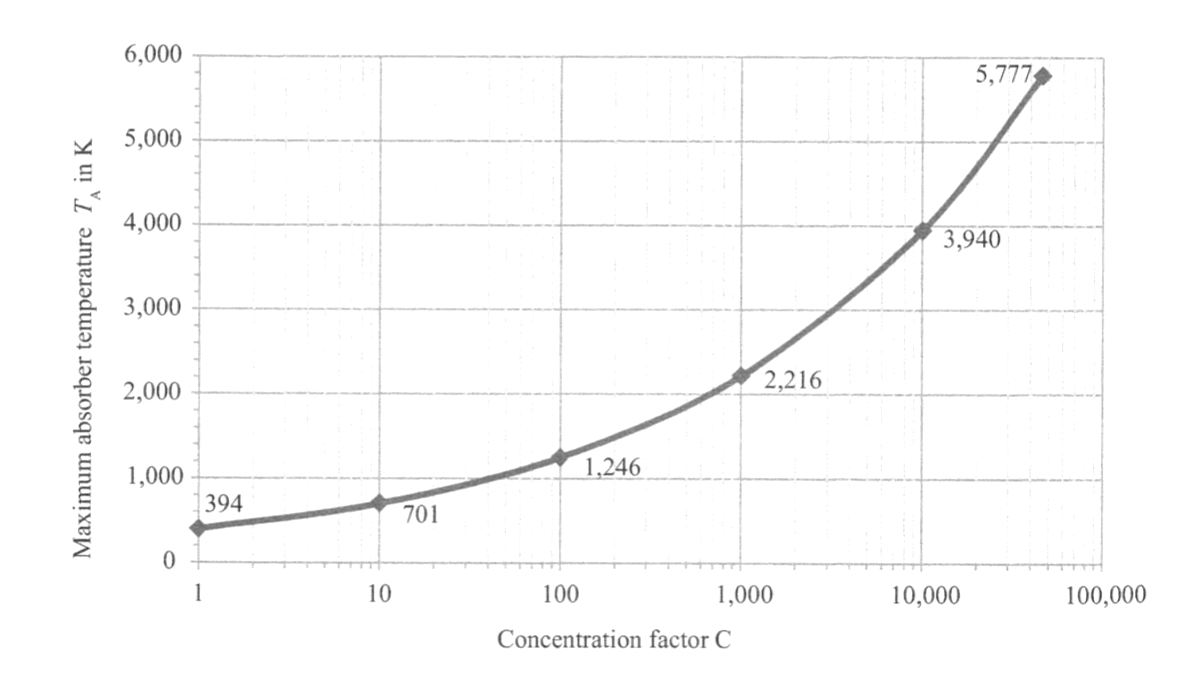
## Concentration factor

<div style="font-size:0.8em;">
::: fragment
Question: how much can the sun be concentrated? What are the limits?
:::

::: fragment
Question: what is the maximum temperature a solar reciever can have?
:::

::: fragment
$$C = \frac{A_C}{A_R}$$
:::

</div>

<img src="concentration_factor.png" title="http://large.stanford.edu/courses/2016/ph240/tew2/images/f1big.png" width=800 alt="image">

## Concentration factor

<div style="font-size:0.8em;">

Power (P) emitted from the sun's surface of radius $r_S$:
$$P_s = \sigma T_s^4 \cdot 4\pi r_s^2$$
Power of the sun at solar collector distace $R_{SE}$ from the sun
<span class="hoverme">
$$P_c = \sigma T_s^4 \cdot 4\pi r_s^2 \cdot\frac{A_c}{4\pi R_{SE}^2}$$
</span>
<span class="hide">
$\frac{A_c}{4\pi R_{SE}^2}$ is the fraction of power reaching the collector.
</span>
The best reciever will have power:
$$P_r = \sigma T_s^4 A_r$$
And $P_c = P_r$ by conservation of energy. This gives

::: {.red}
$$C_\text{max} = \frac{A_c}{A_r} = \frac{R_{SE}^2}{r_s^2} = 46152 $$
:::

</div>

## Concentration factor
<img src="max_T_vs_C.png" title="Understanding Renewable Energy Systems, Quaschning" height=800 alt="image">

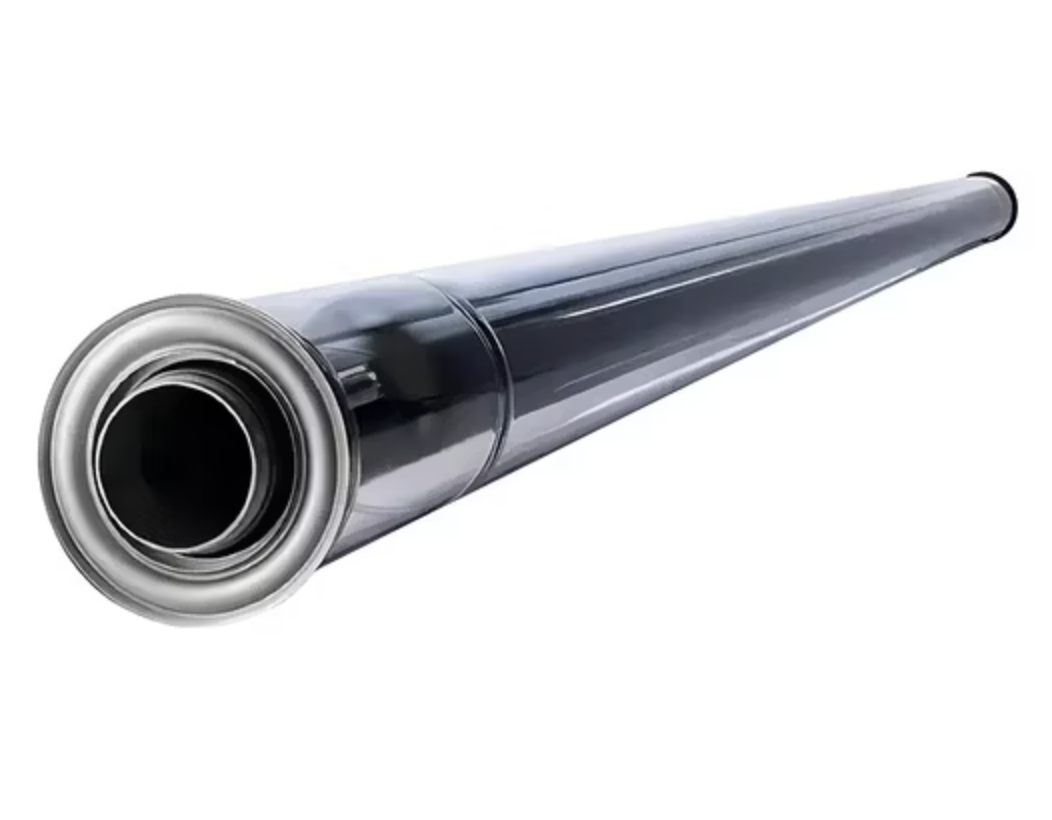
## Absorber tubes
:::{.cols2}
:::{.col2-v}
<img src="solar_receiver.png" width=600 alt="image">
:::
:::{.col2-v}
<img src="tube_events.png" title="Understanding Renewable Energy Systems, Quaschning" width=700 alt="image">  
<div style="font-size:0.6em">
<table>
<tr>
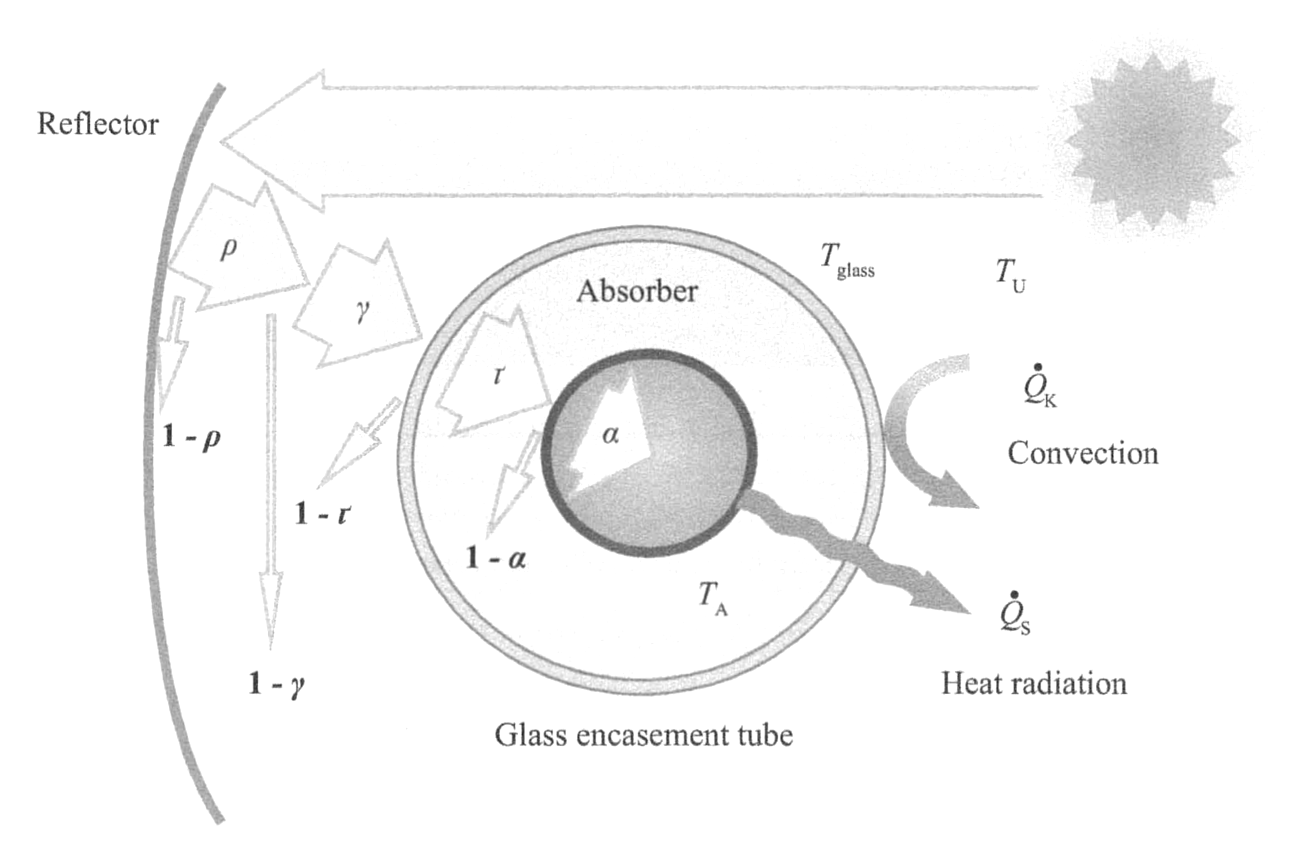
<td> $\rho$: reflectivity </td>
<td> $\gamma$: intercept factor </td>
</tr>
<tr>
<td> $\tau$: transmissivity </td>
<td> $\alpha$: absorptivity </td>
</tr>
</table>
$$\dot{Q}_S = A_\text{A}\epsilon\sigma(T_\text{A}^4 - T_U^4)$$
$$\dot{Q}_K = hA_\text{A}(T_\text{glass} - T_U)$$
</div>
:::
:::

## Cerro Dominador Plant
::: {.cols2}
::: {.col2-vp}
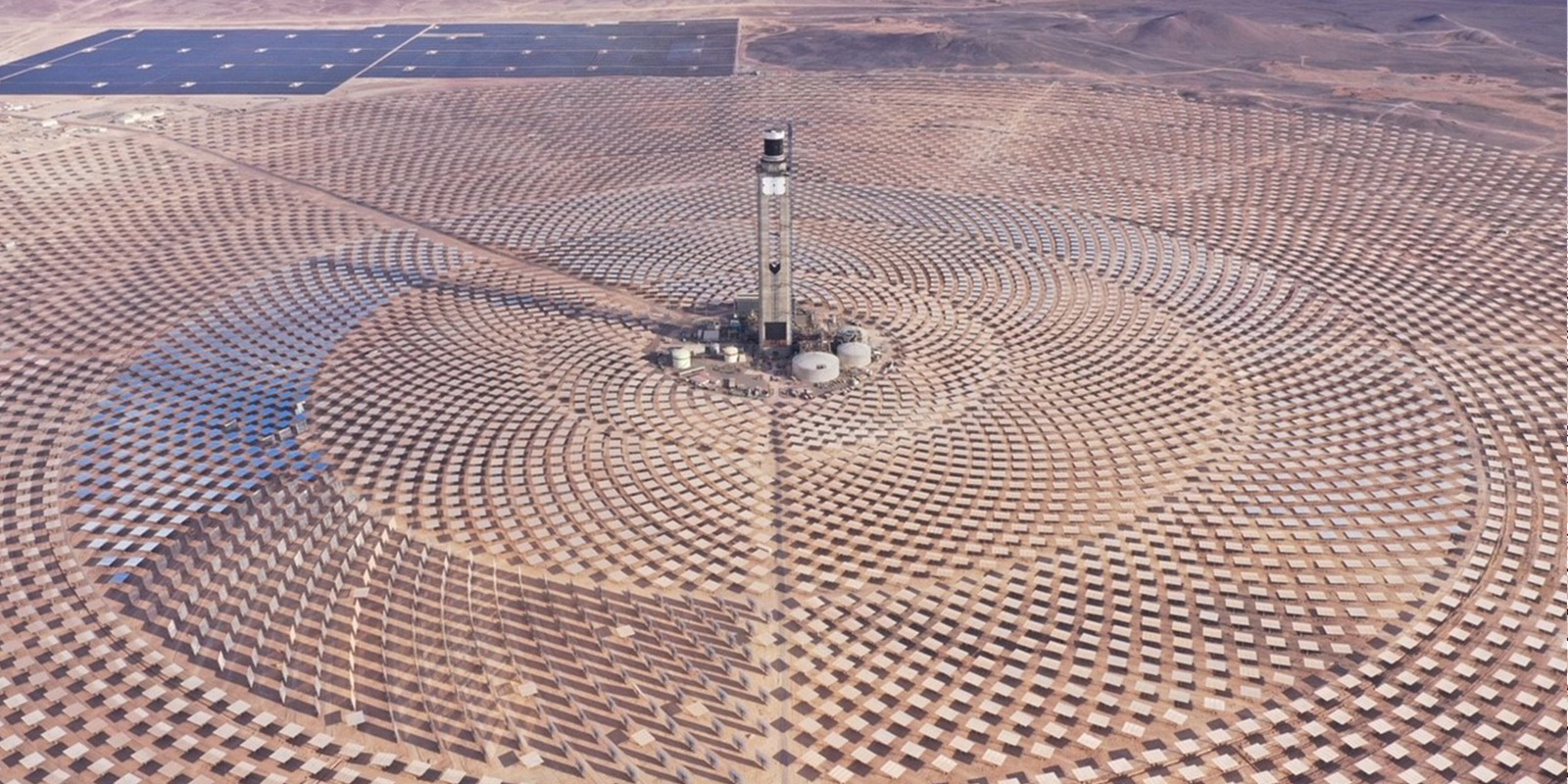
* [Chile](https://en.wikipedia.org/wiki/Cerro_Dominador_Solar_Thermal_Plant)
* 110 MW
* June 2021
* 1.9 GWh energy storage
    * [molten salt](https://en.wikipedia.org/wiki/Solar_thermal_energy#Molten_salt_storage): KNO$_3$, NaNO$_3$
    * Up to 17.5 hrs
* Aperature area = 1,484,000 m$^2$
* 250 m tower [heats salts](https://www.solarpaces.org/the-cerro-dominador-csp-project-has-synchronized-to-the-grid-in-chile/) 560 $^o$C
* 100 MW PV component
:::
::: {.col2-v}
<img src="https://mediacdn.acciona.com/media/rajjsp03/acciona-cerro-dominador.jpg" title="https://mediacdn.acciona.com/media/rajjsp03/acciona-cerro-dominador.jpg" width=700 alt="image">
:::
:::

<!--------------------------------------------------------------------------------------->

# Photovoltaic effect
<div style="font-size:0.8em">
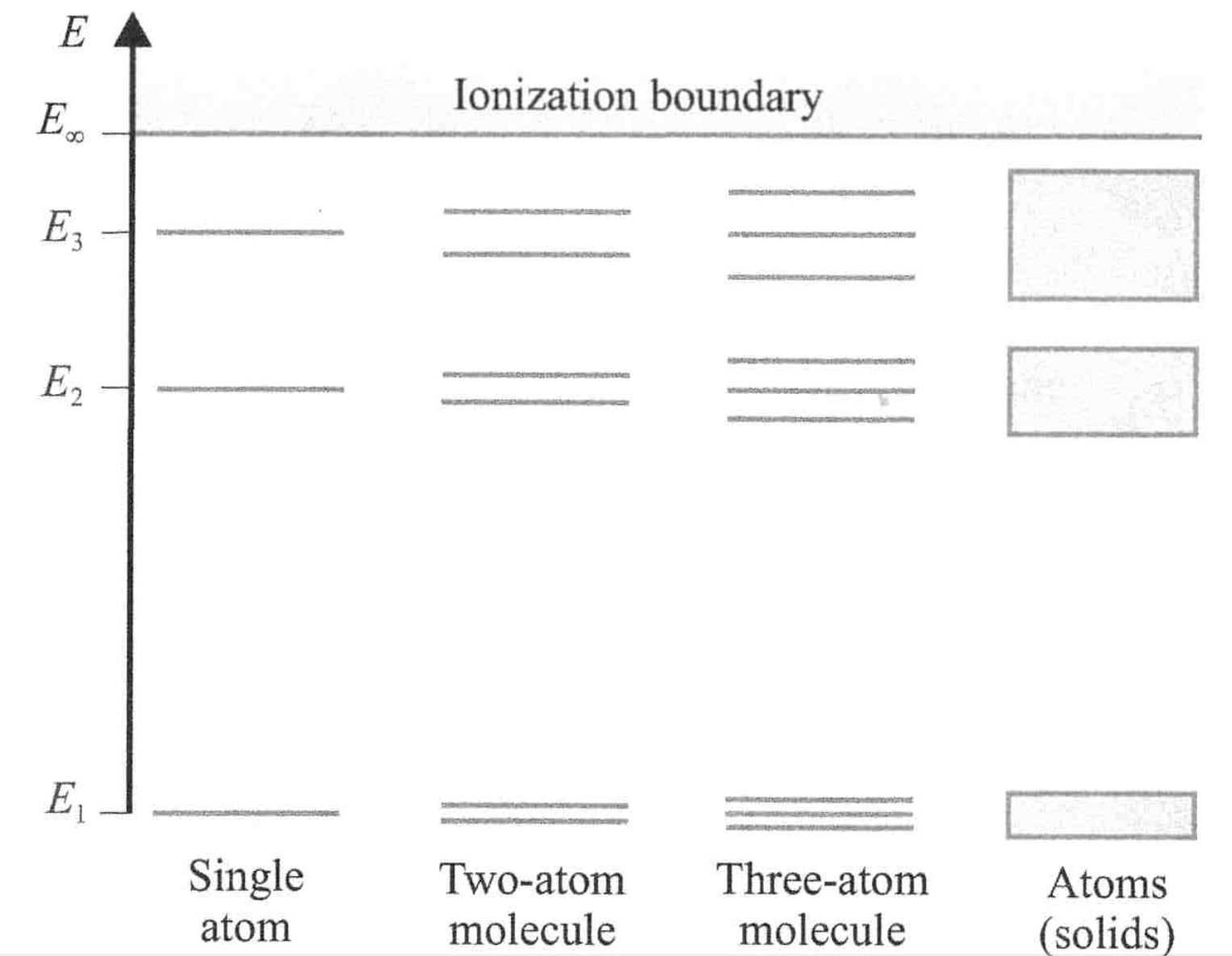
* Atomic energy levels are quantized
* Photon (light) energy $E=hc/\lambda$
    * 13.59 eV (91 nm) light (UV) ionizes hydrogen
        * external photovoltaic effect 
    * Lower energies $\rightarrow$ internal PV effect
* Molecules, atoms, solids $\rightarrow$ many energies $\rightarrow$ bands
* electrons occupy the lower bands, and are excited into upper bands
</div>

<img src="pv_bands.png" title="Understanding Renewable Energy Systems, p. 159' }}.png" height=350 alt="image">
&emsp; &emsp;
<img src="https://upload.wikimedia.org/wikipedia/commons/thumb/1/12/Semiconductor_band_structure_%28lots_of_bands_2%29.svg/2560px-Semiconductor_band_structure_%28lots_of_bands_2%29.svg.png" title="https://upload.wikimedia.org/wikipedia/commons/thumb/1/12/Semiconductor_band_structure_%28lots_of_bands_2%29.svg/2560px-Semiconductor_band_structure_%28lots_of_bands_2%29.svg.png" height=350 alt="image">

## Conductors, semi-conductors, insulators
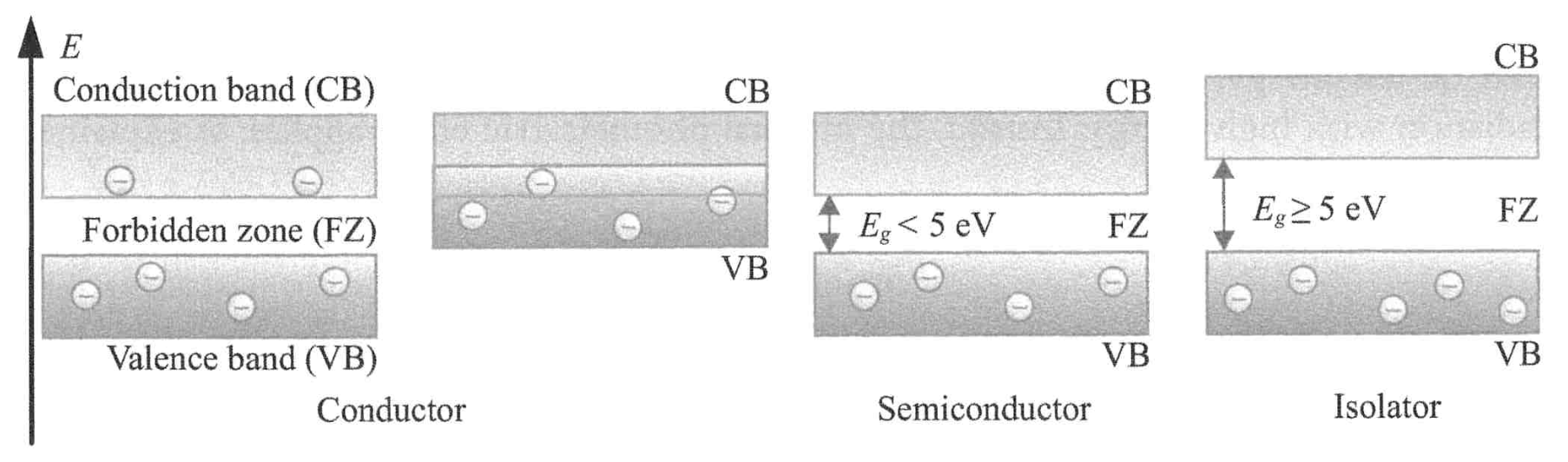
> <a href="https://energyeducation.ca/encyclopedia/Valence_band" style="color:black">
"The valence band is simply the outermost electron orbital of an atom ... that electrons actually occupy"
</a>

> <a href="https://energyeducation.ca/encyclopedia/Conduction_band" style="color:black">
"The conduction band is the band of electron orbitals that electrons can jump into from the valence band when excited. When the electrons are in these orbitals, they have enough energy to move freely in the material."
</a>

*Visible light $\lesssim$ 3 eV*

<img src="pv_bands_2.png" title="Understanding Renewable Energy Systems, p. 160' }}.png" height=400 alt="image">

## Semiconductors 
<div style="padding-left:50px;">
* PV cells use semi-conductors
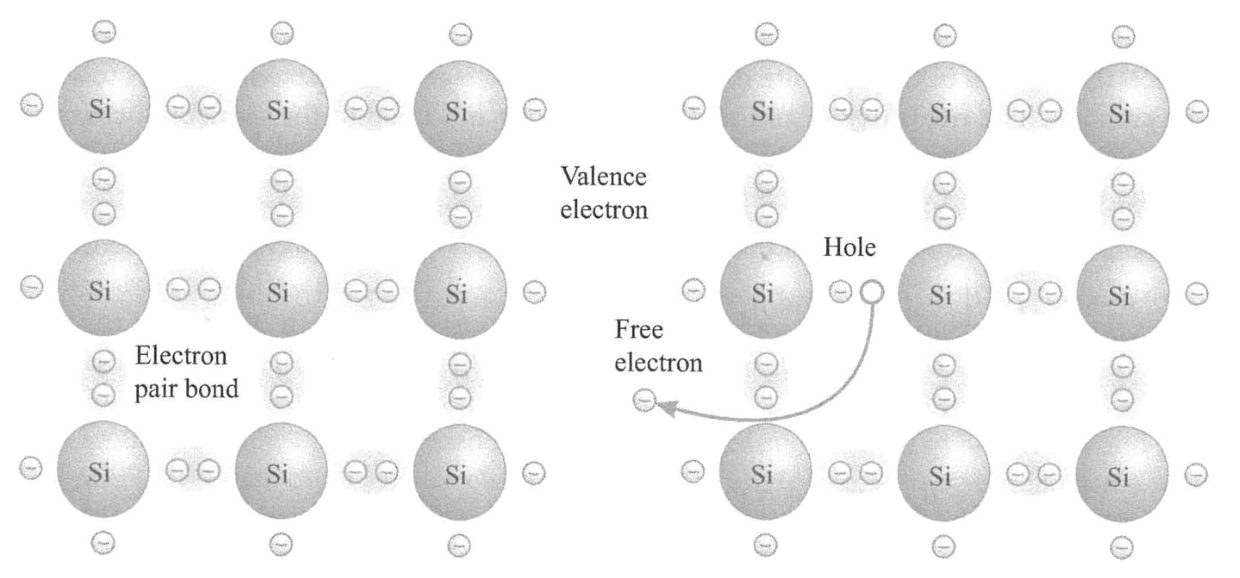
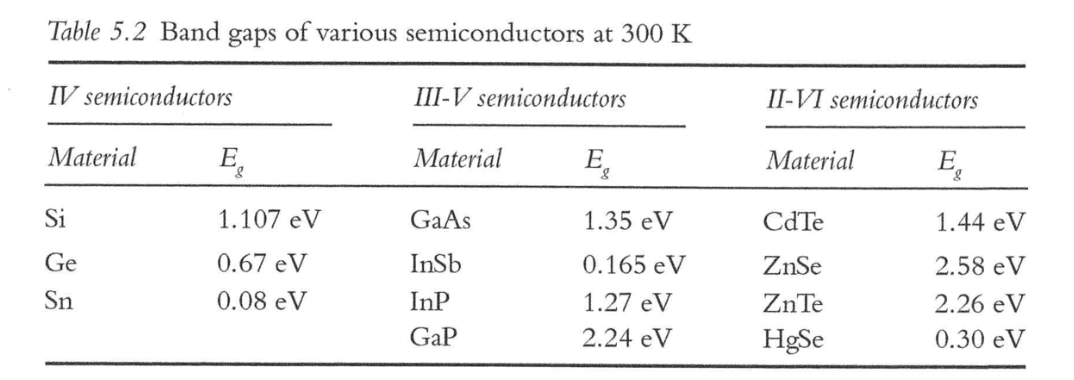
* Group IV elements: Si, Ge, Sn; 4 valence electrons $\rightarrow$ in the crystal shared electrons in covalent bonds fill the valence band.
    * Light can raise electrons to the conduction band: free electron + a *hole*
* Groups III + V, II+VI
</div>

<img src="Si.png" title="Understanding Renewable Energy Systems, p. 161' }}.png" height=500 alt="image">

## Semiconductors 
<div style="padding-left:50px;">
* PV cells use semi-conductors
* Group IV elements: Si, Ge, Sn; 4 valence electrons $\rightarrow$ in the crystal shared electrons in covalent bonds fill the valence band.
    * Light can raise electrons to the conduction band: free electron + a *hole*
* Groups III + V, II+VI
</div>

<img src="semiconductor_table.png" title="Understanding Renewable Energy Systems, p. 161' }}.png" height=500 alt="image">

## p,n Doping

* n electrons, p holes; $n=p$
* $n\cdot p$ is the intrinsic carrier density.
* n-Doping
    * replace some Si with Group V elements like phosphorus (P) or antimony (Sb)
    * five valence electrons $\rightarrow$ one left over, weakly bound
    * more free electrons than holes; electrons are the *majority carriers*
* p-Doping
    * replace some Si with Group III elements like Boron (B) or aluminum (Al)
    * three valence electrons $\rightarrow$ one missing
    * holes are the *majority carriers*
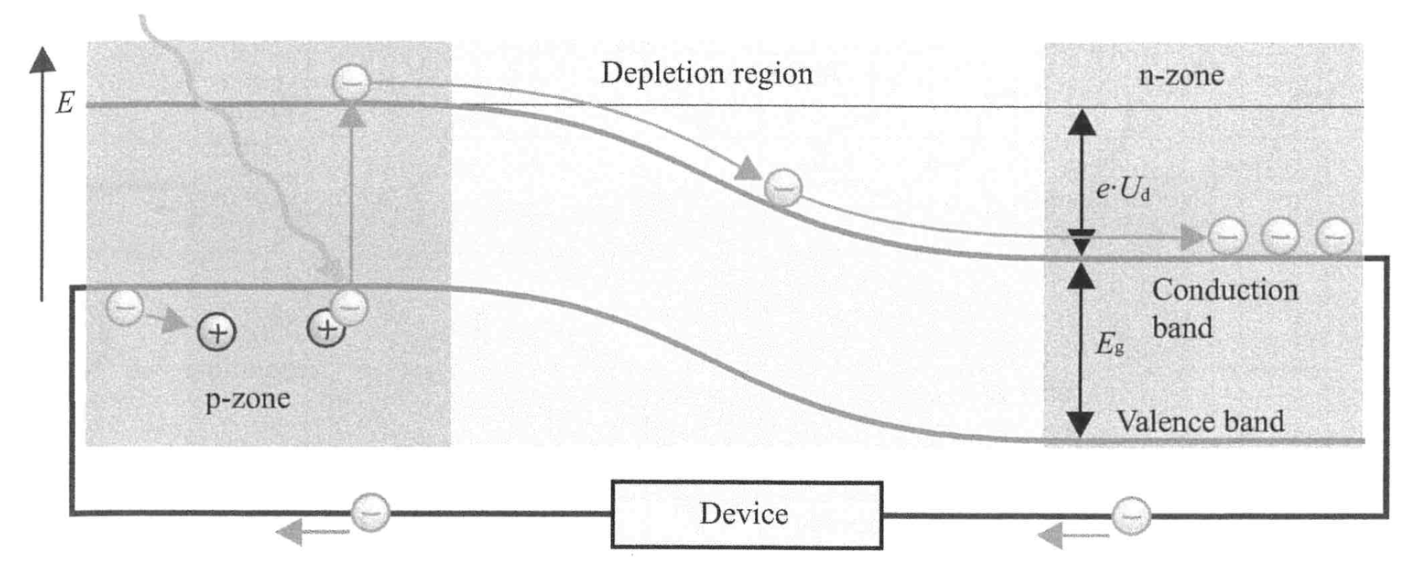
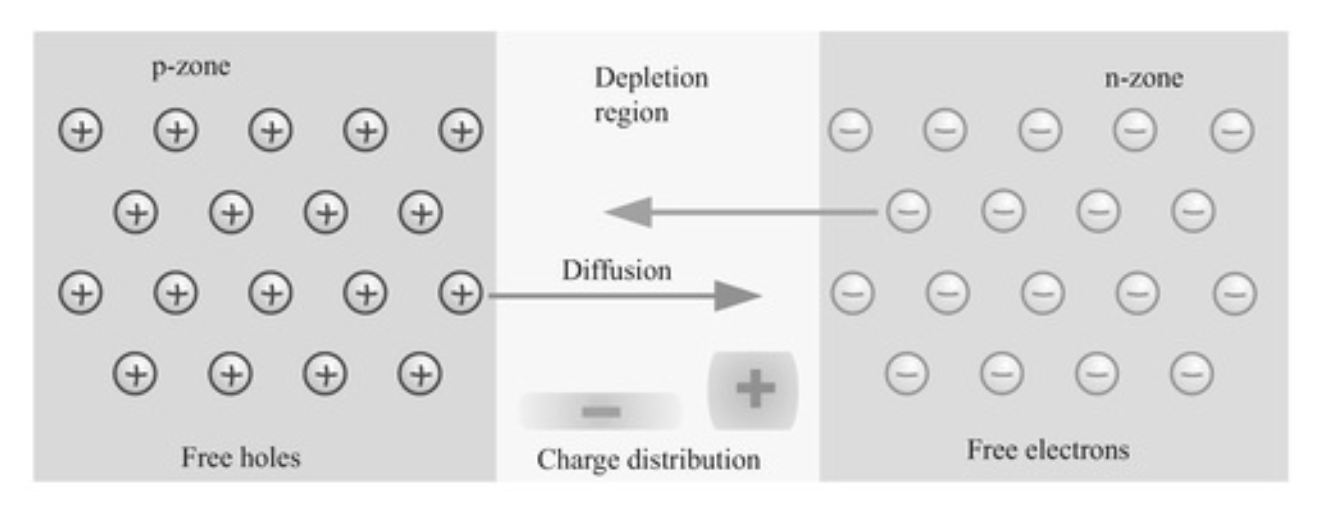
* p-n junction:
    * electrons move from the n-region to the p-region, and vice-versa for the holes
    * an electric field is formed that opposes continued motion
* voltage ~0.5 V open circuit silicon single junction

## p-n Junction
<img src="pn.png" title="Understanding Renewable Energy Systems, p. 164' }}.png" height=370 alt="image">  
<img src="pn_2.png" title="Understanding Renewable Energy Systems, p. 164' }}.png" height=370 alt="image">

## Video
<iframe width="1400" height="787" src="https://www.youtube.com/embed/L_q6LRgKpTw?cc_load_policy=1" title="YouTube video player" frameborder="0" allow="accelerometer; autoplay; clipboard-write; encrypted-media; gyroscope; picture-in-picture" allowfullscreen></iframe>

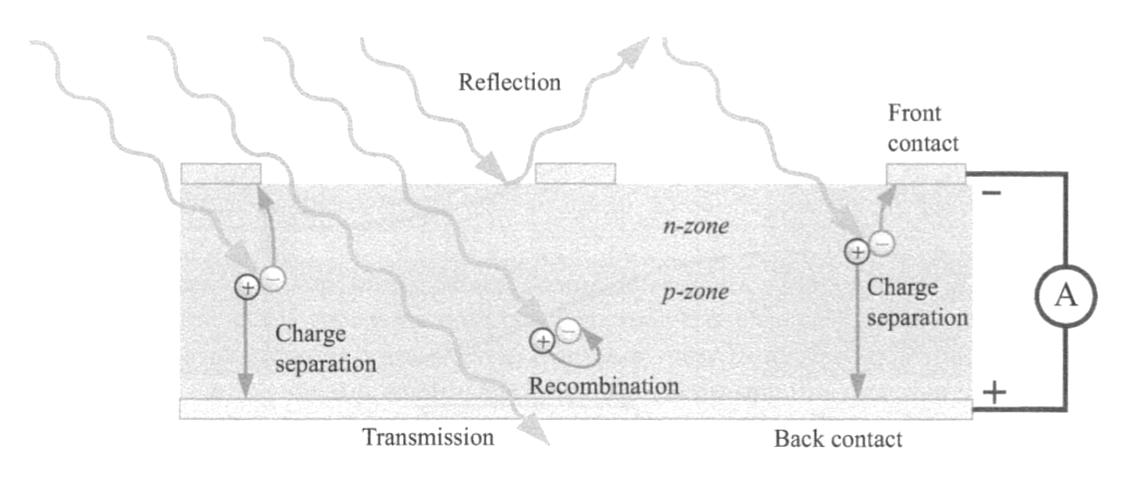
## Losses
::: {.cols2}
::: {.col2-vp}
* Shading
* Transmission
* Reflection
* Absorption
* Heat losses 
    * photons energy > band gap lost to heat
:::
::: {.col2-v}
<img src="losses.png" title="Understanding Renewable Energy Systems, p. 166' }}.png" height=370 alt="image">
:::
:::

## Efficiency
$$\eta = \frac{\text{electrical power}}{\text{incident solar power}}$$

* [Shockley-Queisser limit](https://en.wikipedia.org/wiki/Shockley%E2%80%93Queisser_limit): 
    * $\eta$ = 33%
    * single p-n junction
* Multiple junctions 
    * differing band gaps optimize to different parts of the spectrum

## Efficiency
<img src="https://upload.wikimedia.org/wikipedia/commons/thumb/a/aa/CellPVeff%28rev210104%29.png/2560px-CellPVeff%28rev210104%29.png" title="https://upload.wikimedia.org/wikipedia/commons/thumb/a/aa/CellPVeff%28rev210104%29.png/2560px-CellPVeff%28rev210104%29.png" height=800 alt="image">

## Video
<iframe width="1400" height="787" src="https://www.youtube.com/embed/2uIOeHCOr-0?cc_load_policy=1" title="YouTube video player" frameborder="0" allow="accelerometer; autoplay; clipboard-write; encrypted-media; gyroscope; picture-in-picture" allowfullscreen></iframe>

<!--------------------------------------------------------------------------------------->

# Solar panel
<a href="https://www.pveducation.org/pvcdrom/modules-and-arrays/module-circuit-design">
<img src="https://www.pveducation.org/sites/default/files/PVCDROM/Modules/Images/36Cell02.png" title="https://www.pveducation.org/sites/default/files/PVCDROM/Modules/Images/36Cell02.png" width=1000 alt="image">
</a>

<div style="font-size:0.8em">
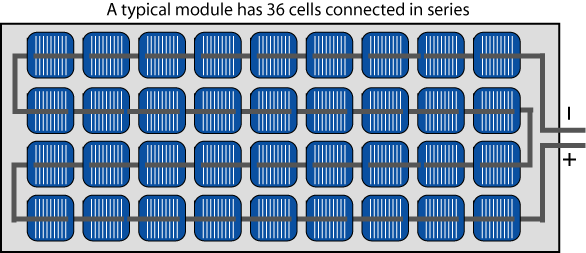
* Series arrangment
* 0.5 V $\cdot$ 36 = 18 V
* ~17% efficient
* 25-30 years
* [textured surfaces](https://en.wikipedia.org/wiki/Solar_cell#Surface_texturing)
</div>

## Example panel
<iframe src="https://www.homedepot.com/p/Grape-Solar-200-Watt-Monocrystalline-PV-Solar-Panel-for-Cabins-RV-s-and-Back-Up-Power-Systems-GS-STAR-200W/318640058?MERCH=REC-_-pipsem-_-204211365-_-318640058-_-N&" height=800 width=1200></iframe>

## PV module prices
<iframe src="https://ourworldindata.org/grapher/solar-pv-prices?yScale=log" height=800 width=1200></iframe>
[Swanson's law](https://en.wikipedia.org/wiki/Swanson%27s_law)