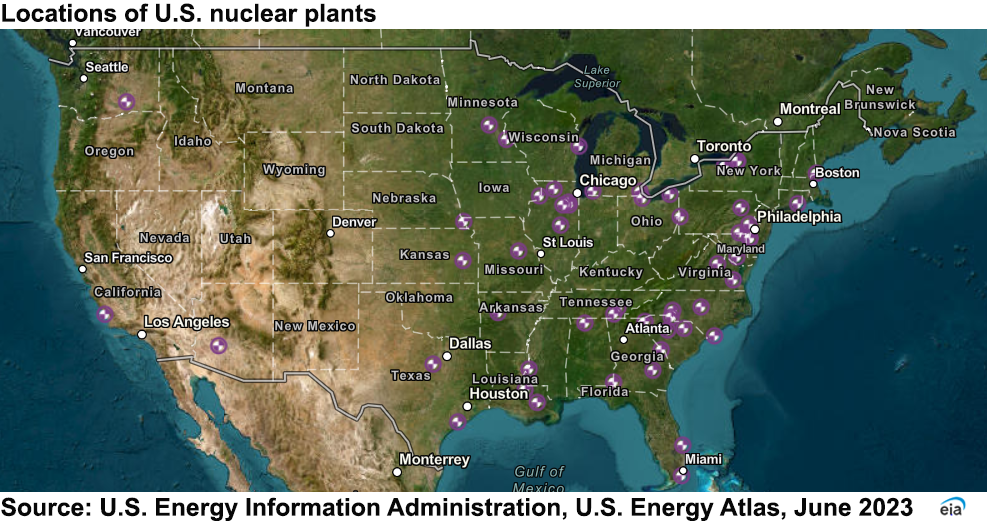
 ## U.S. nuclear plant locations
 ## U.S. nuclear plant stats
::: {.cols2}
::: {.col2-l}
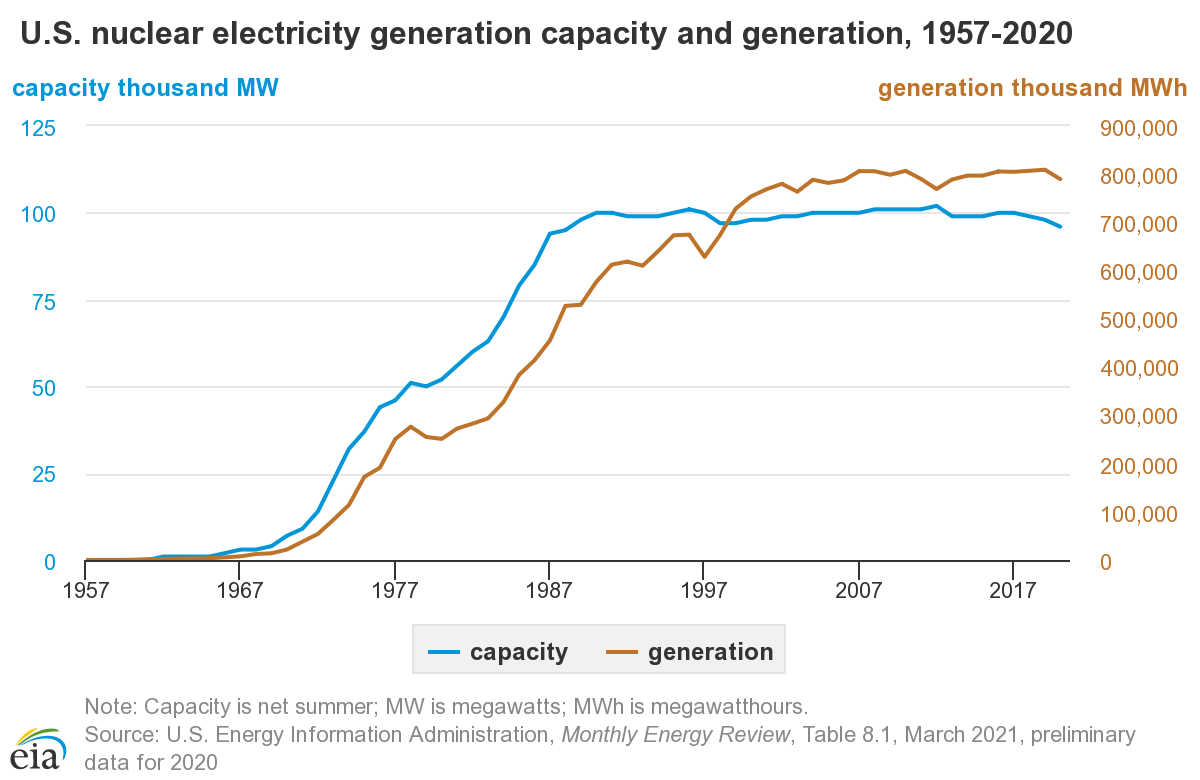
* [20% of U.S. electricity from nuclear](https://www.eia.gov/tools/faqs/faq.php?id=427&t=3)
* First plant in U.S. in 1958
* 2021 stats
* 94 reactors, ~1 GW each (avg)
* 56 plants
* 28 states
* Average age is 39 years
* Oldest plant is Nine Mile Point (NY), Dec. 1969, 52 years
* Newest is [Vogtle Unit 4, 2023](https://www.georgiapower.com/company/news-hub/press-releases/vogtle-unit-4-enters-commercial-operation.html), Georgia
:::
::: {.col2-v}
## U.S. nuclear plant stats
::: {.cols2}
::: {.col2-l}
* [20% of U.S. electricity from nuclear](https://www.eia.gov/tools/faqs/faq.php?id=427&t=3)
* First plant in U.S. in 1958
* 2021 stats
* 94 reactors, ~1 GW each (avg)
* 56 plants
* 28 states
* Average age is 39 years
* Oldest plant is Nine Mile Point (NY), Dec. 1969, 52 years
* Newest is [Vogtle Unit 4, 2023](https://www.georgiapower.com/company/news-hub/press-releases/vogtle-unit-4-enters-commercial-operation.html), Georgia
:::
::: {.col2-v}
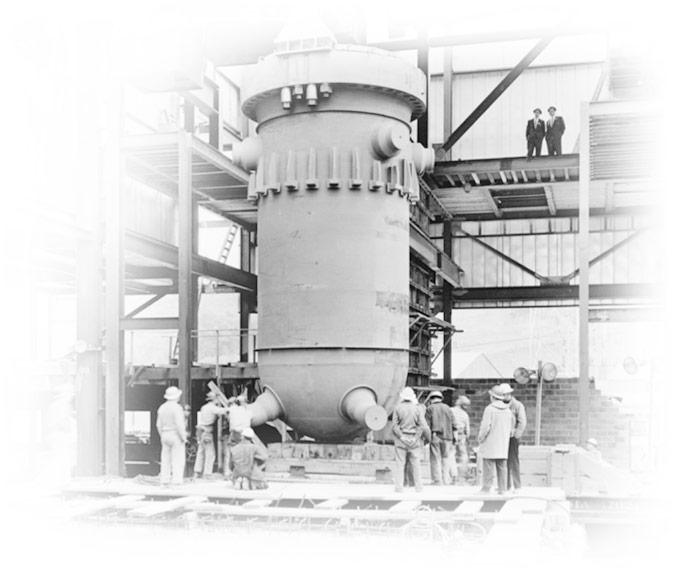
*Shippingport Power Station, Pennsylvania*
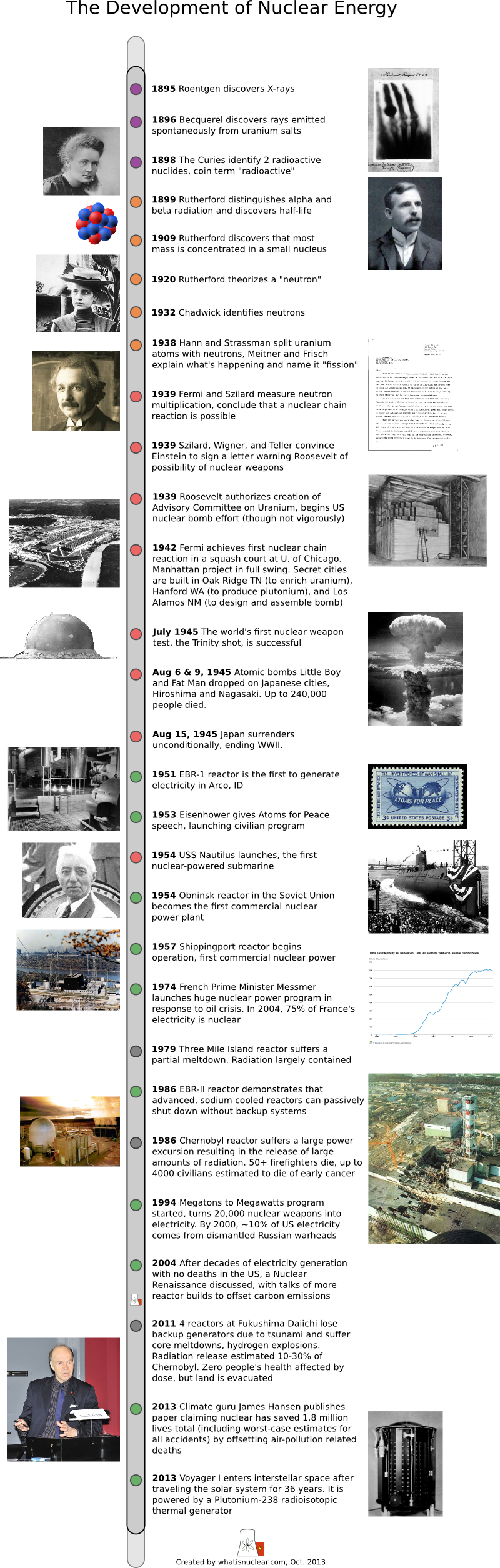
::: ::: ## U.S. nuclear plants timeline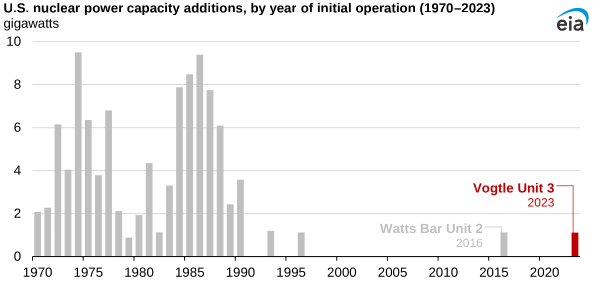 ::: notes
bar chart of US nuclear power capacity additions, by year of initial operation (1970-2023), GW, includes Vogtle 3 unit
:::
## World nuclear plants
::: notes
bar chart of US nuclear power capacity additions, by year of initial operation (1970-2023), GW, includes Vogtle 3 unit
:::
## World nuclear plants
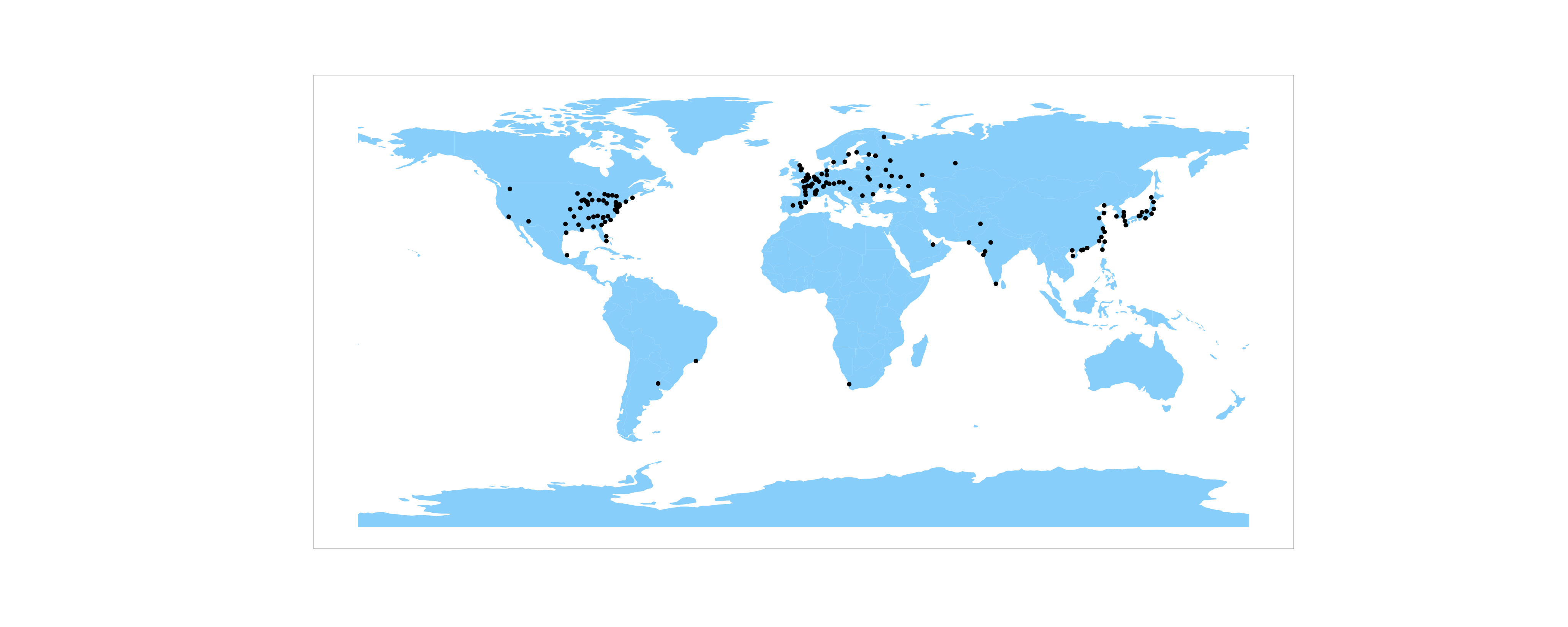
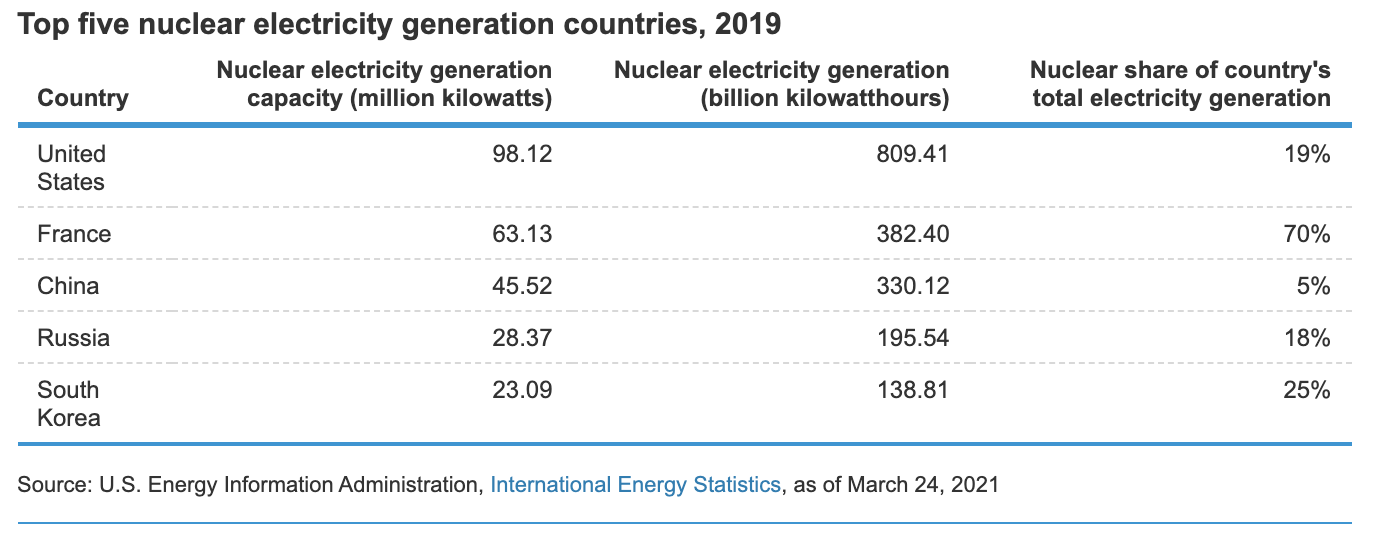 * ~156 plants in service (> 1000 MW)
* Google "list of nuclear reactors" --> people also ask...
## World nuclear plants
* ~156 plants in service (> 1000 MW)
* Google "list of nuclear reactors" --> people also ask...
## World nuclear plants
 # Exercise: World Electricity as Nuclear
::: {.cols2}
::: {.col2-l}
* Look up the world total electricity production. Energy Institute
* Convert this to CMO
* If run continuosly over the year, find the power in GW
* What is the largest nuclear power plant, and it's power?
* What is the average size nuclear power plant > 1000 MW?
* How many of the largest and average size plants are needed?
* If one plant is built per week, how many years are needed?
:::
::: {.col2-v}
# Exercise: World Electricity as Nuclear
::: {.cols2}
::: {.col2-l}
* Look up the world total electricity production. Energy Institute
* Convert this to CMO
* If run continuosly over the year, find the power in GW
* What is the largest nuclear power plant, and it's power?
* What is the average size nuclear power plant > 1000 MW?
* How many of the largest and average size plants are needed?
* If one plant is built per week, how many years are needed?
:::
::: {.col2-v}
 :::
:::
## Exercise: World Electricity as Nuclear
::: incremental
* BP: 26823 TWh $\cdot$ 3600 s/h = 9.65628E19 J (per year)
* 1.6E20 J/CMO $\rightarrow$ 0.6 CMO
* 9.65628E19 J/yr $\cdot$ yr/(3600 $\cdot$ 24 $\cdot$ 365 s) $\cdot$ GW/1E9 W = 3062 GW
* Largest plant is the [Kashiwazaki-Kariwa (K-K) Plant](https://en.wikipedia.org/wiki/Kashiwazaki-Kariwa_Nuclear_Power_Plant) in Japan
* 7965 MW
* Avg size plant = 2382 MW (for plants over 1000 MW)
* 155 plants over 1000 MW
* \# K-K plants = 3062/7.965/0.92 = 418
* with a [92% capacity factor](https://www.energy.gov/ne/articles/what-generation-capacity#:~:text=Nuclear%20has%20the%20highest%20capacity,and%20solar%20(25%25)%20plants.)
* 1 plant per week for 8 years
* \# avg plants = 3062/2.382/0.92 = 1397
* 1 plant per week for 27 years
:::
# Isotope binding energy
Isotope Binding Energy
:::
:::
## Exercise: World Electricity as Nuclear
::: incremental
* BP: 26823 TWh $\cdot$ 3600 s/h = 9.65628E19 J (per year)
* 1.6E20 J/CMO $\rightarrow$ 0.6 CMO
* 9.65628E19 J/yr $\cdot$ yr/(3600 $\cdot$ 24 $\cdot$ 365 s) $\cdot$ GW/1E9 W = 3062 GW
* Largest plant is the [Kashiwazaki-Kariwa (K-K) Plant](https://en.wikipedia.org/wiki/Kashiwazaki-Kariwa_Nuclear_Power_Plant) in Japan
* 7965 MW
* Avg size plant = 2382 MW (for plants over 1000 MW)
* 155 plants over 1000 MW
* \# K-K plants = 3062/7.965/0.92 = 418
* with a [92% capacity factor](https://www.energy.gov/ne/articles/what-generation-capacity#:~:text=Nuclear%20has%20the%20highest%20capacity,and%20solar%20(25%25)%20plants.)
* 1 plant per week for 8 years
* \# avg plants = 3062/2.382/0.92 = 1397
* 1 plant per week for 27 years
:::
# Isotope binding energy
Isotope Binding Energy
 ## Stardust
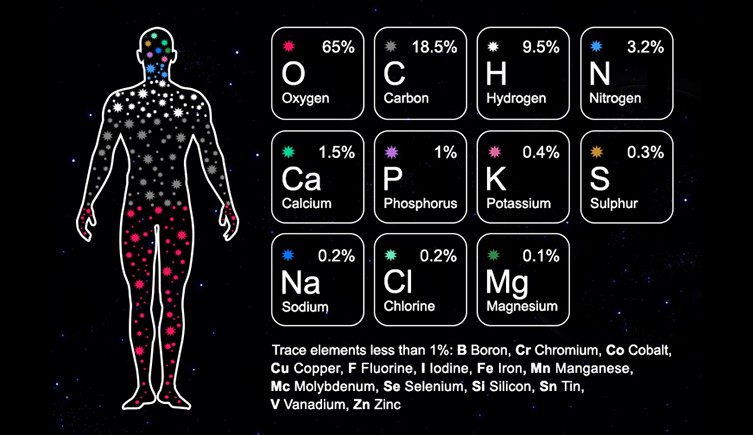
[Genesis 3:19](https://www.churchofjesuschrist.org/study/scriptures/ot/gen/3?lang=eng) ...for dust thou art, and unto dust shalt thou return
["It is totally 100% true: nearly all the elements in the human body were made in a star and many have come through several supernovas."](https://www.nhm.ac.uk/discover/are-we-really-made-of-stardust.html)
## Stardust
[Genesis 3:19](https://www.churchofjesuschrist.org/study/scriptures/ot/gen/3?lang=eng) ...for dust thou art, and unto dust shalt thou return
["It is totally 100% true: nearly all the elements in the human body were made in a star and many have come through several supernovas."](https://www.nhm.ac.uk/discover/are-we-really-made-of-stardust.html)
 ## Emission/Decay
* $\alpha$ (helium nucleus), e.g.,
* $^{238}_{92}\text{U} \rightarrow ^{234}_{90}\!\!\text{Th} + ^4_2\!\text{He}$
* $\beta^-$ (emitted electron)
* $n \rightarrow p + e^- + v_e$
* $\beta^+$ (positron, ~ a positively charged electron)
* $p \rightarrow n + e^+ + v_e$
* $\gamma$ (high energy photon)
* often occurs from an excited daughter nucleus after $\alpha$ or $\beta$ decay
::: notes
$\beta^+$ and $\beta^-$ emission occur in nuclei not bare $p$ or $n$
:::
## Table of Nuclides
## Half life
::: {.cols2}
::: {.col2-l}
**Equation for radiactive decay?**
::: incremental
* Radioactive decay is governed by $\frac{dN}{dt} = -N/\tau$, $N(0) = N_0$.
* Here, $\tau$ is the characteristic decay time.
* The analytic solution is
## Emission/Decay
* $\alpha$ (helium nucleus), e.g.,
* $^{238}_{92}\text{U} \rightarrow ^{234}_{90}\!\!\text{Th} + ^4_2\!\text{He}$
* $\beta^-$ (emitted electron)
* $n \rightarrow p + e^- + v_e$
* $\beta^+$ (positron, ~ a positively charged electron)
* $p \rightarrow n + e^+ + v_e$
* $\gamma$ (high energy photon)
* often occurs from an excited daughter nucleus after $\alpha$ or $\beta$ decay
::: notes
$\beta^+$ and $\beta^-$ emission occur in nuclei not bare $p$ or $n$
:::
## Table of Nuclides
## Half life
::: {.cols2}
::: {.col2-l}
**Equation for radiactive decay?**
::: incremental
* Radioactive decay is governed by $\frac{dN}{dt} = -N/\tau$, $N(0) = N_0$.
* Here, $\tau$ is the characteristic decay time.
* The analytic solution is
$$N = N_0\left(\frac{1}{2}\right)^{t/t_{1/2}}$$
::: ::: ::: {.col2-v} ::: fragment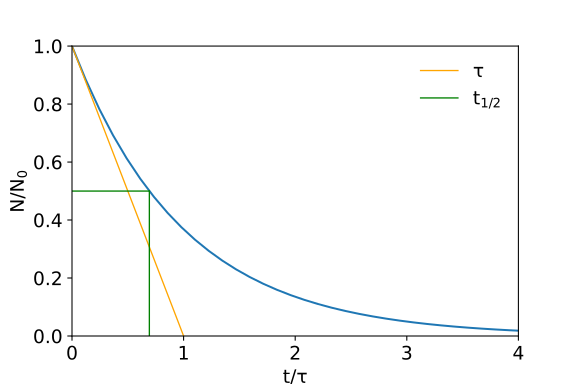 :::
:::
:::
## Radiation penetration
:::
:::
:::
## Radiation penetration
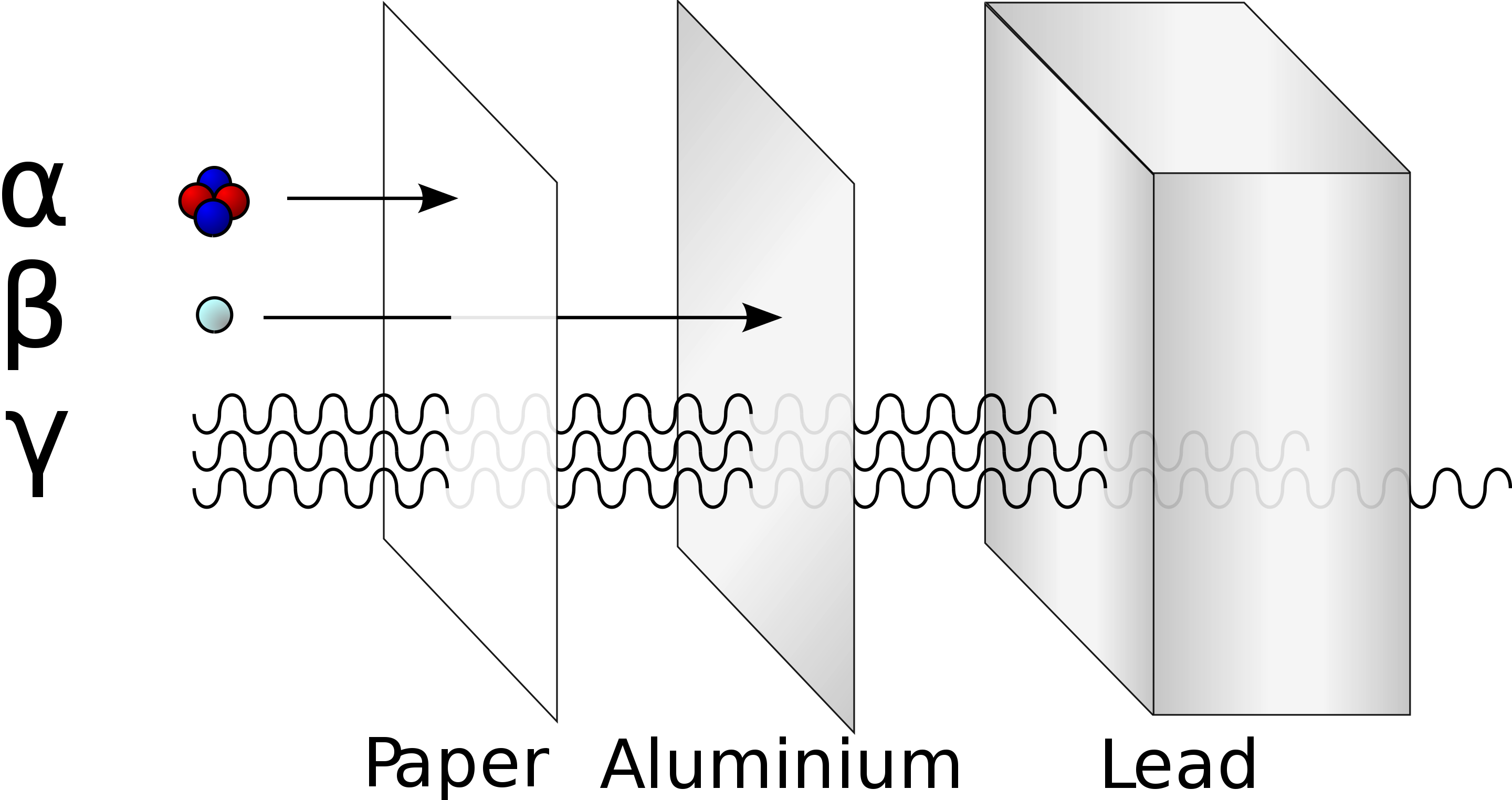 * $\alpha$ stopped by paper, dead outer layer of skin (dangerous if injested)
* Polonium-210 [poisoning of Alexander Litvinenko](https://en.wikipedia.org/wiki/Poisoning_of_Alexander_Litvinenko#Illness_and_poisoning)
* $\beta$ stopped by aluminum foil, can penetrate ~1/2 inch into skin
* $\gamma$ stopped by lead, thick concrete
## Radiation penetration
## Ionization demonstration
# U-235 Fission
::: {.cols2}
::: {.col2-vp}
* $^{235}U + n \rightarrow [^{236}U] \rightarrow ^{144}Ba + ^{89}Kr + 3n$
* typical
* 1n $\rightarrow$ 2.5n *daughter* neutrons
* *prompt* neutrons are fast:
* ~2 MeV = 19.5 million m/s (7% of light).
* $\alpha$ stopped by paper, dead outer layer of skin (dangerous if injested)
* Polonium-210 [poisoning of Alexander Litvinenko](https://en.wikipedia.org/wiki/Poisoning_of_Alexander_Litvinenko#Illness_and_poisoning)
* $\beta$ stopped by aluminum foil, can penetrate ~1/2 inch into skin
* $\gamma$ stopped by lead, thick concrete
## Radiation penetration
## Ionization demonstration
# U-235 Fission
::: {.cols2}
::: {.col2-vp}
* $^{235}U + n \rightarrow [^{236}U] \rightarrow ^{144}Ba + ^{89}Kr + 3n$
* typical
* 1n $\rightarrow$ 2.5n *daughter* neutrons
* *prompt* neutrons are fast:
* ~2 MeV = 19.5 million m/s (7% of light).
 :::
::: {.col2-v}
:::
::: {.col2-v}
 :::
:::
## Chain reaction
::: {.cols2}
::: {.col2-l}
::: incremental
* Neutron fate:
* Fission
* Absorbed (e.g., by U-238)
* Escape
* (bare n is unstable $\rightarrow$ p+$e^-$)
* half life ~ 10 minutes.
* [Chain reaction](https://en.wikipedia.org/wiki/Nuclear_chain_reaction)
* 1 fission creates $\ge$ 1 fission
* Energy from mass:
$$\Delta m = m_\text{reactants} - m_\text{products}$$
$$\Delta m = \frac{E}{c^2}$$
* mass difference as kinetic energy of fission products $\rightarrow$ slows $\rightarrow$ heat.
* Neutrons + protons are conserved, electrons are not (formed).
* Energy released as more stable nuclei are formed (sounds familiar)
:::
:::
::: {.col2-v}
:::
:::
## Chain reaction
::: {.cols2}
::: {.col2-l}
::: incremental
* Neutron fate:
* Fission
* Absorbed (e.g., by U-238)
* Escape
* (bare n is unstable $\rightarrow$ p+$e^-$)
* half life ~ 10 minutes.
* [Chain reaction](https://en.wikipedia.org/wiki/Nuclear_chain_reaction)
* 1 fission creates $\ge$ 1 fission
* Energy from mass:
$$\Delta m = m_\text{reactants} - m_\text{products}$$
$$\Delta m = \frac{E}{c^2}$$
* mass difference as kinetic energy of fission products $\rightarrow$ slows $\rightarrow$ heat.
* Neutrons + protons are conserved, electrons are not (formed).
* Energy released as more stable nuclei are formed (sounds familiar)
:::
:::
::: {.col2-v}
 :::
:::
## Exercise: mass $\rightarrow$ energy
How much mass converted fully to energy equivalent to 1 CMO?
::: incremental
* 1 CMO = 1.6E20 J
* $E = mc^2$ $\rightarrow$ $m = E/c^2$
* c = 299792458 m/s
* m = 1780 kg
* ~ 2 m$^3$ of oil (@ 890 kg/m$^3$)
* Volume is 9 billion times less than 1 CMO
:::
::: fragment
*Of course, nuclear reactions never approach full mass conversion.*
1 CMO requires about 2000 tons of U-235 fission
:::
::: notes
U235 + n --> Ba-144 + Kr-189 + 3n
mU = 235.043928 amu
mn = 1.008664916 amu
mBa = 143.922955 amu
mKr = 88.907835 amu
dM = mReact - mProd = 0.195808 amu
dM/mU = 0.000833 = rest mass change per mass of U-235
So, if 1 cmo = 1780 kg, then 1780/0.000833 is the mass of U235 fission for 1 CMO = 2.1368E6 kg = 2355 tons
CMO book p 130 quotes "about 2000 tons of U235 can release as much energy as burning 4.2 billion tons of oil (which is 1 CMO)."
:::
## Cross section
::: {.cols2}
::: {.col2-l}
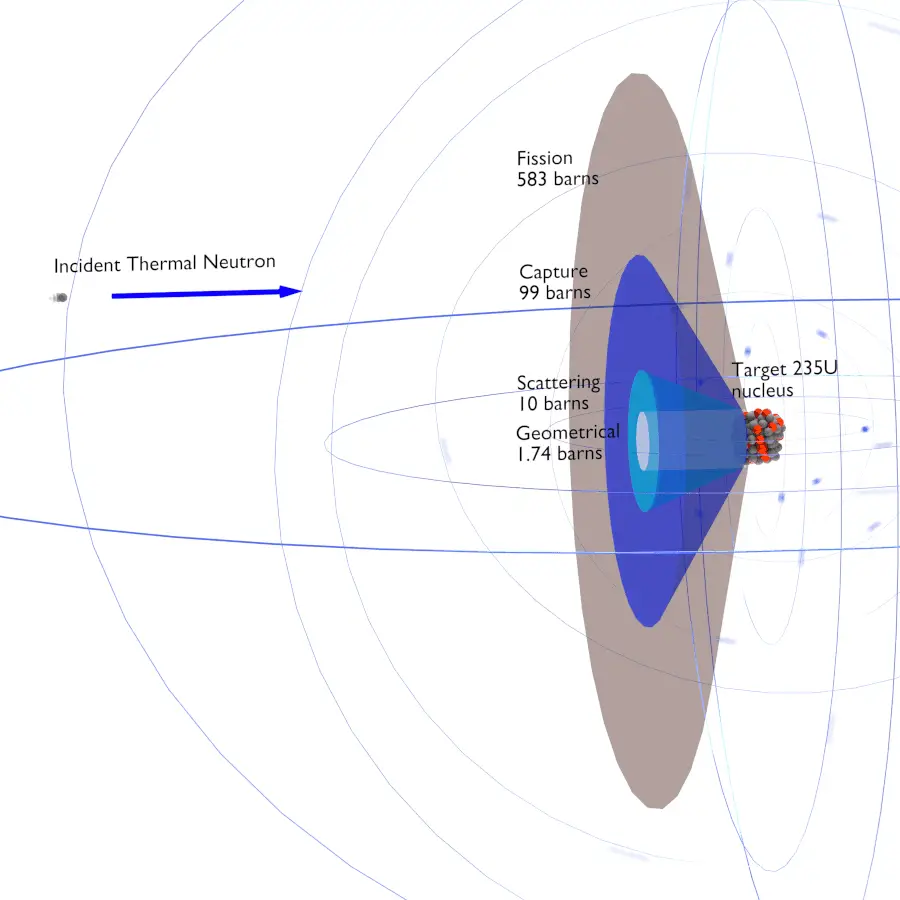
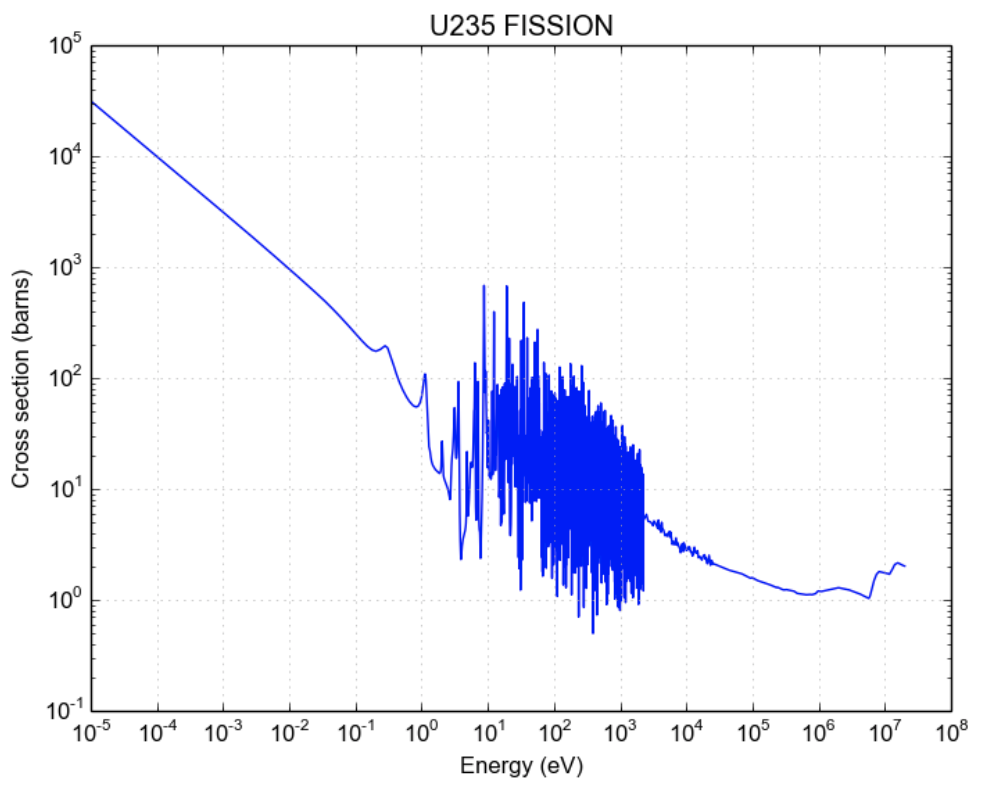
* [Cross section](https://www.nuclear-power.com/nuclear-power/reactor-physics/nuclear-engineering-fundamentals/neutron-nuclear-reactions/microscopic-cross-section/) is an area of interaction of a target particle
* May be bigger or smaller than the geometrical area
* In this sense it's *like* a probability of interation
* Units: 1 **barn** = 10$^{-28}$ m$^3$
* as in "you couldn't hit the broad side of a barn"
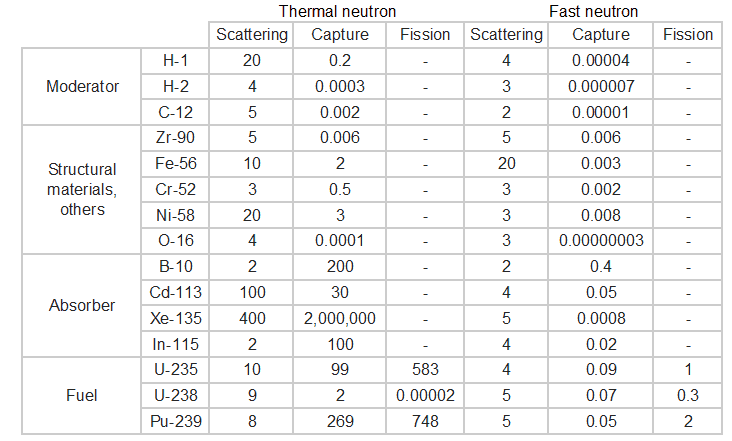
* Depends on the nucleus and the neutron energy
* Fast (prompt) neutrons are released during fusion ([0.1 - 10 MeV](https://www.nuclear-power.com/nuclear-power/fission/prompt-neutrons/prompt-neutrons-and-delayed-neutrons/)).
* These have low fission cross sections though, so they are slowed down to "thermal" by neutron interactions with a *moderator*.
* Thermal neutrons (0.025 eV at 17 $^o$C, ~2.2 km/s=4900 mph)
:::
::: {.col2-v}
:::
:::
## Exercise: mass $\rightarrow$ energy
How much mass converted fully to energy equivalent to 1 CMO?
::: incremental
* 1 CMO = 1.6E20 J
* $E = mc^2$ $\rightarrow$ $m = E/c^2$
* c = 299792458 m/s
* m = 1780 kg
* ~ 2 m$^3$ of oil (@ 890 kg/m$^3$)
* Volume is 9 billion times less than 1 CMO
:::
::: fragment
*Of course, nuclear reactions never approach full mass conversion.*
1 CMO requires about 2000 tons of U-235 fission
:::
::: notes
U235 + n --> Ba-144 + Kr-189 + 3n
mU = 235.043928 amu
mn = 1.008664916 amu
mBa = 143.922955 amu
mKr = 88.907835 amu
dM = mReact - mProd = 0.195808 amu
dM/mU = 0.000833 = rest mass change per mass of U-235
So, if 1 cmo = 1780 kg, then 1780/0.000833 is the mass of U235 fission for 1 CMO = 2.1368E6 kg = 2355 tons
CMO book p 130 quotes "about 2000 tons of U235 can release as much energy as burning 4.2 billion tons of oil (which is 1 CMO)."
:::
## Cross section
::: {.cols2}
::: {.col2-l}
* [Cross section](https://www.nuclear-power.com/nuclear-power/reactor-physics/nuclear-engineering-fundamentals/neutron-nuclear-reactions/microscopic-cross-section/) is an area of interaction of a target particle
* May be bigger or smaller than the geometrical area
* In this sense it's *like* a probability of interation
* Units: 1 **barn** = 10$^{-28}$ m$^3$
* as in "you couldn't hit the broad side of a barn"
* Depends on the nucleus and the neutron energy
* Fast (prompt) neutrons are released during fusion ([0.1 - 10 MeV](https://www.nuclear-power.com/nuclear-power/fission/prompt-neutrons/prompt-neutrons-and-delayed-neutrons/)).
* These have low fission cross sections though, so they are slowed down to "thermal" by neutron interactions with a *moderator*.
* Thermal neutrons (0.025 eV at 17 $^o$C, ~2.2 km/s=4900 mph)
:::
::: {.col2-v}
 :::
:::
## Cross section
:::
:::
## Cross section
 [nuclear-power.com](https://www.nuclear-power.com/nuclear-power/reactor-physics/nuclear-engineering-fundamentals/neutron-nuclear-reactions/microscopic-cross-section/)
## Neutron moderator
::: {.cols2}
::: {.col2-l}
[nuclear-power.com](https://www.nuclear-power.com/nuclear-power/reactor-physics/nuclear-engineering-fundamentals/neutron-nuclear-reactions/microscopic-cross-section/)
## Neutron moderator
::: {.cols2}
::: {.col2-l}
 :::
:::
# Uranium
::: {.cols2}
::: {.col2-l}
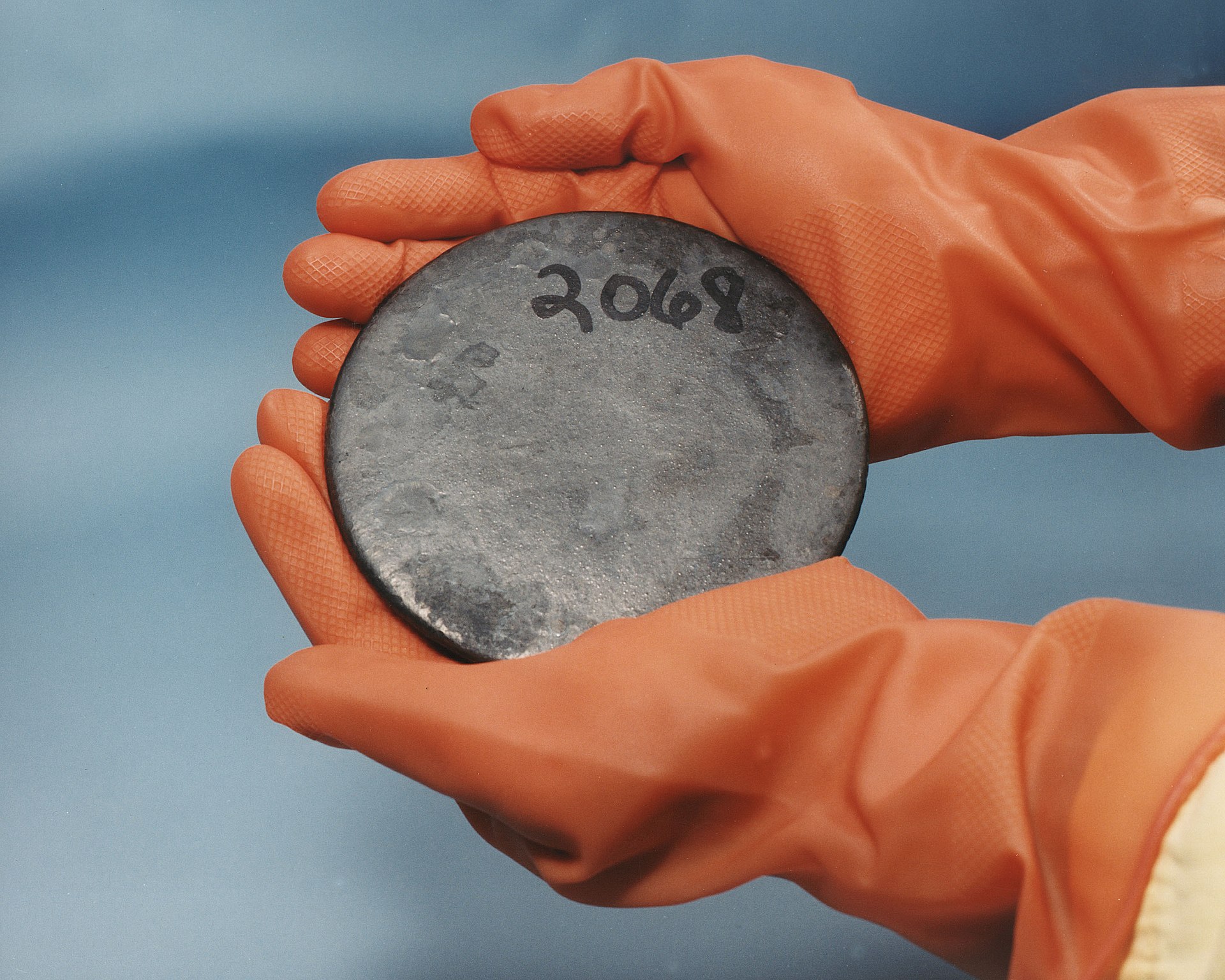
* U-235
* 0.72% abundance
* Only natural fissile isotope
* half life of 703.8 million years
* $\rho=19.1$ g/cm$^3$ (lead is 11.3)
:::
::: {.col2}
* U-238
* 99.27% abundance
* [non-fissile](https://en.wikipedia.org/wiki/Fissile_material#Fissile_vs_fissionable)
* half life of 4.468 billion years
* can form Pu-239
:::
:::
:::
:::
# Uranium
::: {.cols2}
::: {.col2-l}
* U-235
* 0.72% abundance
* Only natural fissile isotope
* half life of 703.8 million years
* $\rho=19.1$ g/cm$^3$ (lead is 11.3)
:::
::: {.col2}
* U-238
* 99.27% abundance
* [non-fissile](https://en.wikipedia.org/wiki/Fissile_material#Fissile_vs_fissionable)
* half life of 4.468 billion years
* can form Pu-239
:::
:::
 ## Uranium deposits
::: {.cols2}
::: {.col2-l}
* 40 times more common than silver, 500 times more common than gold.
* Found everywhere.
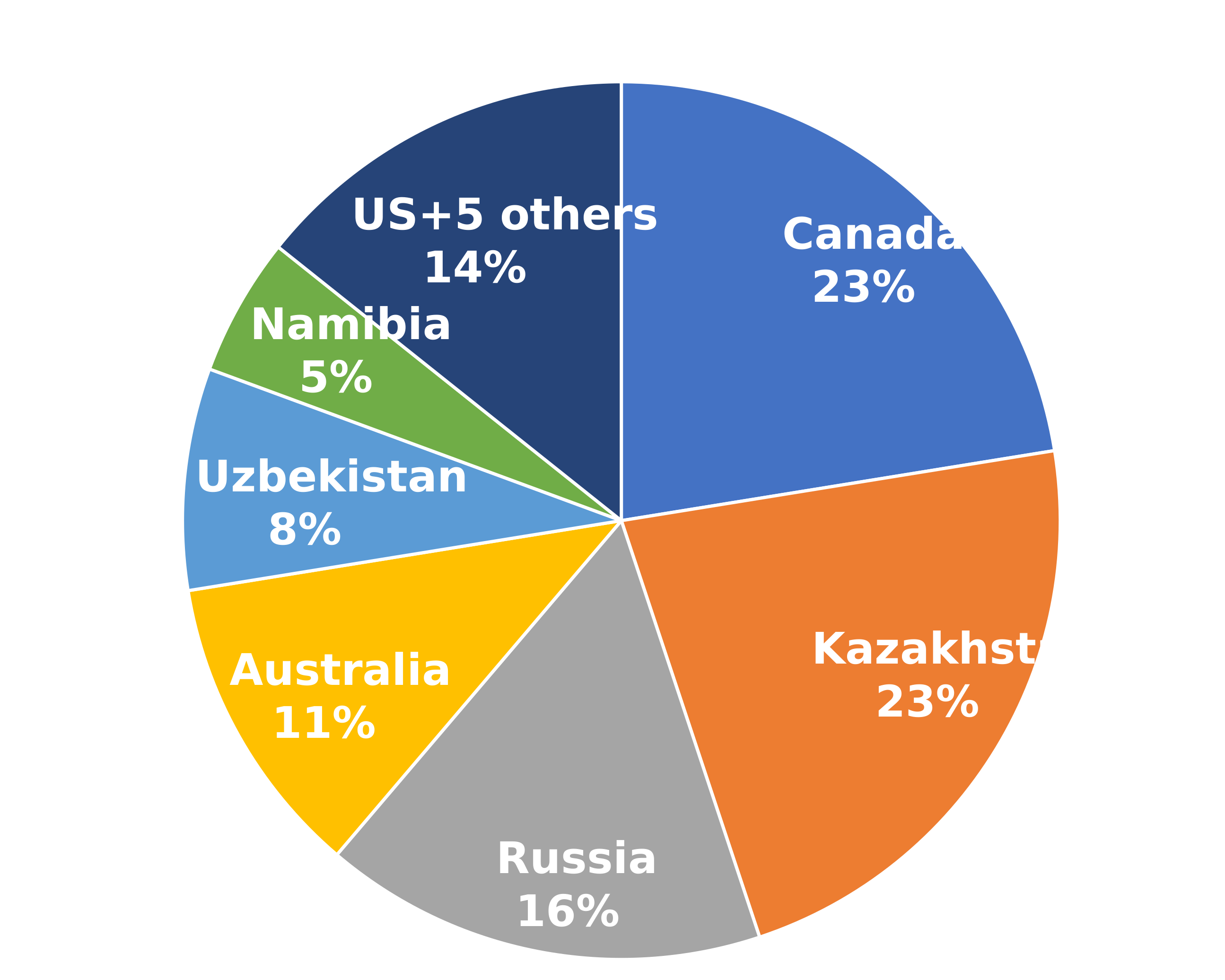
* Highest grade deposits in [Canada](https://en.wikipedia.org/wiki/Athabasca_Basin#Uranium_mines)
:::
::: {.col2-v}
## Uranium deposits
::: {.cols2}
::: {.col2-l}
* 40 times more common than silver, 500 times more common than gold.
* Found everywhere.
* Highest grade deposits in [Canada](https://en.wikipedia.org/wiki/Athabasca_Basin#Uranium_mines)
:::
::: {.col2-v}
 :::
:::
## US Uranium sources
:::
:::
## US Uranium sources
 ## Uranium processing
::: {.cols2}
::: {.col2-l}
## Uranium processing
::: {.cols2}
::: {.col2-l}
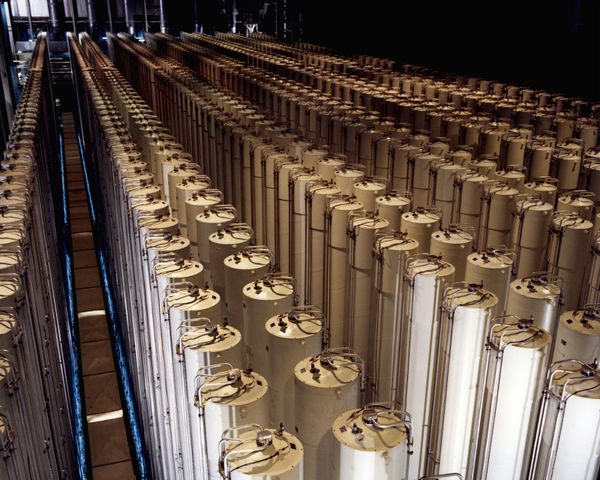
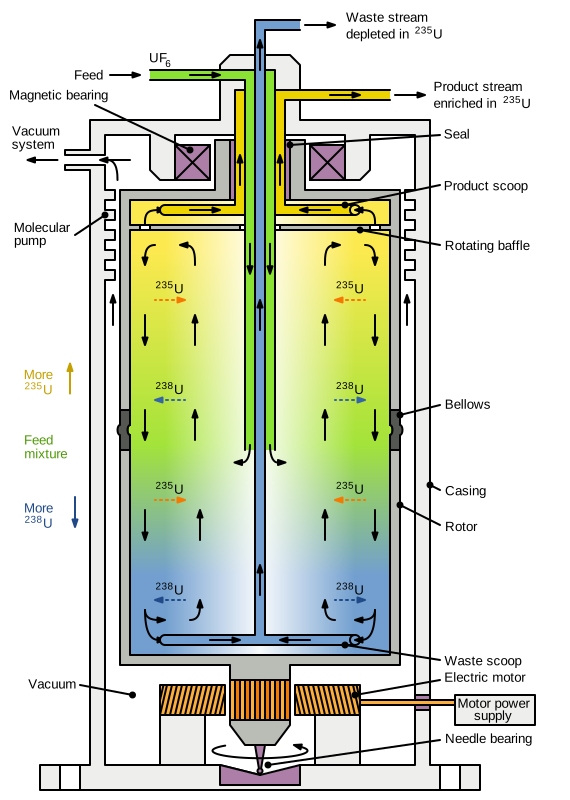
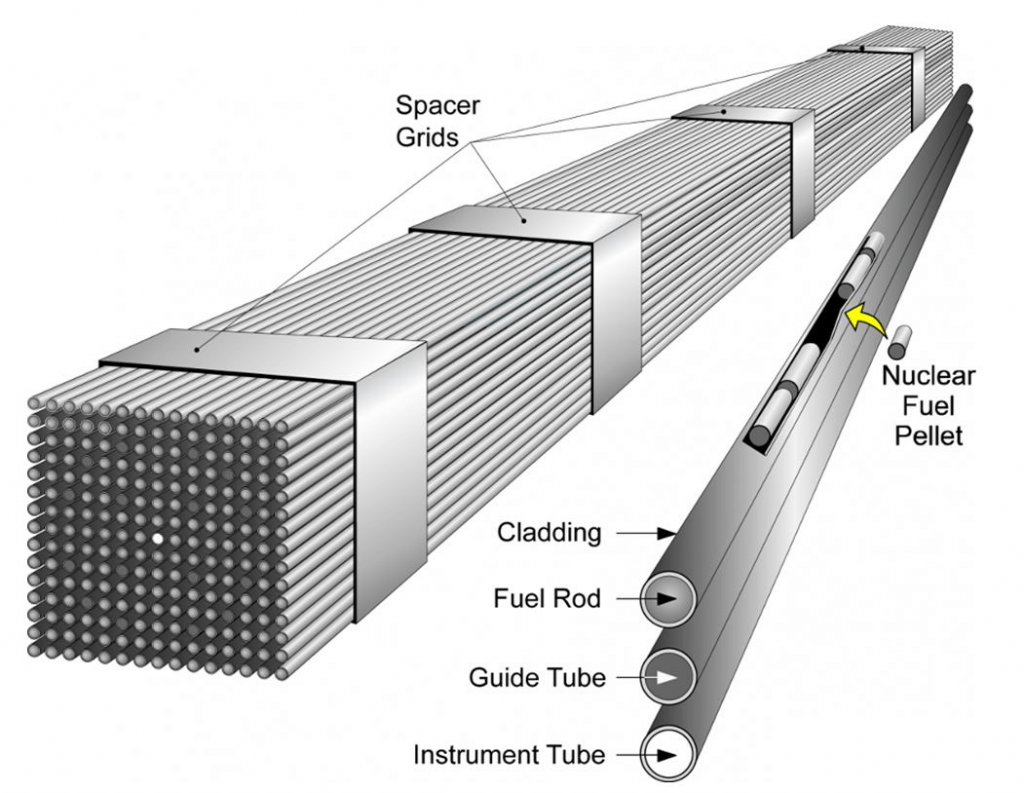 :::
:::
## Uranium reserves
:::
:::
## Uranium reserves
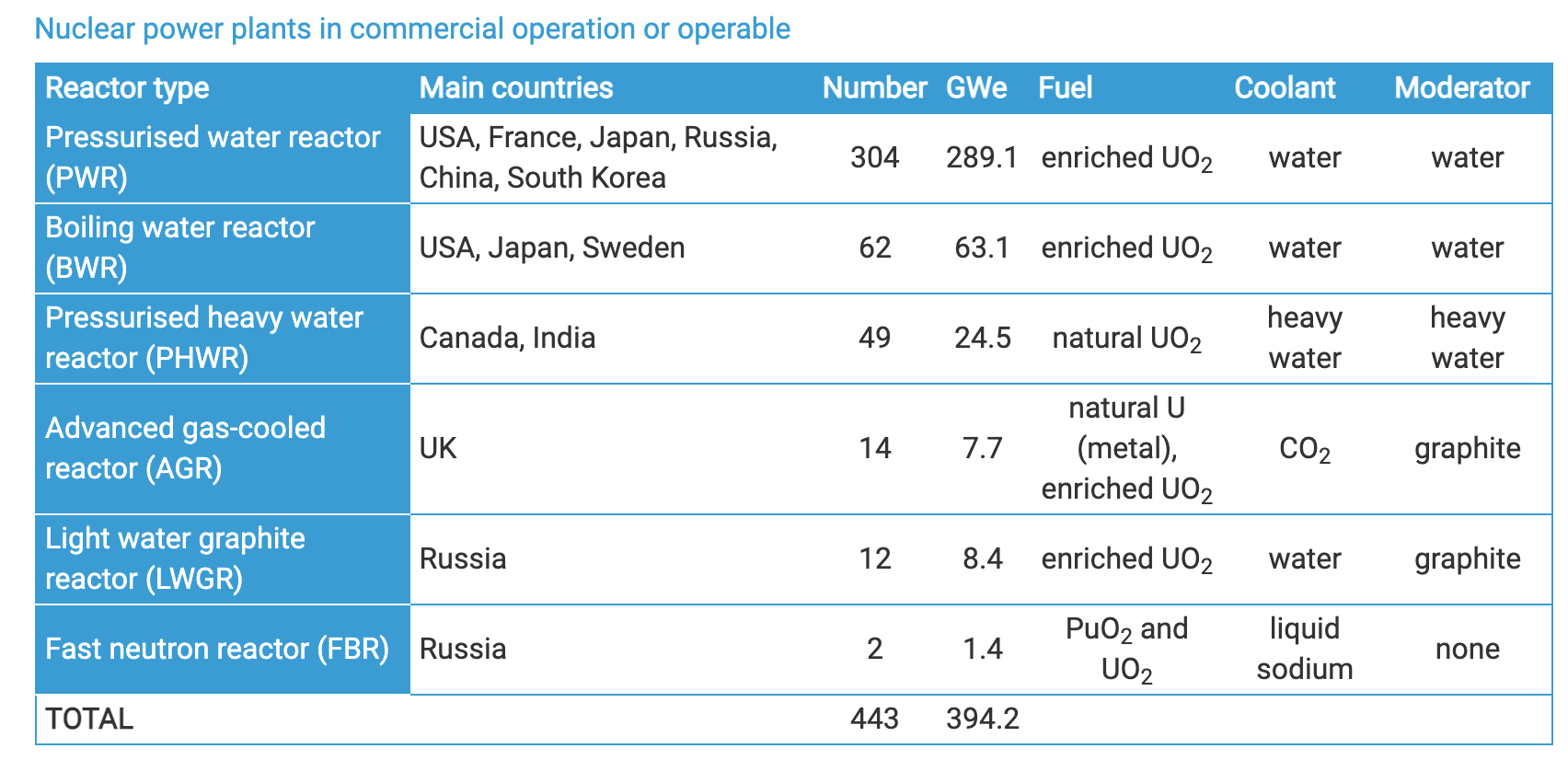
*[world-nuclear.org](https://world-nuclear.org/information-library/nuclear-fuel-cycle/nuclear-power-reactors/nuclear-power-reactors.aspx)*
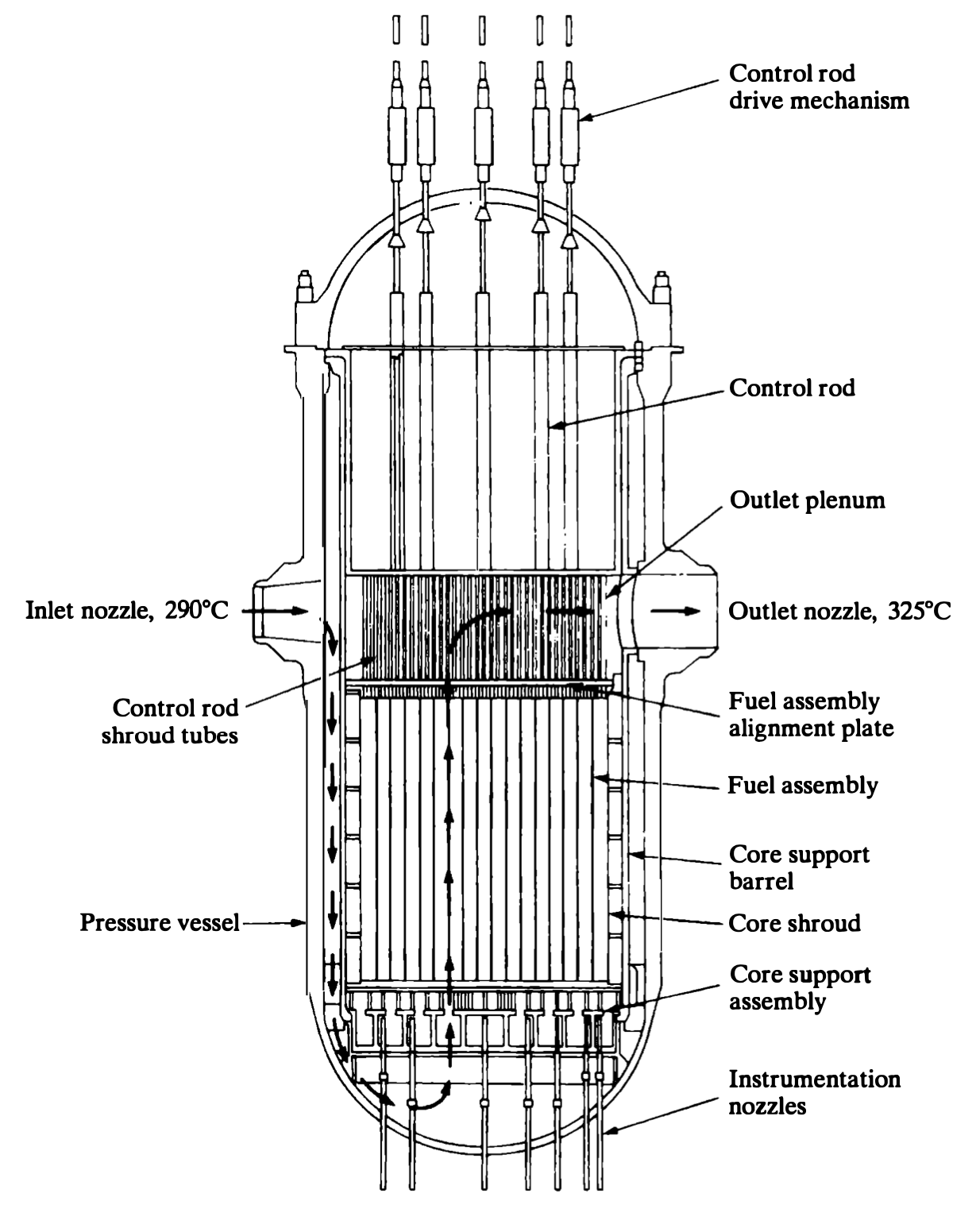
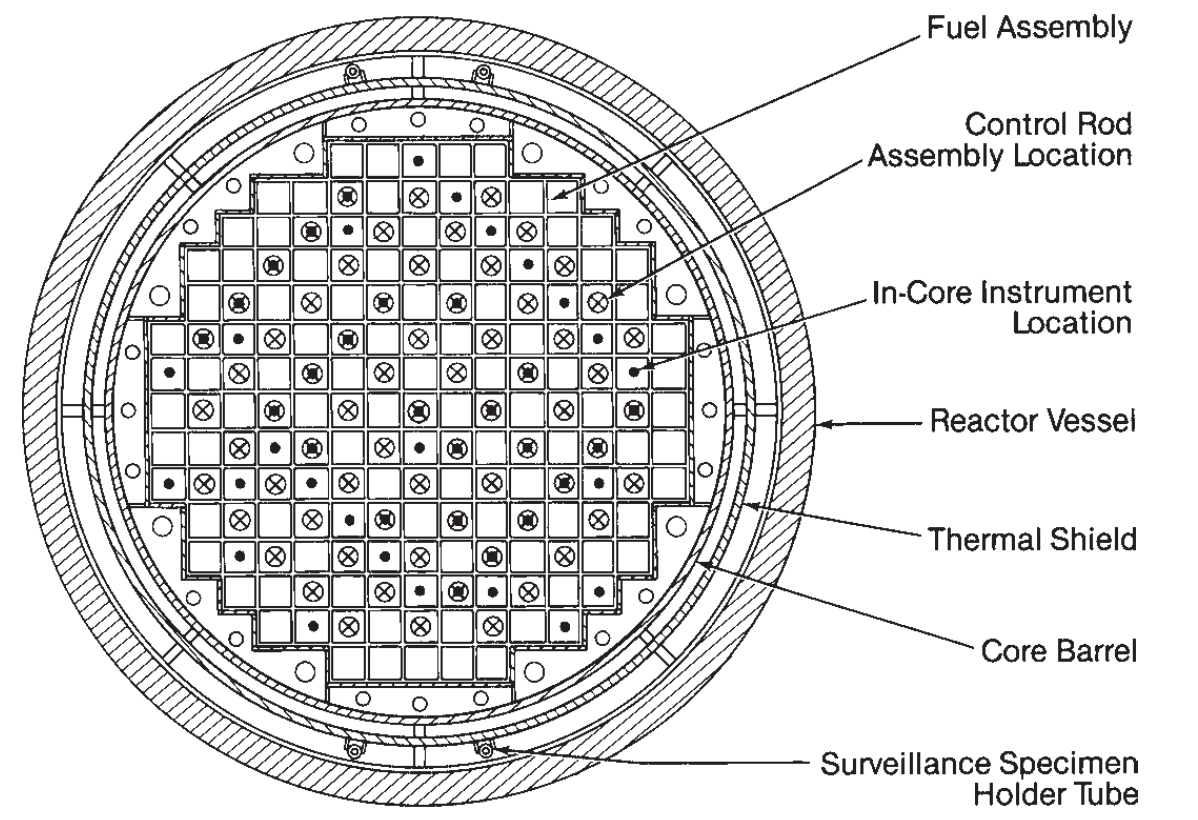
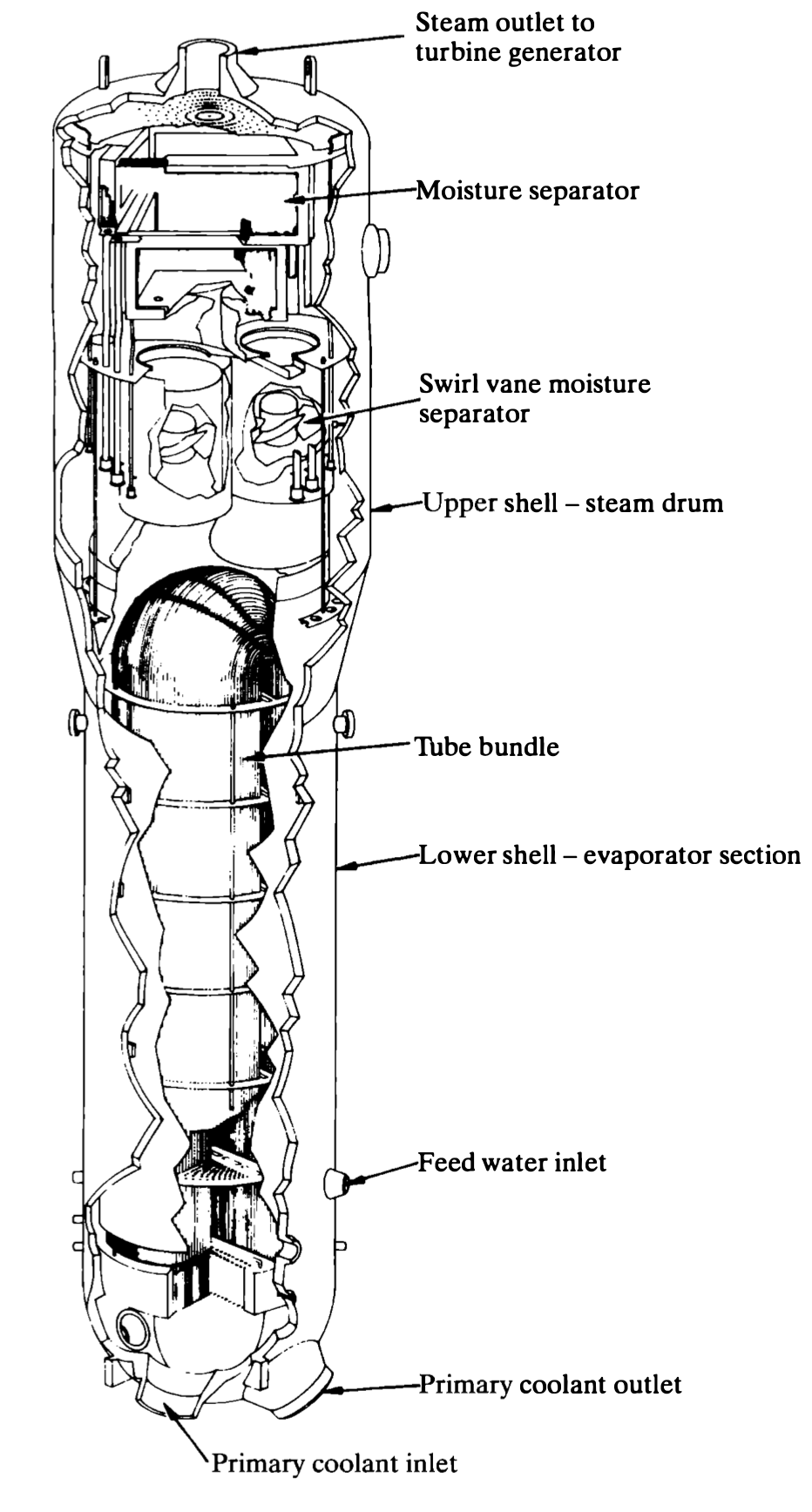
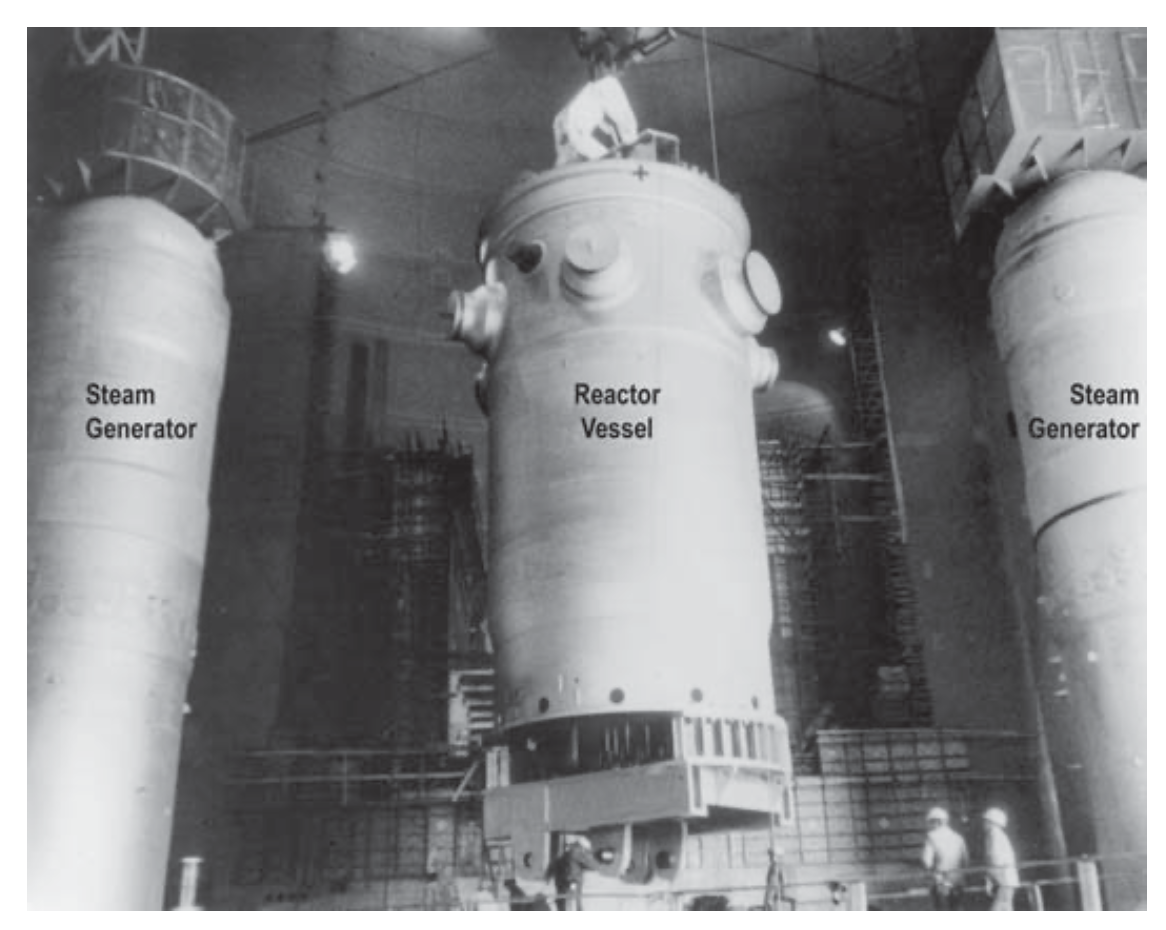
## Nuclear reactors: PWR ::: {.cols2} ::: {.col2-l} * [Pressurized water reactor](https://world-nuclear.org/information-library/nuclear-fuel-cycle/nuclear-power-reactors/nuclear-power-reactors.aspx) * Pressurized water in contact with fuel * Water transfers heat and moderates the neutrons * Nonboiling (high P) * Heat transfer to separate steam loop * T: 290 $\rightarrow$ 325 $^oC$ * P: 15 MPa (2250 psi) ::: ::: {.col2-v}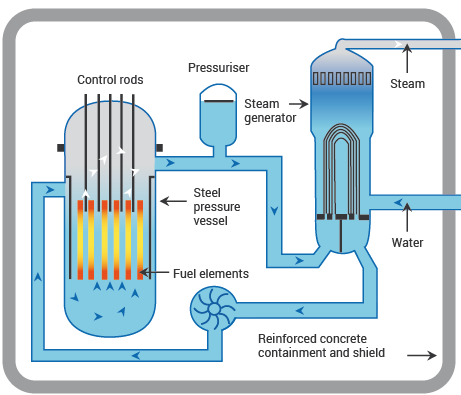 :::
:::
## Nuclear reactors: PWR
:::
:::
## Nuclear reactors: PWR
 ## Nuclear reactors: PWR
 ## Nuclear reactors: BWR
::: {.cols2}
::: {.col2-l}
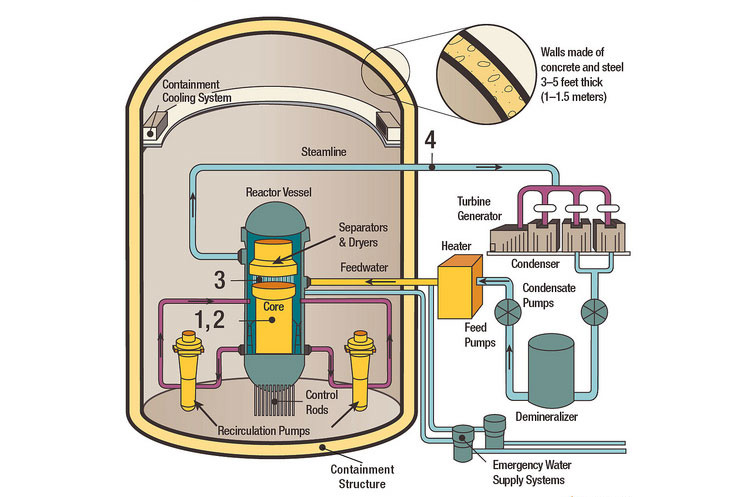
* Boiling water reactor
* Steam is formed directly in the reactor (*direct cycle*)
* No separate heat transfer loop or steam generators needed.
* Latent vs sensible heat $\rightarrow$ less water flow.
* Water becomes radioactive $\rightarrow$ turbine, pumps, pipes, etc. shielded.
* P: 7 MPA (900 psi)
* T: 290 $^oC$
* Larger unit for same energy vs. PWR; (BWR lower energy per volume)
:::
::: {.col2-v}
## Nuclear reactors: BWR
::: {.cols2}
::: {.col2-l}
* Boiling water reactor
* Steam is formed directly in the reactor (*direct cycle*)
* No separate heat transfer loop or steam generators needed.
* Latent vs sensible heat $\rightarrow$ less water flow.
* Water becomes radioactive $\rightarrow$ turbine, pumps, pipes, etc. shielded.
* P: 7 MPA (900 psi)
* T: 290 $^oC$
* Larger unit for same energy vs. PWR; (BWR lower energy per volume)
:::
::: {.col2-v}
 :::
:::
## Nuclear reactors: PHWR/CANDU
::: {.cols2}
::: {.col2-l}
:::
:::
## Nuclear reactors: PHWR/CANDU
::: {.cols2}
::: {.col2-l}
 :::
:::
::: notes
* safety:
* careful alignment is needed. If tubes overheat, they bend, throwing off the alignment.
* add lightwater --> slows reaction as water absorbs neutrons
:::
## Nuclear reactors: PHWR/CANDU
## Nuclear reactors: AGR
::: {.cols2}
::: {.col2-l}
* Advanced Gas Reactor
* CO$_2$ cooled
* non-reactive with fuel or moderator, non-absorbing
* not pressurized
* [Graphite moderated](https://energyeducation.ca/encyclopedia/Neutron_moderator)
* enriched U-235 (2.5-3.5%)
* T: 650 $o^C$.
* Higher efficiencies: 41%
* Indirect steam but heat transfer internal to the reactor vessel.
:::
::: {.col2-v}
:::
:::
::: notes
* safety:
* careful alignment is needed. If tubes overheat, they bend, throwing off the alignment.
* add lightwater --> slows reaction as water absorbs neutrons
:::
## Nuclear reactors: PHWR/CANDU
## Nuclear reactors: AGR
::: {.cols2}
::: {.col2-l}
* Advanced Gas Reactor
* CO$_2$ cooled
* non-reactive with fuel or moderator, non-absorbing
* not pressurized
* [Graphite moderated](https://energyeducation.ca/encyclopedia/Neutron_moderator)
* enriched U-235 (2.5-3.5%)
* T: 650 $o^C$.
* Higher efficiencies: 41%
* Indirect steam but heat transfer internal to the reactor vessel.
:::
::: {.col2-v}
 :::
:::
## Nuclear plant tour
# Economics
* Dominated by capital costs
* Fuel costs are around 15% of the cost of the power
* Compared to 30% and 70% for coal and NG (~2006)
* Time to complete
* Gas-fired: 2 years
* Coal-fired: 2-4 years
* Nuclear: 3-5 or more years
* Each nuclear plant is one-of-a-kind
* Lack of standardization, contributes to long approval process
* Prices of steel and concrete
* Headline: "Steel prices are up 219% since early 2020. What to expect next"
* [fortune.com](https://fortune.com/2021/08/16/steel-prices-2021-covid-commodities-lumber-costs/) August 16, 2021
## Economics
:::
:::
## Nuclear plant tour
# Economics
* Dominated by capital costs
* Fuel costs are around 15% of the cost of the power
* Compared to 30% and 70% for coal and NG (~2006)
* Time to complete
* Gas-fired: 2 years
* Coal-fired: 2-4 years
* Nuclear: 3-5 or more years
* Each nuclear plant is one-of-a-kind
* Lack of standardization, contributes to long approval process
* Prices of steel and concrete
* Headline: "Steel prices are up 219% since early 2020. What to expect next"
* [fortune.com](https://fortune.com/2021/08/16/steel-prices-2021-covid-commodities-lumber-costs/) August 16, 2021
## Economics

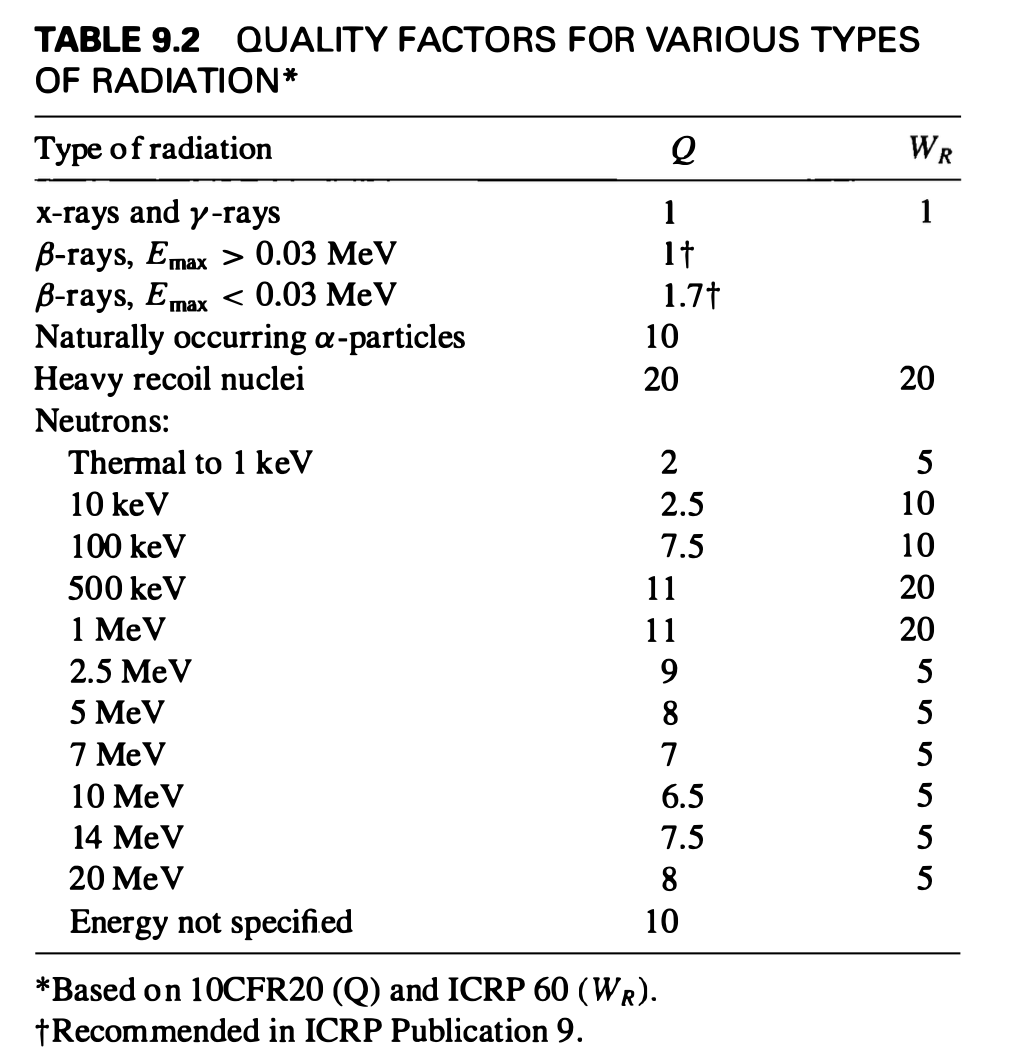 $$Sv = Gy \cdot W_R$
::: notes
Q is quality factor (related to $W_R$)
:::
## Radiation dose
# Nuclear Regulatory Commission
$$Sv = Gy \cdot W_R$
::: notes
Q is quality factor (related to $W_R$)
:::
## Radiation dose
# Nuclear Regulatory Commission