---
title: "ChEn 433 Combustion"
author: David Lignell
date: Class 9-10
lang: en-US
slideNumber: false
width: 1600
height: 1000
transition: fade
css: ../assets/style.css
theme: simple
title-slide-attributes:
data-background-image: "https://d2cbg94ubxgsnp.cloudfront.net/Pictures/2000x1125/3/2/9/130329_gas_flare_shutterstock_548204362_hero.jpg"
data-background-opacity: "1.0"
verticator:
enable: true
menu:
enable: true
chalkboard:
enable: false
---
# Nonpremixed flames
Most common combustion mode
Fuel and oxidizer are separated, mix by molecular diffusion, often aided by turbulence
**Examples?**
## Diesel engine
## Fire
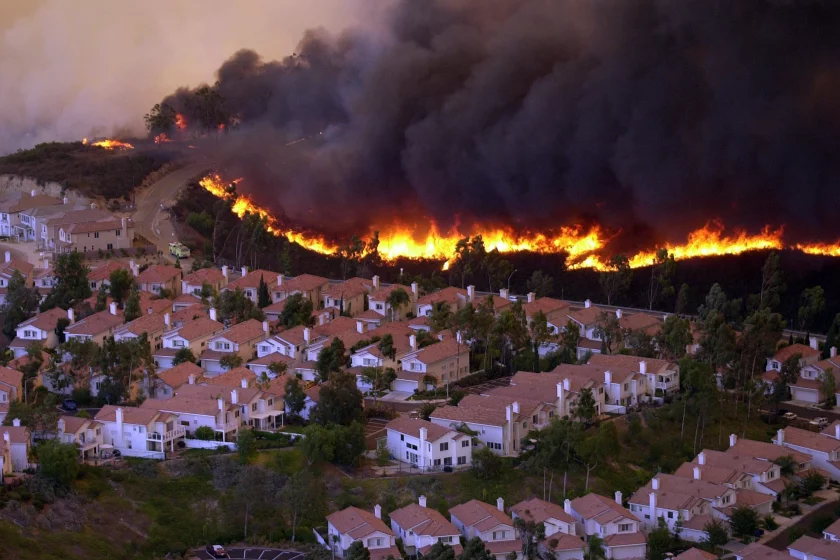
## Flares
## Candle flame
***Demo***
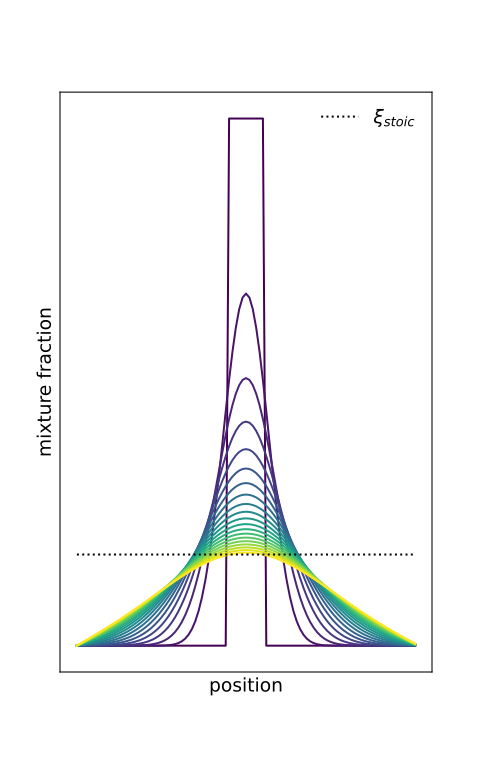
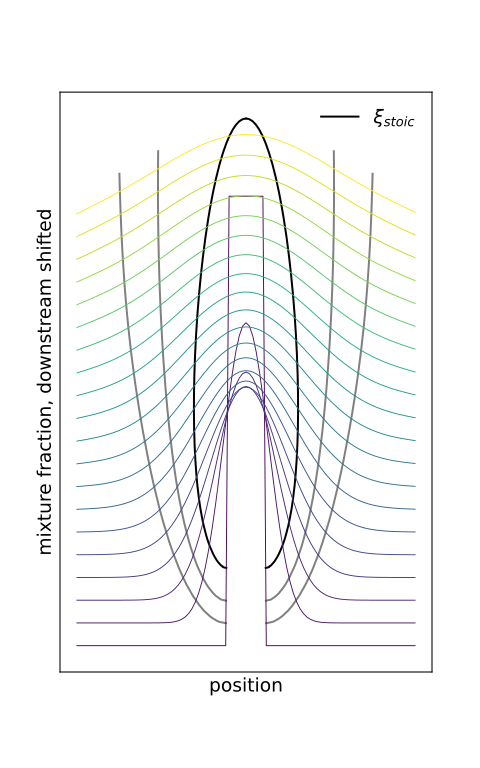
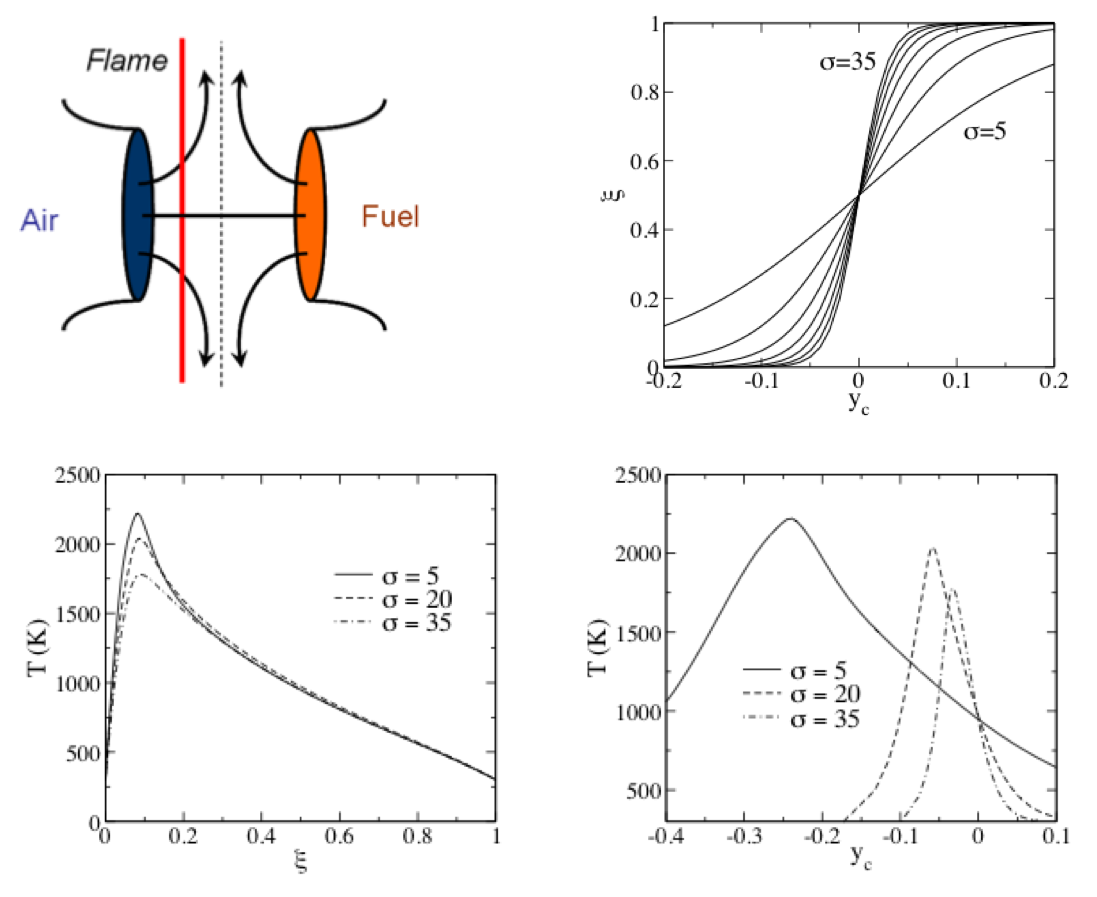
# Diffusion flame structure
## Diffusion flame structure
# Laminar to turbulent
## Turbulent swirled flame
## Turbulence
## Siphonaptera
>Big whorls have little whorls
>that feed on their velocity,
>and little whorls have lesser whorls
>and so on to viscosity.
>---Lewis Richardson
::: fragment
>Big fleas have little fleas upon their backs to bite 'em,
>And little fleas have lesser fleas, and so, ad infinitum.
>And the great fleas, themselves, in turn, have greater fleas to go on;
>While these again have greater still, and greater still, and so on.
>---Augustus De Morgan (mathematician, 1915)
:::
## Eternal principles
>And therefore, he that will harden his heart, the same receiveth the lesser portion of the word; and he that will not harden his heart, to him is given the greater portion of the word, until it is given unto him to know the mysteries of God until he know them in full. ---Alma 12:10
::: fragment
>The works of God continue,
>And worlds and lives abound;
>Improvement and progression
>Have one eternal round.
>There is no end to glory;
>There is no end to love;
>There is no end to being;
>There is no death above.
>—W.W. Phelps, If you could Hie to Kolob
:::
## Turbulence scales
::: {.cols2}
::: {.col2-l}
* Integral scale L
* Kolmogorov scale $\eta$
* Turbulent kinetic energy dissipation rate:
$$\epsilon = u^2/\tau = u^3/L$$
* At high Re, small scales depend on $\epsilon$ and $\nu$
$$\eta = (\nu^3/\epsilon)^{1/4},\,\,\,\tau_\eta=(\nu/\epsilon)^{1/2}$$
Then, with $Re = uL/\nu$, we can obtain
$$L/\eta = Re^{3/4},\,\,\,\tau/\tau_\eta = Re^{1/2}$$
:::
::: {.col2-v}
:::
:::
# Flame length
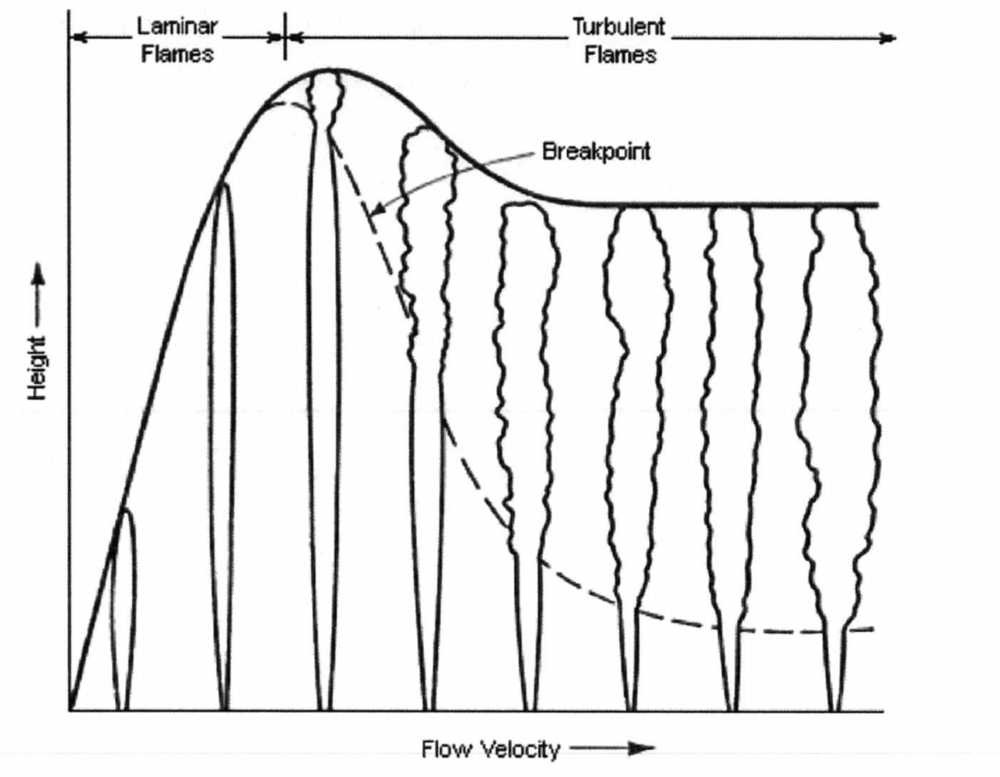
## Flame length
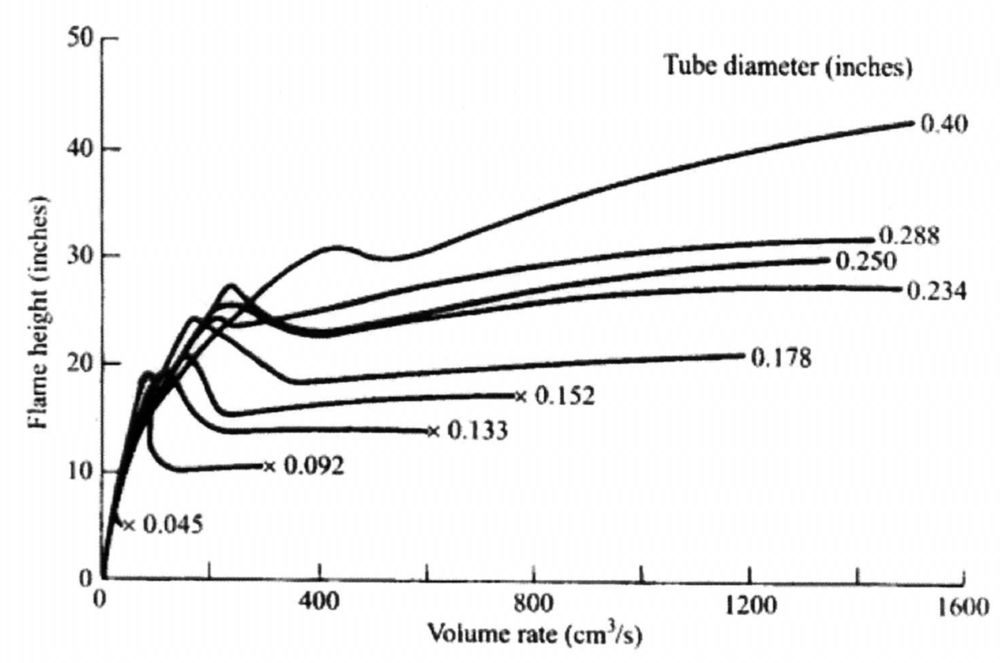
## Flame length correlations
::: columns
::: column
:::
::: column
::: {.math}
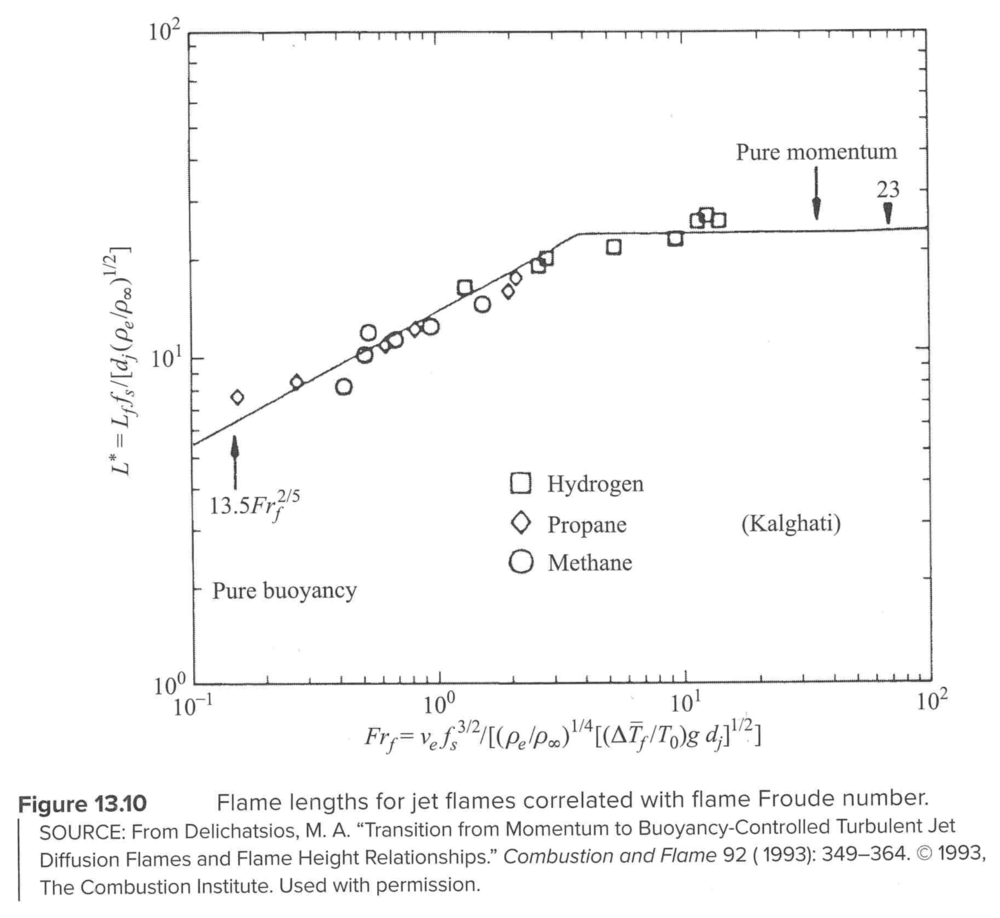
* $v_e$=jet exit velocity
* $f_s$=stoichiometric mixture fraction
* $d_j$=jet exit diameter
* $\rho_e$, $\rho_\infty$ = density at the jet exit, and in the surroundings
* $T_0$ is really $T_\infty$, is the surrounding temperature
* $\Delta T_f = T_f-T_\infty$
Note the collapse of several fuels
:::
:::
:::
# Soot
## Soot
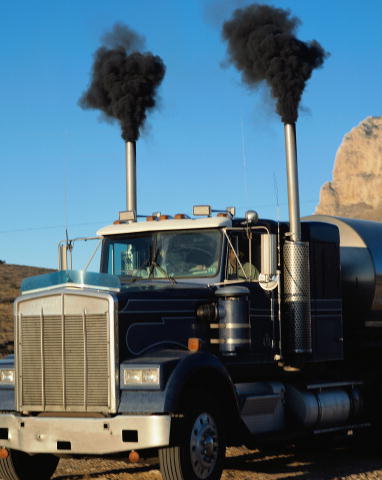
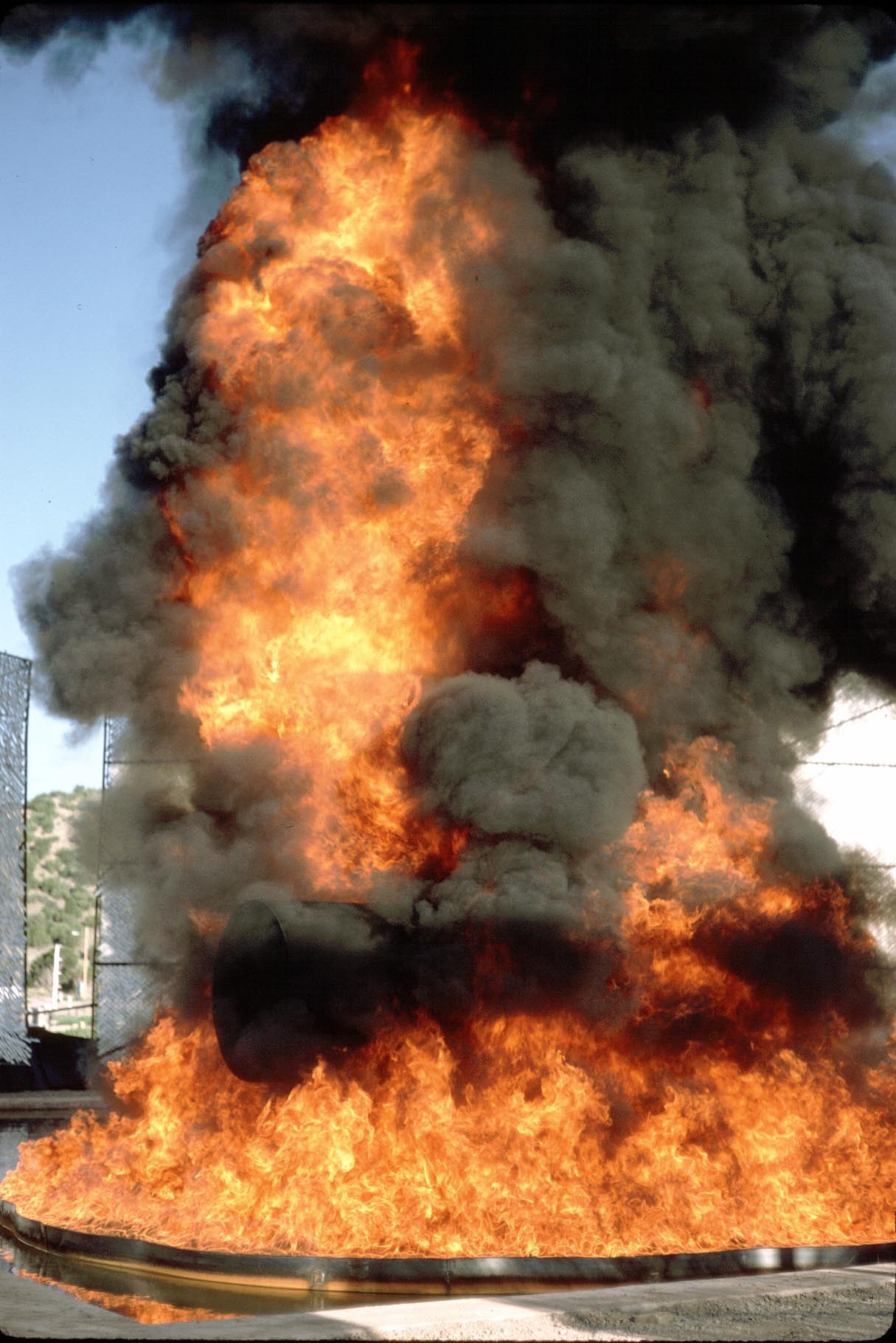
* Soot forms in nonpremixed and rich premixed flames, but is most
important in nonpremixed flames.
* Soot is a small carbonacious particulate species
* Soot forms on the rich side of nonpremixed flames as gaseous fuels
are pyrolysed.
* Soot particles consist of agglomerates of nominally round primary
particles.
* Primary particle sizes are around 50 nm.
* Soot volume fractions are around 1-2 ppmv (up to 10-20).
* Soot forms at temperatures between 1300 and 1600 K.
* Formation mechanisms are highly complex and an important area of
current research.
* Concentrations increase with pressure (engines)
## Soot formation
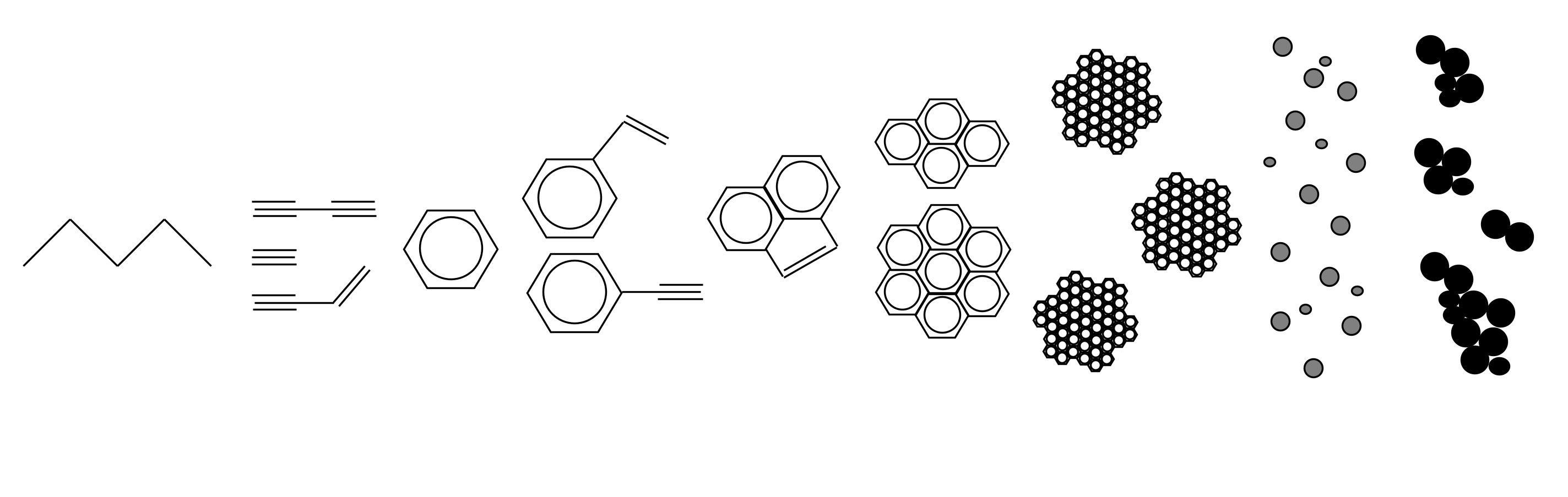
* Soot forms as a progression:
* Small molecules $\rightarrow$ ring structures
* These rings grow by acetelyne addition to form sheets
* These sheets bend and collide to form primary particles
* Primary particles agglomorate
* Particle oxidation may or may not occur
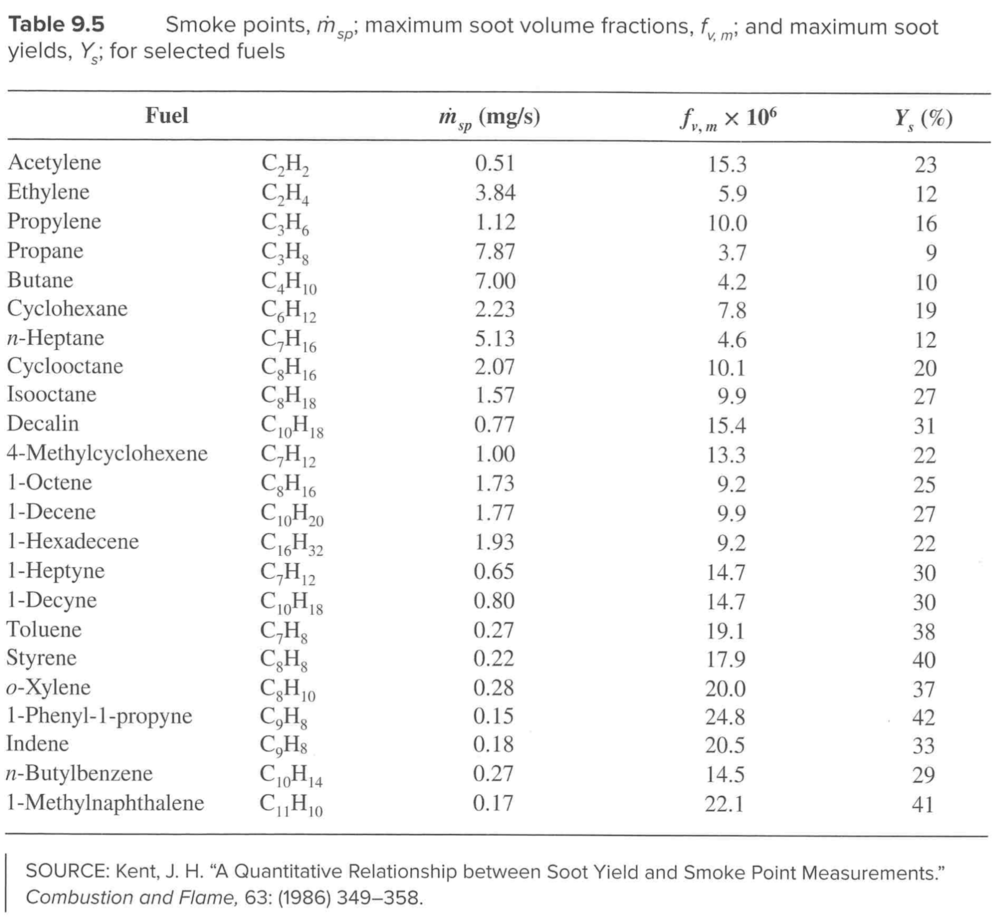
## Smoke point
## Soot modeling
::: {.cols2}
::: {.col2-l}
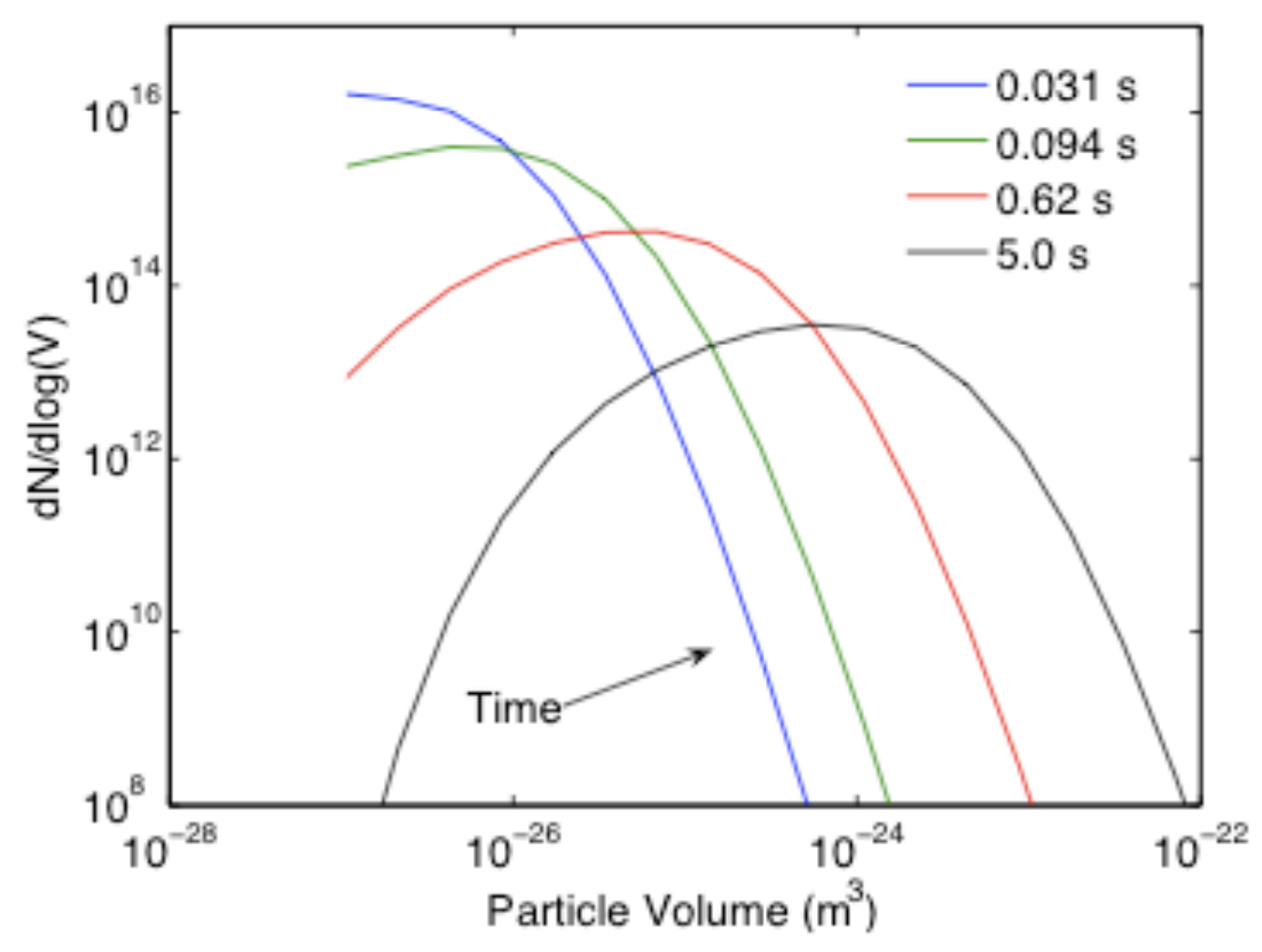
* Particle size distribution
* Direct or MC
* Sectional
* Method of Moments: $M_0=N_s$, $M_1=\rho Y_s$
* Chemistry
* Empirical
* Semi-empirical (nucleation, growth, oxidation, coagulation)
* Detailed (HACA)
* Transport
* Thermophoresis: $j_s = 0.556\nu M_r\nabla T/T$
:::
::: {.col2-v}
:::
:::
::: {.math}
[A.J. Josephson, R.R. Linn, D.O. Lignell, “Modeling soot formation from solid complex fuels,” Combustion and Flame, 196:265-283 (2018)](https://www.sciencedirect.com/science/article/pii/S0010218018302633)
:::
 ## Flares
 ## Candle flame
:max_bytes(150000):strip_icc():format(webp)/178789772-56a131315f9b58b7d0bceb7e.jpg "https://www.thoughtco.com/thmb/VypaFy1JUmNYHATwbi5NRLokaxU=/768x0/filters:no_upscale():max_bytes(150000):strip_icc():format(webp)/178789772-56a131315f9b58b7d0bceb7e.jpg") ***Demo***
# Diffusion flame structure
***Demo***
# Diffusion flame structure
 ## Diffusion flame structure
 # Laminar to turbulent
## Turbulent swirled flame
## Turbulence
# Laminar to turbulent
## Turbulent swirled flame
## Turbulence
 ## Siphonaptera
>Big whorls have little whorls
## Siphonaptera
>Big whorls have little whorls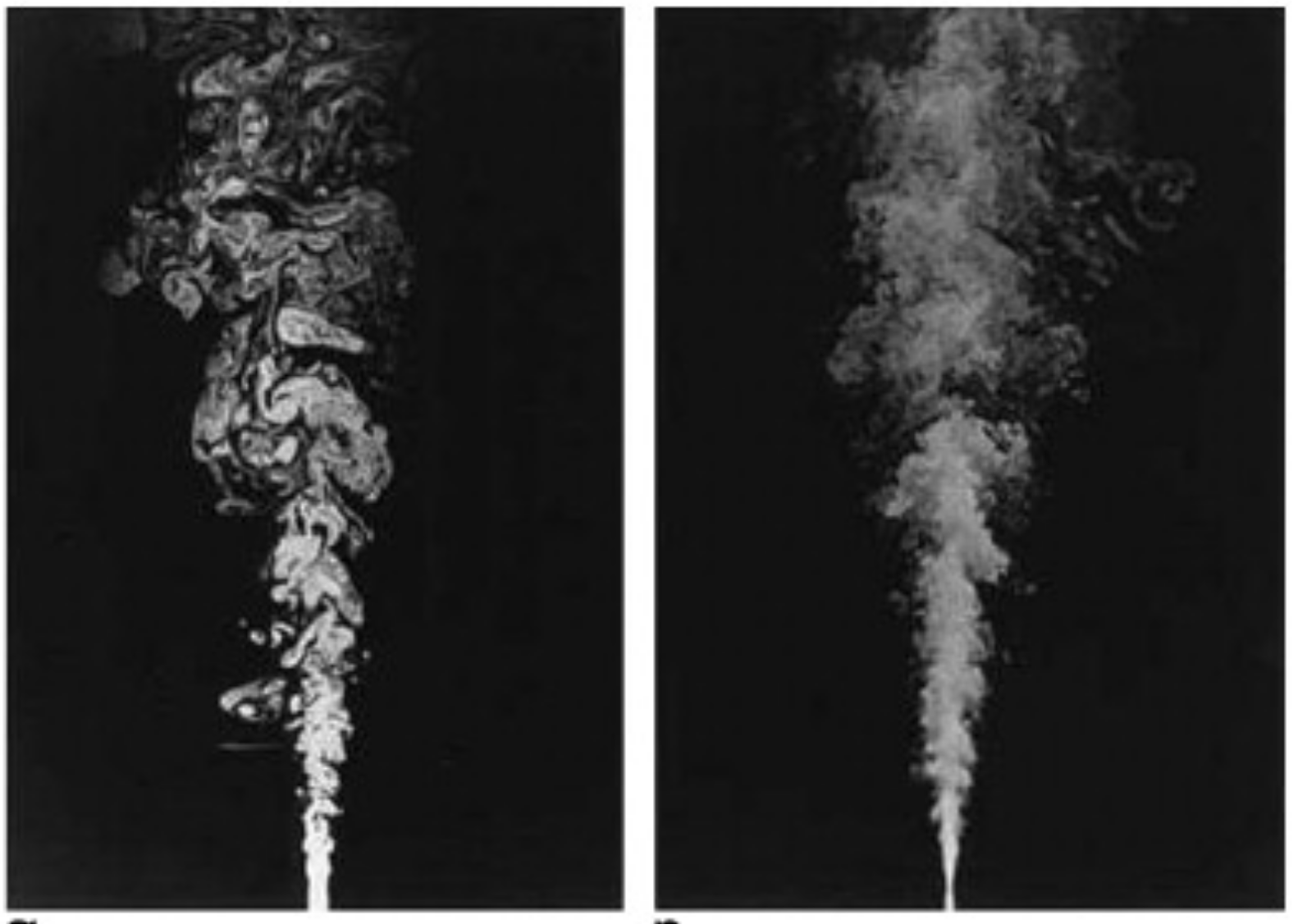 :::
:::
# Flame length
:::
:::
# Flame length
 ## Flame length
 ## Flame length correlations
::: columns
::: column
## Flame length correlations
::: columns
::: column
 :::
::: column
::: {.math}
* $v_e$=jet exit velocity
* $f_s$=stoichiometric mixture fraction
* $d_j$=jet exit diameter
* $\rho_e$, $\rho_\infty$ = density at the jet exit, and in the surroundings
* $T_0$ is really $T_\infty$, is the surrounding temperature
* $\Delta T_f = T_f-T_\infty$
Note the collapse of several fuels
:::
:::
:::
# Soot
:::
::: column
::: {.math}
* $v_e$=jet exit velocity
* $f_s$=stoichiometric mixture fraction
* $d_j$=jet exit diameter
* $\rho_e$, $\rho_\infty$ = density at the jet exit, and in the surroundings
* $T_0$ is really $T_\infty$, is the surrounding temperature
* $\Delta T_f = T_f-T_\infty$
Note the collapse of several fuels
:::
:::
:::
# Soot
 ## Soot
* Soot forms in nonpremixed and rich premixed flames, but is most
important in nonpremixed flames.
* Soot is a small carbonacious particulate species
* Soot forms on the rich side of nonpremixed flames as gaseous fuels
are pyrolysed.
* Soot particles consist of agglomerates of nominally round primary
particles.
* Primary particle sizes are around 50 nm.
* Soot volume fractions are around 1-2 ppmv (up to 10-20).
* Soot forms at temperatures between 1300 and 1600 K.
* Formation mechanisms are highly complex and an important area of
current research.
* Concentrations increase with pressure (engines)
## Soot formation
## Soot
* Soot forms in nonpremixed and rich premixed flames, but is most
important in nonpremixed flames.
* Soot is a small carbonacious particulate species
* Soot forms on the rich side of nonpremixed flames as gaseous fuels
are pyrolysed.
* Soot particles consist of agglomerates of nominally round primary
particles.
* Primary particle sizes are around 50 nm.
* Soot volume fractions are around 1-2 ppmv (up to 10-20).
* Soot forms at temperatures between 1300 and 1600 K.
* Formation mechanisms are highly complex and an important area of
current research.
* Concentrations increase with pressure (engines)
## Soot formation
 * Soot forms as a progression:
* Small molecules $\rightarrow$ ring structures
* These rings grow by acetelyne addition to form sheets
* These sheets bend and collide to form primary particles
* Primary particles agglomorate
* Particle oxidation may or may not occur
## Smoke point
* Soot forms as a progression:
* Small molecules $\rightarrow$ ring structures
* These rings grow by acetelyne addition to form sheets
* These sheets bend and collide to form primary particles
* Primary particles agglomorate
* Particle oxidation may or may not occur
## Smoke point
 ## Soot modeling
::: {.cols2}
::: {.col2-l}
* Particle size distribution
* Direct or MC
* Sectional
* Method of Moments: $M_0=N_s$, $M_1=\rho Y_s$
* Chemistry
* Empirical
* Semi-empirical (nucleation, growth, oxidation, coagulation)
* Detailed (HACA)
* Transport
* Thermophoresis: $j_s = 0.556\nu M_r\nabla T/T$
:::
::: {.col2-v}
## Soot modeling
::: {.cols2}
::: {.col2-l}
* Particle size distribution
* Direct or MC
* Sectional
* Method of Moments: $M_0=N_s$, $M_1=\rho Y_s$
* Chemistry
* Empirical
* Semi-empirical (nucleation, growth, oxidation, coagulation)
* Detailed (HACA)
* Transport
* Thermophoresis: $j_s = 0.556\nu M_r\nabla T/T$
:::
::: {.col2-v}
 :::
:::
::: {.math}
[A.J. Josephson, R.R. Linn, D.O. Lignell, “Modeling soot formation from solid complex fuels,” Combustion and Flame, 196:265-283 (2018)](https://www.sciencedirect.com/science/article/pii/S0010218018302633)
:::
:::
:::
::: {.math}
[A.J. Josephson, R.R. Linn, D.O. Lignell, “Modeling soot formation from solid complex fuels,” Combustion and Flame, 196:265-283 (2018)](https://www.sciencedirect.com/science/article/pii/S0010218018302633)
:::