---
title: "ChEn 433 Combustion"
author: David Lignell
date: Class 8
lang: en-US
slideNumber: false
width: 1600
height: 1000
transition: fade
css: ../assets/style.css
theme: simple
title-slide-attributes:
data-background-image: "https://d2cbg94ubxgsnp.cloudfront.net/Pictures/2000x1125/3/2/9/130329_gas_flare_shutterstock_548204362_hero.jpg"
data-background-opacity: "1.0"
verticator:
enable: true
menu:
enable: true
chalkboard:
enable: false
---
# Combustion
*[Inferno - Bullet Time Camera Array from Orbital EXP](https://vimeo.com/orbitalexp)*
## What is combustion?
* What is combustion?
* How can we define it?
* What are its properties and
characteristics?
* How do we know something is combustion
and when it is not?
## Definitions from the web
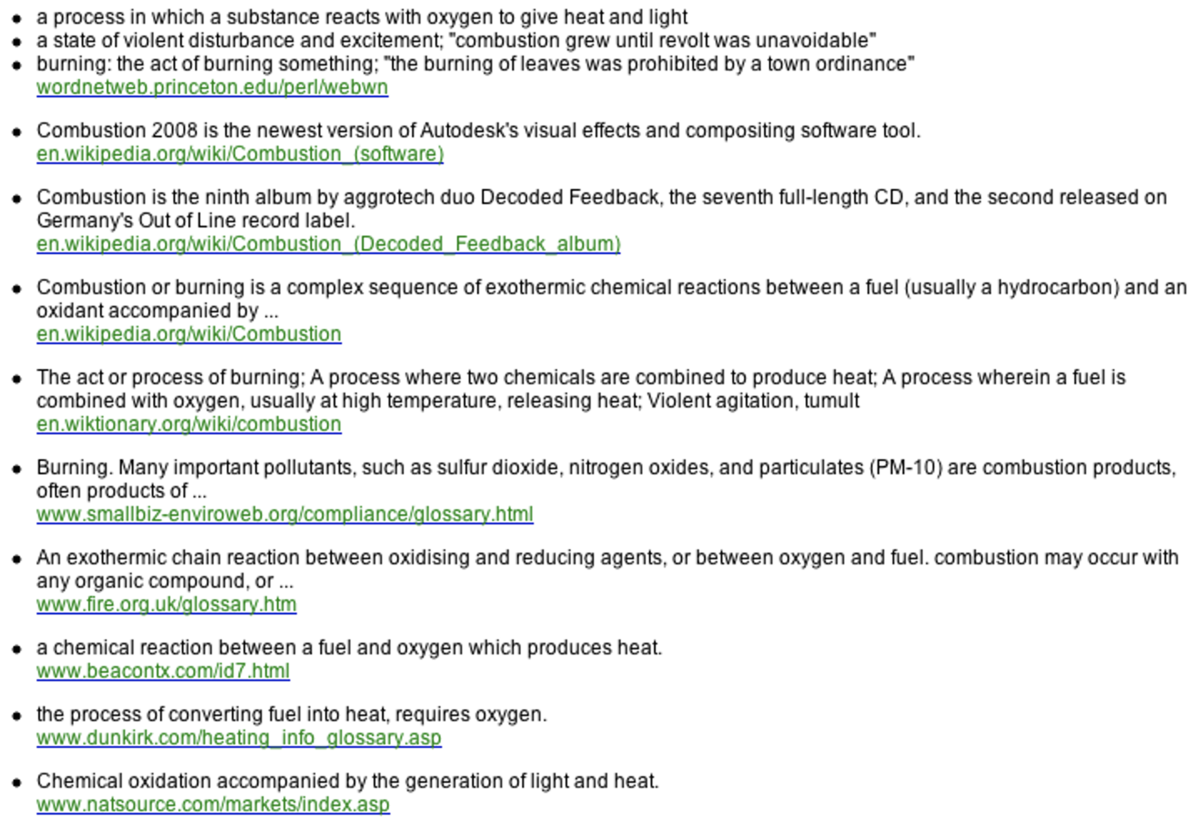 ## Webster's
Rapid oxidation generating heat, or both light and heat; also, slow oxidation accompanied by relatively little heat and no light
::: fragment
## Webster's
Rapid oxidation generating heat, or both light and heat; also, slow oxidation accompanied by relatively little heat and no light
::: fragment
 :::
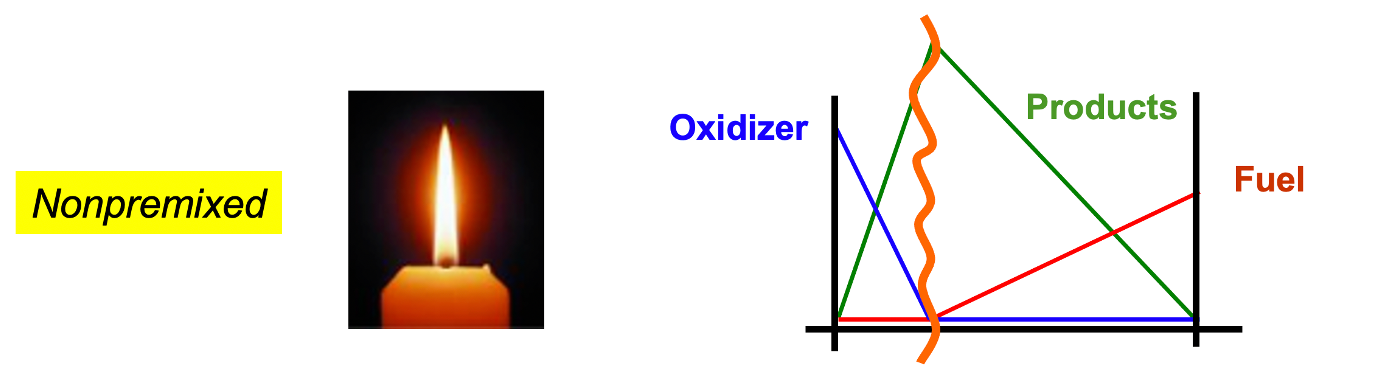
# Premixed and nonpremixed
:::
# Premixed and nonpremixed
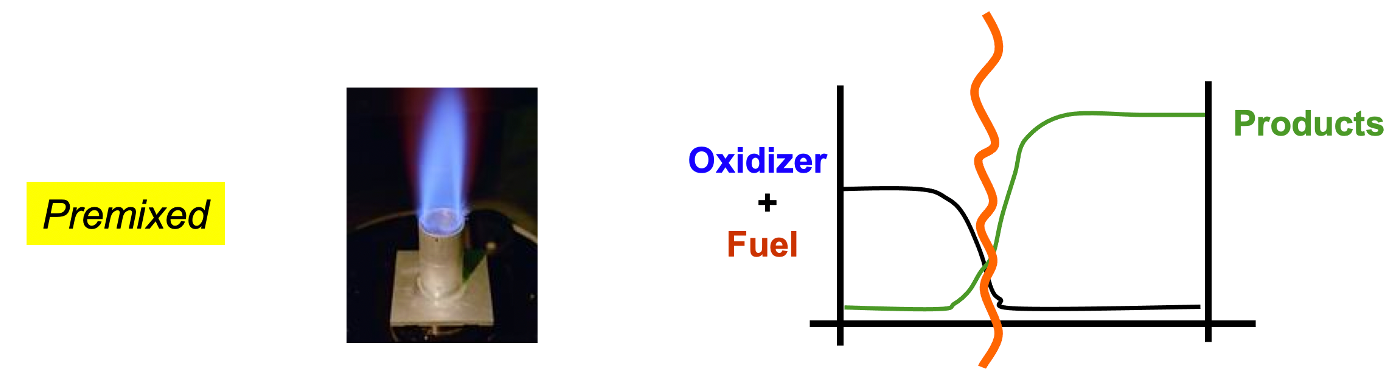 ## Premixed and nonpremixed
 # Air properties
::: {.cols2}
::: {.col2-v}
Use $x$ for mole fraction, $y$ for mass fraction.
Lump Ar with N$_2$
**n$_{N2}$/n$_{O2}$ = 3.76**
**n$_{air}$/n$_{O2}$ = 4.76**
:::
::: {.col2-v}
| species| x | y |
|---------|:---------:|:--------:|
| N$_2$ | 0.7809 | 0.75532 |
| O$_2$ | 0.2095 | 0.23144 |
| Ar | 0.0096 | 0.01324 |
| species | x | y |
|---------|:---------:|:--------:|
| **N$_2$** | **0.79** | **0.77** |
| **O$_2$** | **0.21** | **0.23** |
:::
:::
## MW, x-y conversions
::: {.cols2}
::: {.col2-v}
**M$_{air}$ = 29 kg/kmol**
$$ M = \sum_k x_k M_k,$$
$$ M = \frac{1}{\sum_k \frac{y_k}{M_k}}.$$
:::
::: {.col2-v}
**Convert $x_k$ to $y_k$**
$$ x_kM_k = y_kM,$$
$$ y_k = \frac{x_kM_k}{M},$$
$$ x_k = \frac{y_kM}{M_k}.$$
:::
:::
# Stoichiometry
* Rich (too much fuel)
* Lean (too much air)
* Stoichiometric (Goldilocks)
**Air-to-Fuel Ratio**
$$\frac{A}{F} = \frac{m_{air}}{m_{fuel}}$$
$$0\le A/F\le\infty$$
## Equivalence Ratio
$$\phi = \frac{F/A}{(F/A)_{stoic}}$$
mass or mole basis is same
$$0\le\phi\le\infty$$
$\phi<0$ is lean
$\phi > 1$ is rich
common in applications
## Mixture fraction
$$\xi = \frac{m_f}{m_f + m_a}$$
$$0\le\xi\le 1$$
Like a mass fraction
$\xi=0$ is pure air
$\xi=1$ is pure fuel
common in modeling
# Balanced reactions
Write the stoichiometric reaction for methane combustion
::: incremental
* 1 mole fuel basis (typical)
* products: $C\rightarrow CO_2$, $H\rightarrow H_2O$
* Solve for species coefficients by balancing elements
:::
::: {.fragment .byublue}
$$CH_4 + 2(O_2 + 3.76N_2) \rightarrow CO_2 + 2H_2O + 7.52N_2$$
:::
::: {.fragment}
**What is $m_f/m_a$?**
:::
::: {.fragment}
$$m_f/m_a = M_{CH4} / (2*4.76*M_{air}) = 16/(9.52*29) = 0.058$$
5.8% of mass is fuel.
:::
## Generalize the fuel
Try out $C_xH_y$
::: {.fragment .byublue}
$$C_xH_y + \left(x + \frac{y}{4}\right)O_2 + 3.76\left(x+\frac{y}{4}\right)N_2 \rightarrow xCO_2 + \frac{y}{2}H_2O + 3.76\left(x+\frac{y}{4}\right)N_2$$
:::
## Rich and Lean
$$C_xH_y + \left(x + \frac{y}{4}\right) + 3.76\left(x+\frac{y}{4}\right)N_2 \rightarrow xCO_2 + \frac{y}{2}H_2O + 3.76\left(x+\frac{y}{4}\right)N_2$$
::: {.red}
**Rich**
Write the rich reaction in terms of $\phi$
::: fragment
$$\phi C_xH_y + \left(x+\frac{y}{4}\right)O_2 + 3.76\left(x+\frac{y}{4}\right)N_2 \rightarrow xCO_2 + \frac{y}{2}H_2O + 3.76\left(x+\frac{y}{4}\right)N_2 + (\phi-1)C_xH_y$$
:::
:::
::: {.fragment .byublue .math90}
**Lean**
Write the lean reaction in terms of the fractional excess air $E$
:::
::: {.fragment .byublue .math90}
$$C_xH_y + (1+E)\left(x+\frac{y}{4}\right)(O_2 + 3.76 N_2) \rightarrow xCO_2 + \frac{y}{2}H_2O + E\left(x+\frac{y}{4}\right)O_2 + (1+E)3.76\left(x+\frac{y}{4}\right)N_2$$
:::
# Flame temperatures
What is the temperature of a flame?
# Air properties
::: {.cols2}
::: {.col2-v}
Use $x$ for mole fraction, $y$ for mass fraction.
Lump Ar with N$_2$
**n$_{N2}$/n$_{O2}$ = 3.76**
**n$_{air}$/n$_{O2}$ = 4.76**
:::
::: {.col2-v}
| species| x | y |
|---------|:---------:|:--------:|
| N$_2$ | 0.7809 | 0.75532 |
| O$_2$ | 0.2095 | 0.23144 |
| Ar | 0.0096 | 0.01324 |
| species | x | y |
|---------|:---------:|:--------:|
| **N$_2$** | **0.79** | **0.77** |
| **O$_2$** | **0.21** | **0.23** |
:::
:::
## MW, x-y conversions
::: {.cols2}
::: {.col2-v}
**M$_{air}$ = 29 kg/kmol**
$$ M = \sum_k x_k M_k,$$
$$ M = \frac{1}{\sum_k \frac{y_k}{M_k}}.$$
:::
::: {.col2-v}
**Convert $x_k$ to $y_k$**
$$ x_kM_k = y_kM,$$
$$ y_k = \frac{x_kM_k}{M},$$
$$ x_k = \frac{y_kM}{M_k}.$$
:::
:::
# Stoichiometry
* Rich (too much fuel)
* Lean (too much air)
* Stoichiometric (Goldilocks)
**Air-to-Fuel Ratio**
$$\frac{A}{F} = \frac{m_{air}}{m_{fuel}}$$
$$0\le A/F\le\infty$$
## Equivalence Ratio
$$\phi = \frac{F/A}{(F/A)_{stoic}}$$
mass or mole basis is same
$$0\le\phi\le\infty$$
$\phi<0$ is lean
$\phi > 1$ is rich
common in applications
## Mixture fraction
$$\xi = \frac{m_f}{m_f + m_a}$$
$$0\le\xi\le 1$$
Like a mass fraction
$\xi=0$ is pure air
$\xi=1$ is pure fuel
common in modeling
# Balanced reactions
Write the stoichiometric reaction for methane combustion
::: incremental
* 1 mole fuel basis (typical)
* products: $C\rightarrow CO_2$, $H\rightarrow H_2O$
* Solve for species coefficients by balancing elements
:::
::: {.fragment .byublue}
$$CH_4 + 2(O_2 + 3.76N_2) \rightarrow CO_2 + 2H_2O + 7.52N_2$$
:::
::: {.fragment}
**What is $m_f/m_a$?**
:::
::: {.fragment}
$$m_f/m_a = M_{CH4} / (2*4.76*M_{air}) = 16/(9.52*29) = 0.058$$
5.8% of mass is fuel.
:::
## Generalize the fuel
Try out $C_xH_y$
::: {.fragment .byublue}
$$C_xH_y + \left(x + \frac{y}{4}\right)O_2 + 3.76\left(x+\frac{y}{4}\right)N_2 \rightarrow xCO_2 + \frac{y}{2}H_2O + 3.76\left(x+\frac{y}{4}\right)N_2$$
:::
## Rich and Lean
$$C_xH_y + \left(x + \frac{y}{4}\right) + 3.76\left(x+\frac{y}{4}\right)N_2 \rightarrow xCO_2 + \frac{y}{2}H_2O + 3.76\left(x+\frac{y}{4}\right)N_2$$
::: {.red}
**Rich**
Write the rich reaction in terms of $\phi$
::: fragment
$$\phi C_xH_y + \left(x+\frac{y}{4}\right)O_2 + 3.76\left(x+\frac{y}{4}\right)N_2 \rightarrow xCO_2 + \frac{y}{2}H_2O + 3.76\left(x+\frac{y}{4}\right)N_2 + (\phi-1)C_xH_y$$
:::
:::
::: {.fragment .byublue .math90}
**Lean**
Write the lean reaction in terms of the fractional excess air $E$
:::
::: {.fragment .byublue .math90}
$$C_xH_y + (1+E)\left(x+\frac{y}{4}\right)(O_2 + 3.76 N_2) \rightarrow xCO_2 + \frac{y}{2}H_2O + E\left(x+\frac{y}{4}\right)O_2 + (1+E)3.76\left(x+\frac{y}{4}\right)N_2$$
:::
# Flame temperatures
What is the temperature of a flame?
 ## Flame temperatures
* heat loss
* flame strain
* fuel/oxidizer composition
* local stoichiomtry
* ...
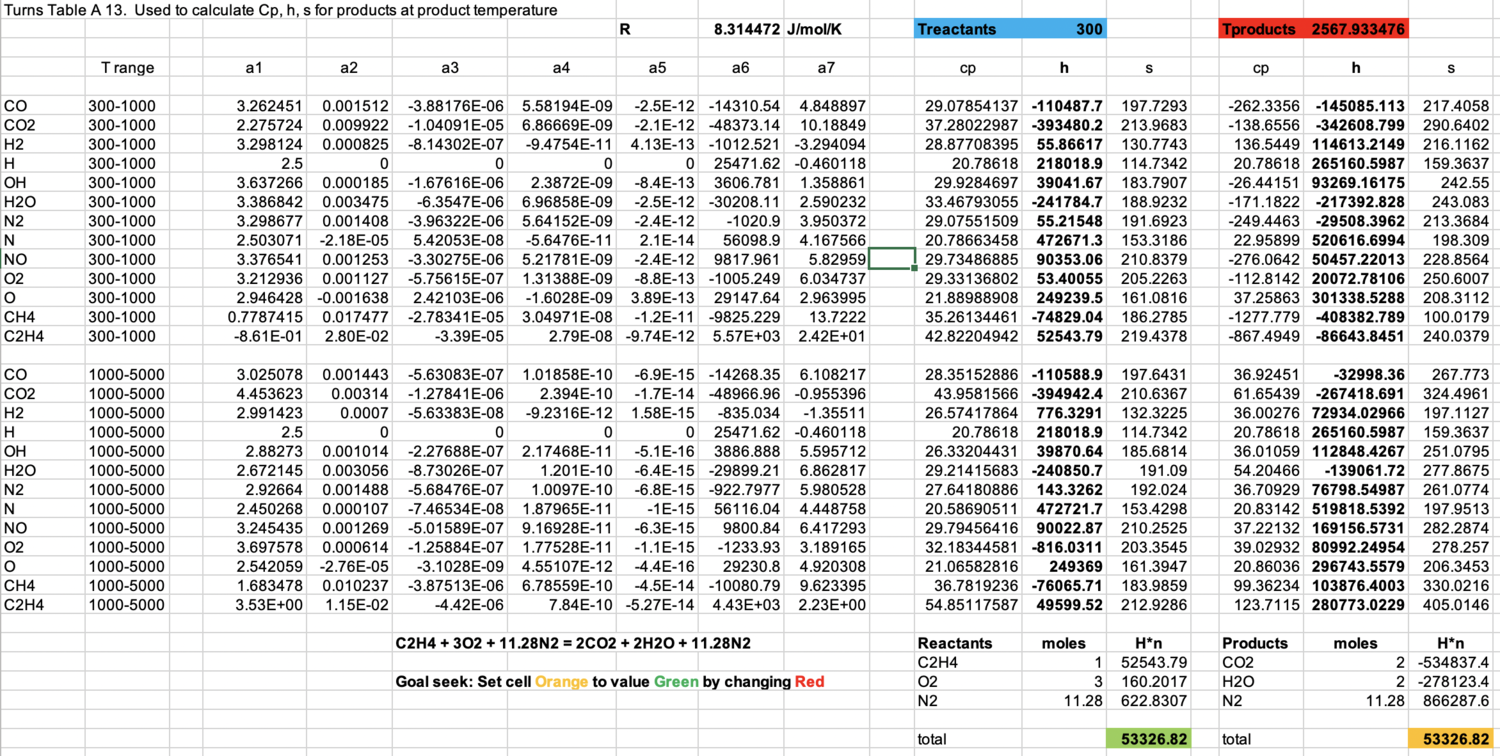
## Adiabatic flame temperature
* No heat losses
* Typically computed as a thermodynamic property, independent of flow physics
Formulate a relation to allow calculation of $T_{ad}$
::: fragment
Adiabatic $\rightarrow$ $h_\text{reactants} = h_\text{products}$
:::
::: fragment
$$h = h(T, y_i)$$
$$h = \underbrace{h_f(T_\text{ref}, y_i)}_{\sum_iy_ih_{f,i}(T_\text{ref})} + \int_{T_\text{ref}}^T\underbrace{c_p(T,y_i)}_{\sum_iy_ic_{p,i}(T)}dT$$
:::
::: fragment
Then, $h_\text{reactants} = h_\text{products}$ is one equation in one unknown $T_\text{products}\equiv T_{ad}$
:::
::: {.fragment .gray}
$c_{p,i}(T)$ is typically given as a polynomial in $T$, in two temperature ranges
:::
## Flame temperatures
## Flame temperatures
* heat loss
* flame strain
* fuel/oxidizer composition
* local stoichiomtry
* ...
## Adiabatic flame temperature
* No heat losses
* Typically computed as a thermodynamic property, independent of flow physics
Formulate a relation to allow calculation of $T_{ad}$
::: fragment
Adiabatic $\rightarrow$ $h_\text{reactants} = h_\text{products}$
:::
::: fragment
$$h = h(T, y_i)$$
$$h = \underbrace{h_f(T_\text{ref}, y_i)}_{\sum_iy_ih_{f,i}(T_\text{ref})} + \int_{T_\text{ref}}^T\underbrace{c_p(T,y_i)}_{\sum_iy_ic_{p,i}(T)}dT$$
:::
::: fragment
Then, $h_\text{reactants} = h_\text{products}$ is one equation in one unknown $T_\text{products}\equiv T_{ad}$
:::
::: {.fragment .gray}
$c_{p,i}(T)$ is typically given as a polynomial in $T$, in two temperature ranges
:::
## Flame temperatures
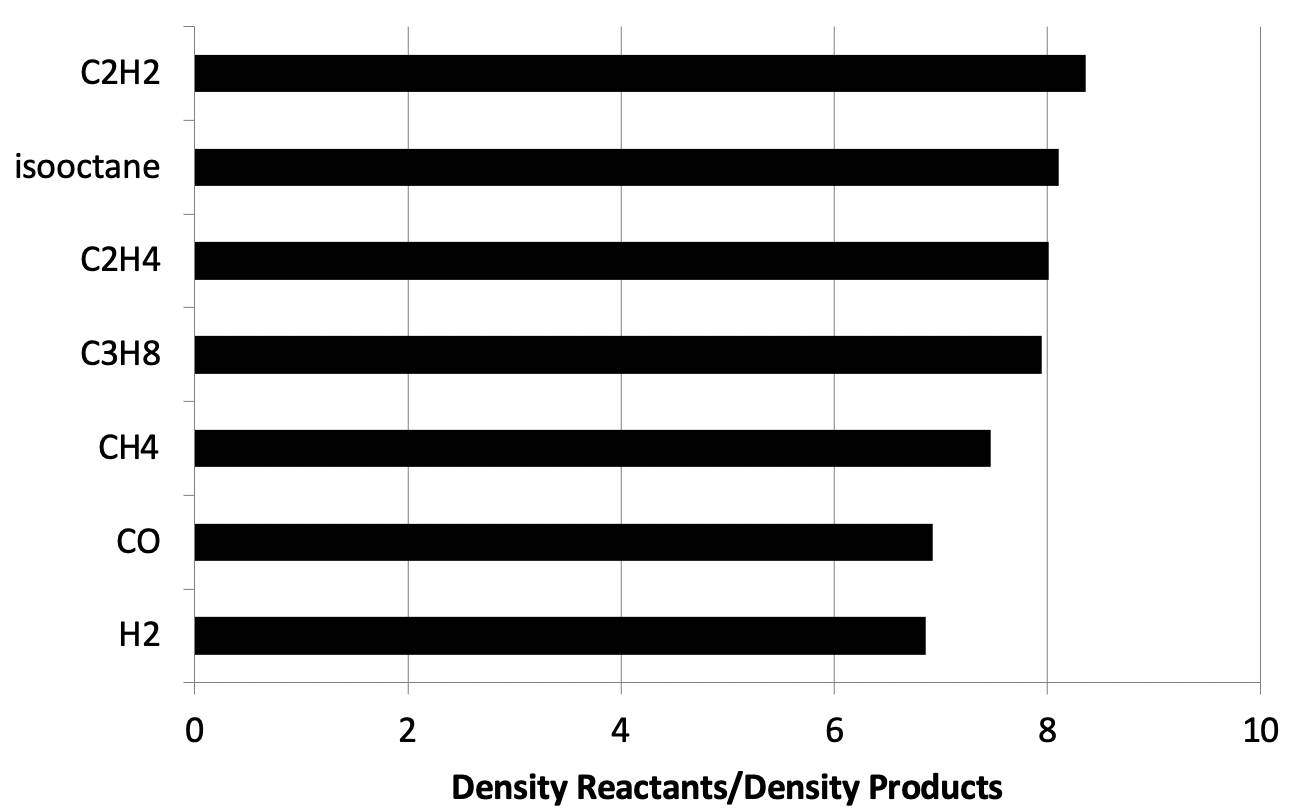
 ## Flame expansion