 :::
:::
## Rankine cycle
::: {.cols2}
::: {.col2-l}
* 1-2: $W_{in}$, pump liquid from low P to high P; isentropic compression
* 2-3: $Q_{in}$, heat at constant pressure: boiling
* 3-4: $W_{out}$, expand fluid through turbine; isentropic expansion
* 4-1: $Q_{out}$, cool in condenser; vapor to liquid
:::
::: {.col2-v}
:::
:::
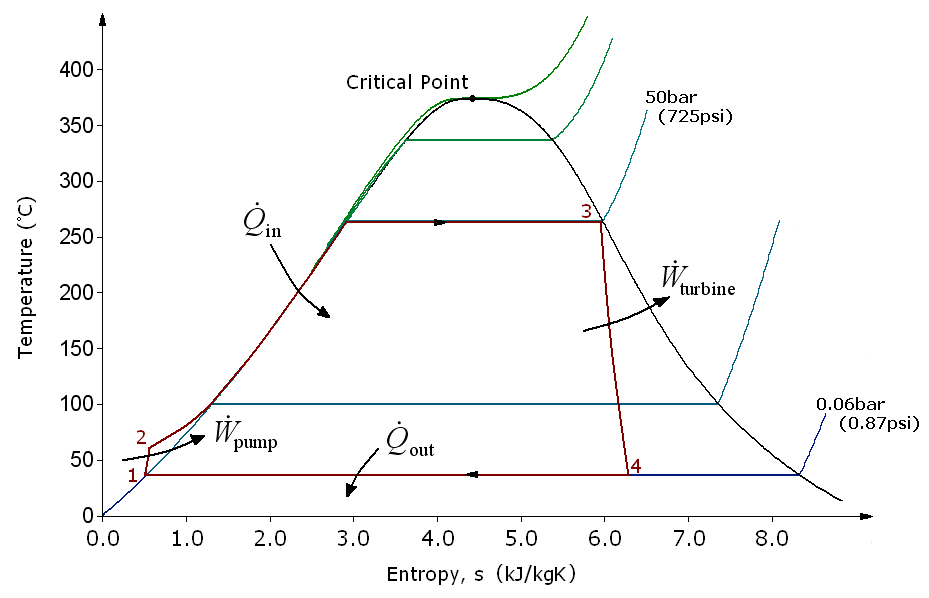
## Rankine cycle
::: {.cols2}
::: {.col2-l}
* 1-2: $W_{in}$, pump liquid from low P to high P; isentropic compression
* 2-3: $Q_{in}$, heat at constant pressure: boiling
* 3-4: $W_{out}$, expand fluid through turbine; isentropic expansion
* 4-1: $Q_{out}$, cool in condenser; vapor to liquid
:::
::: {.col2-v}
 :::
:::
## Rankine cycle: issues
::: fragment
***Issues?***
:::
::: incremental
* Peak temperature $→$ efficiency $→$ superheat
* Turbine steam quality > 90%
* Pumping a liquid vs vapor vs mixture.
* [Fluid choice](https://en.wikipedia.org/wiki/Working_fluid_selection)
* Temperature range. [Organic Rankine cycle (wiki)](https://en.wikipedia.org/wiki/Organic_Rankine_cycle)
* [Organic Rankine Cycle article](https://www.sciencedirect.com/science/article/pii/B978008100510100017X)
:::
::: notes
* Cengel thermo book 3rd edition, page 556;
* Compare in context of Carnot: box below the dome, box above the dome.
:::
## Rankine cycle: TS
:::
:::
## Rankine cycle: issues
::: fragment
***Issues?***
:::
::: incremental
* Peak temperature $→$ efficiency $→$ superheat
* Turbine steam quality > 90%
* Pumping a liquid vs vapor vs mixture.
* [Fluid choice](https://en.wikipedia.org/wiki/Working_fluid_selection)
* Temperature range. [Organic Rankine cycle (wiki)](https://en.wikipedia.org/wiki/Organic_Rankine_cycle)
* [Organic Rankine Cycle article](https://www.sciencedirect.com/science/article/pii/B978008100510100017X)
:::
::: notes
* Cengel thermo book 3rd edition, page 556;
* Compare in context of Carnot: box below the dome, box above the dome.
:::
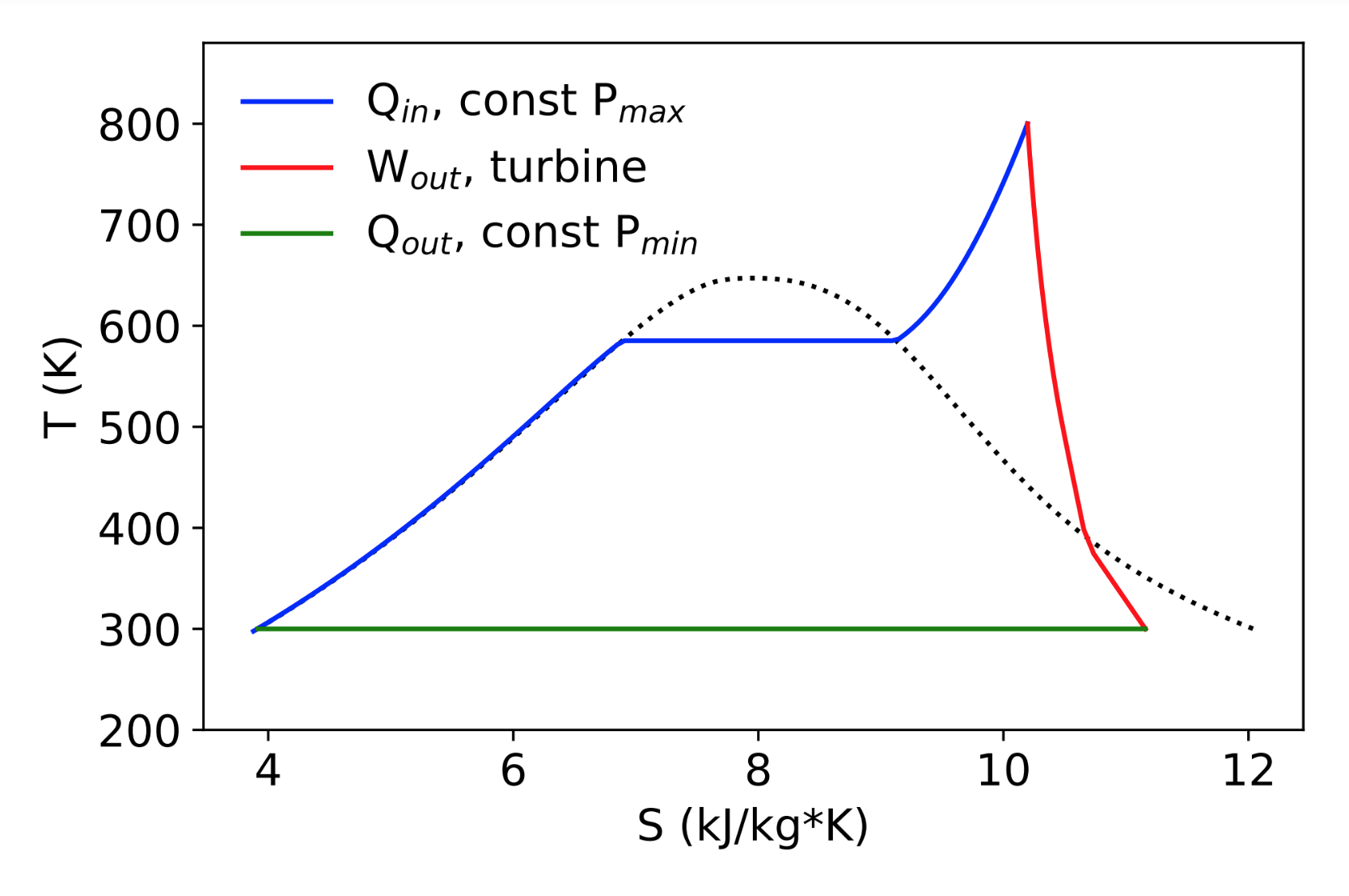
## Rankine cycle: TS
 ## Rankine cycle: PV
***What does the PV diagram look like?***
::: fragment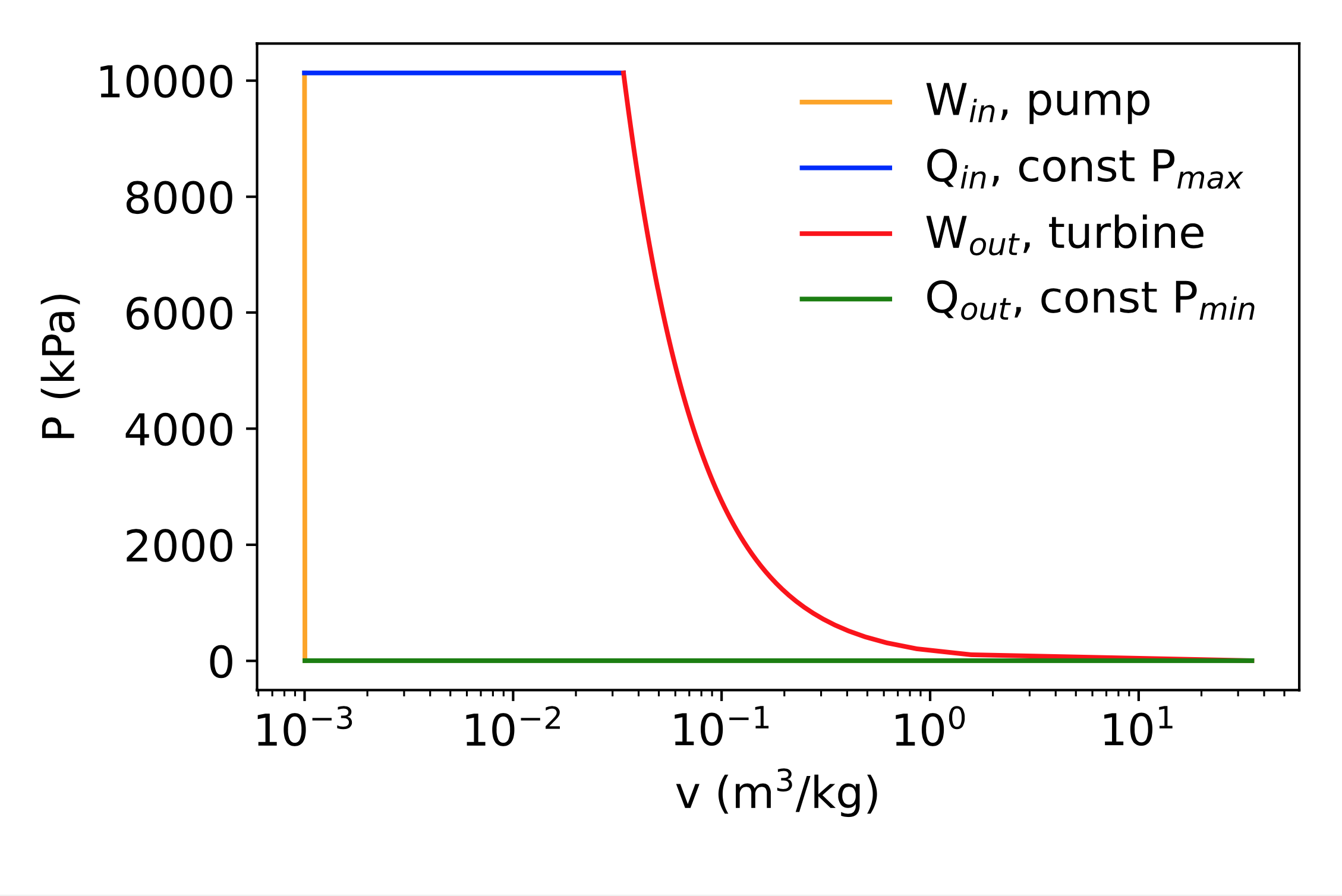 :::
## Rankine cycle: nonidealities
::: fragment
***Nonidealities?***
:::
::: incremental
* Pressure drop in the boiler
* Nonideal turbine
* Subcool the condensed liquid to avoid pump cavitation
* Heat losses to surroundings
:::
::: notes
* horizontal blue curve drops due to pressure drop
* red line isn't vertical
:::
## Rankine cycle: increase $η$
::: fragment
***Increase efficiency?***
:::
::: incremental
* Decrease condenser pressure (hence temperature)
* real condensers operate below atmospheric pressure
* limited by the saturation pressure corresponding to $T_{cooling}$.
* river at 20 $^oC$ $→$ P=2312 Pa = 0.023 atm.
* Typically 2-7 kPa
* but...quality of steam in turbine, and... air leakage
* Superheat steam to higher T, even supercritical
* higher turbine exit steam quality
* but...limited by material performance and cost: [620 $^oC$ max](https://www.sciencedirect.com/topics/engineering/steam-inlet-temperature).
:::
::: notes
* decreasing condenser pressure: extracting more work from the turbine
:::
## Rankine cycle: increase $η$
::: fragment
***Increase efficiency?***
:::
::: incremental
* Increase boiler pressure ($P_c$=218 atm)
* [Supercritical steam](https://en.wikipedia.org/wiki/Supercritical_steam_generator)
* [Turk Plant](https://en.wikipedia.org/wiki/John_W._Turk_Jr._Coal_Plant) P > 310 bar, T > 600 $^o$C.
* At a given $T_{turbine}$, higher P results in lower steam quality, so reheat
* Reheat
* 4-5% higher efficiency.
* Usually limited to single reheat stage (except for supercritical plants)
* A second reheat gives $Δ η$ about half the initial gain.
* Avoid superheated turbine exhaust.
* Optimal reheat pressure ~ 1/4 $P_{max}$
:::
## Rankine cycle: steam with reheat
:::
## Rankine cycle: nonidealities
::: fragment
***Nonidealities?***
:::
::: incremental
* Pressure drop in the boiler
* Nonideal turbine
* Subcool the condensed liquid to avoid pump cavitation
* Heat losses to surroundings
:::
::: notes
* horizontal blue curve drops due to pressure drop
* red line isn't vertical
:::
## Rankine cycle: increase $η$
::: fragment
***Increase efficiency?***
:::
::: incremental
* Decrease condenser pressure (hence temperature)
* real condensers operate below atmospheric pressure
* limited by the saturation pressure corresponding to $T_{cooling}$.
* river at 20 $^oC$ $→$ P=2312 Pa = 0.023 atm.
* Typically 2-7 kPa
* but...quality of steam in turbine, and... air leakage
* Superheat steam to higher T, even supercritical
* higher turbine exit steam quality
* but...limited by material performance and cost: [620 $^oC$ max](https://www.sciencedirect.com/topics/engineering/steam-inlet-temperature).
:::
::: notes
* decreasing condenser pressure: extracting more work from the turbine
:::
## Rankine cycle: increase $η$
::: fragment
***Increase efficiency?***
:::
::: incremental
* Increase boiler pressure ($P_c$=218 atm)
* [Supercritical steam](https://en.wikipedia.org/wiki/Supercritical_steam_generator)
* [Turk Plant](https://en.wikipedia.org/wiki/John_W._Turk_Jr._Coal_Plant) P > 310 bar, T > 600 $^o$C.
* At a given $T_{turbine}$, higher P results in lower steam quality, so reheat
* Reheat
* 4-5% higher efficiency.
* Usually limited to single reheat stage (except for supercritical plants)
* A second reheat gives $Δ η$ about half the initial gain.
* Avoid superheated turbine exhaust.
* Optimal reheat pressure ~ 1/4 $P_{max}$
:::
## Rankine cycle: steam with reheat
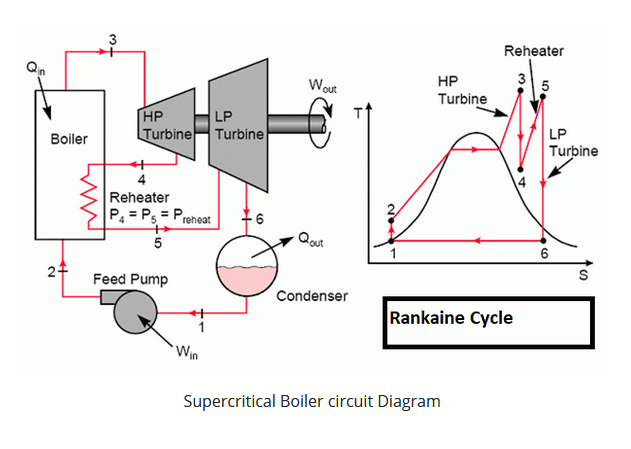 * 1-2: $W_{in}$, pump liquid from low P to high P; isentropic compression
* 2-3: $Q_{in}$, heat at constant pressure: heat, boil, superheat
* 3-4: $W_{out}$, expand fluid through turbine; isentropic expansion
* 4-5: $Q_{in}$, re-heat at constant pressure: superheat
* 5-6: $W_{out}$, expand fluid through turbine; isentropic expansion
* 6-1: $Q_{out}$, cool in condenser; vapor to liquid
# Conversion efficiencies
# Steam properties: Cantera
## Cantera Links
* [Cantera.org](https://cantera.org)
* [Python thermodynamic properties](https://cantera.org/documentation/docs-2.5/sphinx/html/cython/thermo.html)
* [Phase objects: water, R134a, heptane, etc.](https://cantera.org/documentation/dev/sphinx/html/cython/importing.html#pure-fluid-phases)
* [C++ reference](https://cantera.org/documentation/docs-2.5/doxygen/html/)
- useful for detailed documentation, units, available properties.
* [General documentation](https://cantera.org/documentation/)
* [Installation with Conda](https://cantera.org/install/conda-install.html)
## Cantera example: steam tables
## Cantera example: TS diagram
## Cantera example: Rankine cycle
# Work potential
* For conversion of thermal energy to electricity or mechanical work, energy alone is not enough.
* A 1 K temperature change in the oceans would supply 17000 CMO!
* But at the average surface temperature, the thermal conversion efficiency would be ~0.003.
* We really want the *work potential* of an energy source.
- Names: *exergy*, *availability*, *lost work*, *second law analysis*
How much work can be extracted in going from one state to another?
* 1-2: $W_{in}$, pump liquid from low P to high P; isentropic compression
* 2-3: $Q_{in}$, heat at constant pressure: heat, boil, superheat
* 3-4: $W_{out}$, expand fluid through turbine; isentropic expansion
* 4-5: $Q_{in}$, re-heat at constant pressure: superheat
* 5-6: $W_{out}$, expand fluid through turbine; isentropic expansion
* 6-1: $Q_{out}$, cool in condenser; vapor to liquid
# Conversion efficiencies
# Steam properties: Cantera
## Cantera Links
* [Cantera.org](https://cantera.org)
* [Python thermodynamic properties](https://cantera.org/documentation/docs-2.5/sphinx/html/cython/thermo.html)
* [Phase objects: water, R134a, heptane, etc.](https://cantera.org/documentation/dev/sphinx/html/cython/importing.html#pure-fluid-phases)
* [C++ reference](https://cantera.org/documentation/docs-2.5/doxygen/html/)
- useful for detailed documentation, units, available properties.
* [General documentation](https://cantera.org/documentation/)
* [Installation with Conda](https://cantera.org/install/conda-install.html)
## Cantera example: steam tables
## Cantera example: TS diagram
## Cantera example: Rankine cycle
# Work potential
* For conversion of thermal energy to electricity or mechanical work, energy alone is not enough.
* A 1 K temperature change in the oceans would supply 17000 CMO!
* But at the average surface temperature, the thermal conversion efficiency would be ~0.003.
* We really want the *work potential* of an energy source.
- Names: *exergy*, *availability*, *lost work*, *second law analysis*
How much work can be extracted in going from one state to another?
Or, how much work is required in going from one state to another?
## Work Potential: KE, PE The wind blows at 10 m/s, what is the work potential per unit mass? ::: fragment What is the work potential in a 5.1 meter high waterfall? ::: ## Work potential: heat transfer We transfer 1 kW of power from a thermal energy source at 500 K. What is the work potential? ::: fragment Need to define the surrounding state, so, 300 $K$, say. ::: ::: fragment ::: {.red} WP here is simply 1 kW times the Carnot efficiency: $$W = 1\,\mbox{kW} ⋅ \underbrace{(1 - 300/500)}_{η_c} = 0.40\,\mbox{kW}$$ ::: ::: ## Work potential: air, change state **Air** | quantity | state 1 | state 2 | |--------------|:-------:|:-------:| | T (K) | 573 | 300 | | P (atm) | 10 | 1 | | S (J/kg$⋅$K) | 6892 | 6892 | | H (kJ/kg) | 282 | 1.91 | *How much work can be extracted in moving from state 1 to state 2?* ::: fragment
Isentropic
Work is just $Δ H$
That is, the maximum 1$^{st}$ law work can be extracted