
Introduction to Loops
In [ ]:
import numpy as np
Problem 1
Write code to print the numbers 0 to 4 on each line below.
Solution
In [1]:
print(0)
print(1)
print(2)
print(3)
0
1
2
3
Discussion
- Okay, let's keep going to 10000...(!?)
Loops
- Loops in programing are used to simplify repetative work.
- Above, each line is a print statement.
- The only thing different on each line is the number we are printing.
- We can write a loop statment to do the above problem as follows
In [2]:
for i in range(4):
    print(i)
0
1
2
3
Discussion
- What are the parts of this: list them?
ican be any variable, not just "i"- Is there anything weird or unexpected here?
Problem 2
- We can put any code in the for loop
- Variables, functions, expressions, math, etc.
- We can put variables outside of the loop that are available inside of the loop
For the ideal gas law, pressure is given by $$P = nRT/V$$
- n = 1 kmol
- R = 8314 J/kmol*K
- T = 300 K
For V = 2, 3, 4, 5, ... 20, use a loop to find and print the values of P for each V.
Solution
In [4]:
n = 1     # kmol
R = 8314  # J/kmol*K
T = 300   # K

for V in range(2,21):
    P = n*R*T/V
    print(V, P)
2 1247100.0
3 831400.0
4 623550.0
5 498840.0
6 415700.0
7 356314.28571428574
8 311775.0
9 277133.3333333333
10 249420.0
11 226745.45454545456
12 207850.0
13 191861.53846153847
14 178157.14285714287
15 166280.0
16 155887.5
17 146717.64705882352
18 138566.66666666666
19 131273.68421052632
20 124710.0
Discussion
- What if you wanted V to not step by integers?
- Step by 2? Step by 5?
- Step by 0.2?
Problem 3
Add all the numbers from 0 to 100
- Before you start the code, think about what you would do if solving this in your head?
- How do you start?
- What things do you keep track of?
- What variables to use?
- What is the loop syntax?
- How do variables interact with the loop?
- Think through the process of the problem to the solution
- Talk to your neighbor
- If you've solved it, help your neighbor.
Solution
In [5]:
s = 0
for i in range(101):
    s += i
print(s)
5050
Nested loops
- We can put any code in a
forloop. Even another loop. - Look at the code below.
- Before running it, think of what you expect to see.
- Now run it and compare. Did you get what you thought you would?
In [ ]:
for i in range(3):
    print("i =", i)
    for j in range(4):
        print("   j =", j)
- Note, each time through the top (outer) loop, everything inside is done.
- This means the whole inner loop is computed for each outer loop.
- Think of an actual application for a nested loop.
Problem 4a
Given the following function $$f(x) = x^2 - 3,$$ we can use Newton's method to find $x$ for $f(x)=0$.
Recall, Newton recurrence formula: $$x_{new} = x_{old} - \frac{f(x_{old})}{f^\prime(x_{old})}$$
We solved this previously in Excel
- Open Excel and solve this problem.
- Think about the steps involved, how we set it up.
- Use the simplest method possible.
Solution-Excel
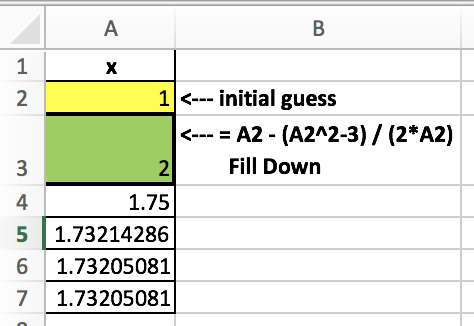
| Excel | Python |
|---|---|
| cell for guess | ?? |
| Newton equation in terms of x cell A2 - (A2^2-3)/(2*A2) |
?? |
| repeat: fill down | ?? |
Solution-Python
In [7]:
x = 1
for i in range(5):
    x = x - (x**2-3)/(2*x)
    print(x)
2.0
1.75
1.7321428571428572
1.7320508100147276
1.7320508075688772
Discussion
- Note that
iisn't used, it's just convenient for making the loop - x is reassigned in place (x is replaced with the updated value on each loop)
Explicitly write out the four steps
- We don't have to code it from top to bottom...
- Compare to Excel
| Excel | Python |
|---|---|
| cell for guess | variable for x |
| Newton equation in terms of x cell A2 - (A2^2-3)/(2*A2) |
Newton equation in terms of x x = x - (x**2-3)/(2*x) |
| repeat: fill down | repeat: wrap in loop |
In [8]:
# step 1: initial guess
x = 1

# step 2: add Newton equation
x=1
x = x - (x**2 - 3)/(2*x)

# step 3: wrap in loop
x=1
for i in range(6):
    x = x - (x**2 - 3)/(2*x)

# step 4: add a print
x=1
for i in range(6):
    x = x - (x**2 - 3)/(2*x)
    print(x)
2.0
1.75
1.7321428571428572
1.7320508100147276
1.7320508075688772
1.7320508075688774
Problem 4c
Redo Solution 1 using functions for $f(x)$ and $f^\prime(x)$.
- Recall: we discussed functions two classes back.
In [9]:
def f(x):
    return x**2-3
def fp(x):
    return 2*x

x = 1
for i in range(5):
    x = x - f(x)/fp(x)
    print(x)
2.0
1.75
1.7321428571428572
1.7320508100147276
1.7320508075688772
Problem 4d
- Now, to get to three decimal places we only needed 3 iterations.
- But we didn't know this at the beginning, so we guessed the number of iterations.
- If 6 wasn't enough, we would do more.
- This guess and check is not very efficient.
Modify the code above to do just the right number of iterations.
- What Python features do you need to use?
- How do you decide when you are done?
- Talk with your neighbor.
Solution
In [15]:
def f(x):
    return x**2-3
def fp(x):
    return 2*x

eps = 0.001
xold = 1
for i in range(5):
    xnew = xold - f(xold)/fp(xold)
    print(xnew)
    rerr = np.abs((xold - xnew)/xnew)
    if rerr < eps:
        break
    xold = xnew
2.0
1.75
1.7321428571428572
1.7320508100147276
Discussion
- Keep track of old and new x:
xoldandxnew.- Need to reset
xold=xnewat the end to get set for next interation.
- Need to reset
- New keyword
break - Define the error and compare it to the desired accuracy.
- Use absolute value:
np.abs()
- Use absolute value:
In [ ]: